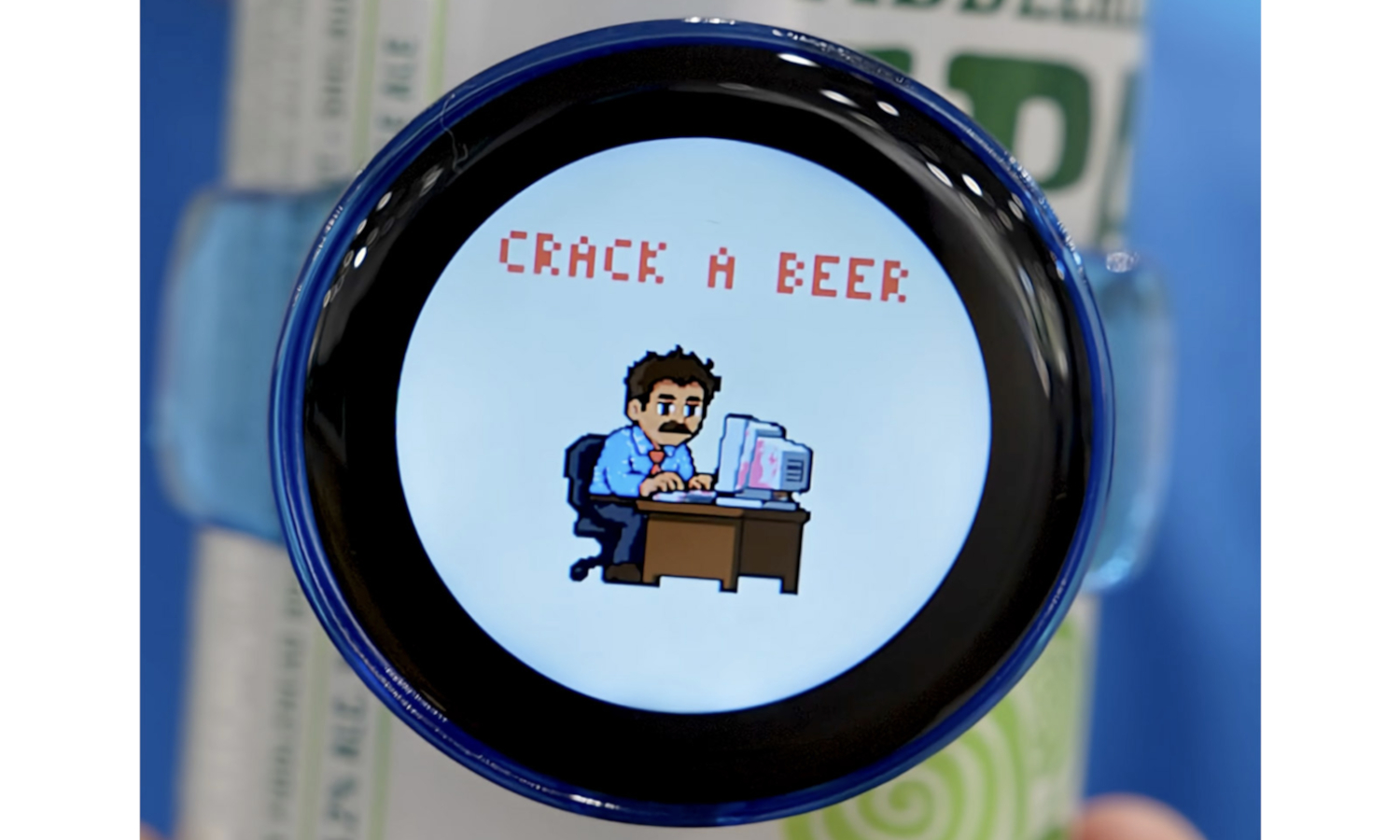
Nobody asked for a digital pet that mirrors your drinking pace. Matty Benedetto built one anyway, which is entirely on brand for Unnecessary Inventions, his Burlington, Vermont design practice dedicated to solving problems the world never identified. Invention No. 469 is called the Buzz Buddy: a compact, egg-shaped device that perches on a beer can and hosts a pixel character that advances through increasingly intoxicated-looking states as you drink. Think Tamagotchi, except instead of feeding a virtual creature, you drink, and the creature drinks with you. If you enjoy offbeat smart gadgets, this one fits right in.
How the Sip Cycle Works
The interaction is straightforward: lift the can, watch your pixel companion suffer the consequences.
A concealed motion sensor detects when the can is lifted, advancing the on-screen character’s Buzz Meter through progressively unsteady visual states. Leave the can alone and the meter drains; the character returns to its baseline condition. The full interaction set breaks down cleanly:
- Lift the can: the character registers a sip and advances along the Buzz Meter.
- Set it down and wait: the meter drains and the character recovers.
- Tap the device: the character dances.
- Swipe down: drinking statistics from the session appear.
- Finish the can entirely: the character hits a final celebratory state.
The care-and-neglect loop that made the original Tamagotchi genuinely stressful has been reframed here as a drink-and-recover cycle. Less existential dread, considerably more backyard energy.
The Gadget Behind the Gag
The design is compact and considered, even if the brief was deliberately absurd.
The housing is egg-shaped, with a pixel character sitting at a tiny desk, built to perch on a standard beer can. Benedetto’s broader practice combines 3D-printed parts, custom electronics, and presentation-focused humor. Fast Company reporting has previously described his creations as engineered joke products: fully prototyped, thoroughly demonstrated, and not necessarily offered for sale. Buzz Buddy fits that description. Bandai brought the Tamagotchi back and Gen Z bought it without irony; Buzz Buddy arrives as perhaps the least emotionally complicated digital companion yet proposed, requiring nothing from you except that you were already going to drink anyway.
A Prototype, Not a Product
No retail price, purchase page, or production information appears on the official listing.
Buzz Buddy is listed as a 2026 project item in Benedetto’s archive. No commercial production or distribution is identified in the official listing, and technical specifications such as display type, battery life, materials, and waterproofing are not publicly detailed. Treat those details as unavailable for now.
One thing worth stating plainly: the Buzz Meter is a fictional software state. No evidence in the official listing indicates that the sensor measures alcohol consumed or blood-alcohol concentration; it detects can movement. The device offers no safety guidance and is not presented as a health or moderation tool. A blinking pixel character is, to its credit, more transparent about that limitation than most wellness apps claiming to optimize your wellbeing.
Why This Kind of Invention Matters
Deliberately unnecessary ideas still require real design thinking, and Buzz Buddy makes that visible.
Buzz Buddy will not fix anything, and the official listing does not offer a way to ship it to your door. What it does is prove that genuine design thinking applied to an absurd brief still produces something worth noticing. Someone in Burlington spent real engineering hours making a beer can come alive, and the result is specific enough to be funny and functional enough to be genuinely charming. That is harder than it looks.