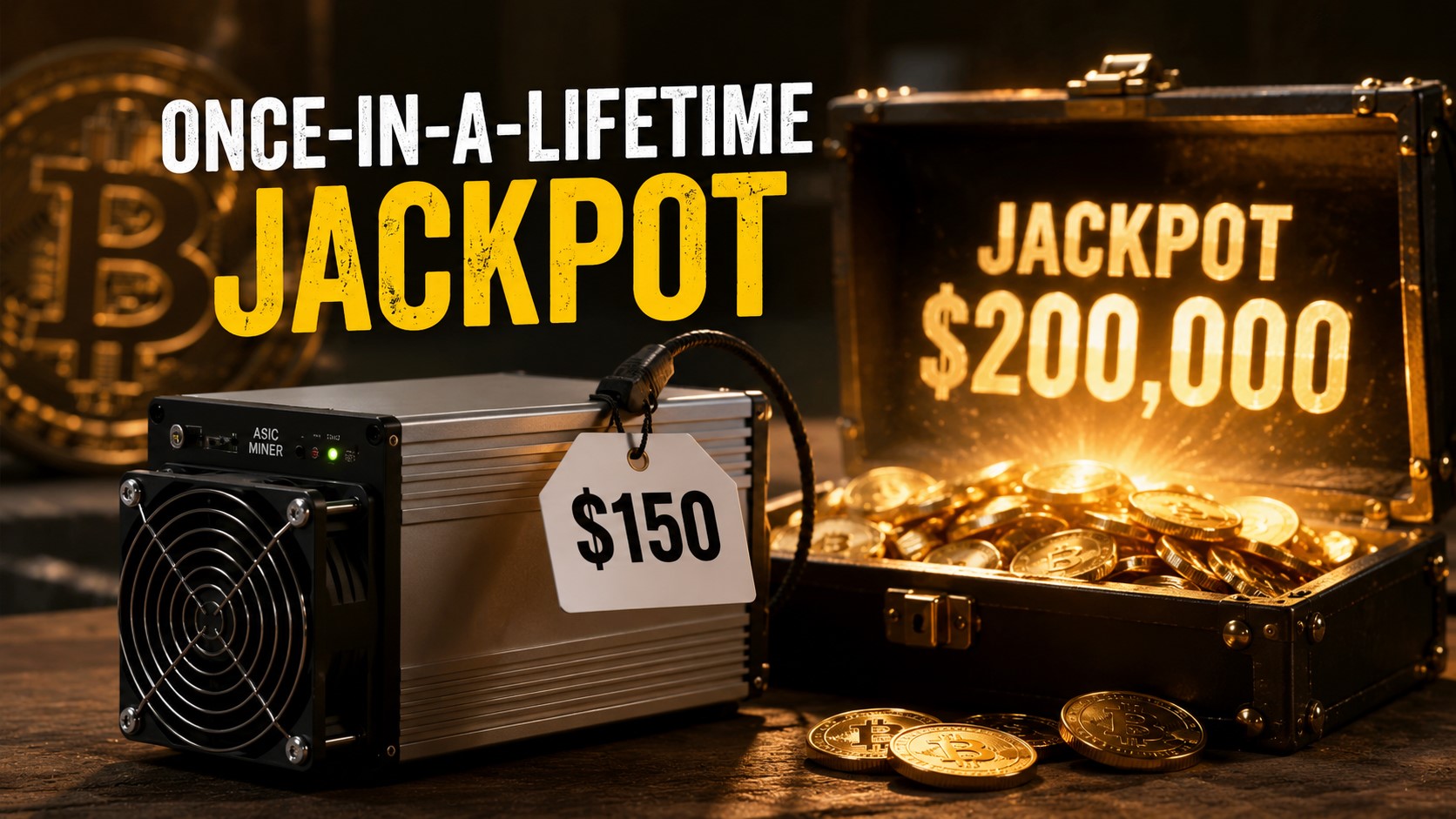
A device that earns roughly four cents a day in Bitcoin just produced $200,000 in a single afternoon. An anonymous hobbyist plugged a Bitaxe miner — a palm-sized circuit board costing somewhere between $60 and $150 — into their home Wi-Fi, pointed it at Public Pool, and eight hours later had mined Bitcoin block 957,382. The reward: 3.1382 BTC, worth approximately $200,000 at the time. In an era where Bitcoin mining is dominated by warehouse-sized operations, this is the crypto equivalent of winning Powerball with a ticket you found in your couch cushions.
Same Chip, Absurdly Different Scale
The Bitaxe Gamma runs the same Bitmain silicon as industrial rigs — just 194 fewer chips of them.
The Bitaxe Gamma runs on Bitmain’s BM1370 ASIC chip, the identical silicon inside industrial Antminer S21 Pro rigs. The difference?
- An Antminer uses roughly 195 of those chips, draws 3,510 watts, and requires serious industrial cooling.
- The Bitaxe uses one or two chips, draws 15 to 18 watts — phone-charger territory — and sits quietly on your desk gadgets list, according to D-Central and SoloSatoshi reviews.
Normal output: about $0.04 per day in Bitcoin, per MiningNow’s profitability calculator.
Block 957,382 was mined via Public Pool, a free, open-source solo mining service charging 0% fees. The 3.1382 BTC payout included the post-April 2024 halving base subsidy of 3.125 BTC plus transaction fees collected from that block. The device ran approximately eight hours before finding it. A single Bitaxe would statistically expect to find one block every 18,000 years, according to CoinDesk — and because solo mining means the winner keeps everything, there was no splitting rewards with anyone else.
“Solo mining is the lottery model… if YOU find the block you keep almost the entire reward (3.125 BTC + transaction fees).” — D-Central
Here’s the math that makes this genuinely staggering. Hash rate — the speed at which a miner generates guesses at valid solutions — sits around 1.2 terahashes per second for a Bitaxe. The global Bitcoin network runs at hundreds of exahashes per second. That puts a single Bitaxe’s share of total computing power at roughly one in hundreds of millions. Most small miners join shared pools instead, combining their hash rate with thousands of others to generate small, predictable daily payouts rather than gambling on a near-impossible jackpot. Block 957,382 was the statistical equivalent of getting struck by lightning while holding a winning scratch-off ticket.
A Trend With an Asterisk
Solo-mined blocks jumped 41% last year, but the merciless math hasn’t budged.
This wasn’t entirely isolated. CoinDesk reported 24 solo-mined Bitcoin blocks in the past 12 months, a 41% year-over-year increase, as hobbyist “lottery mining” quietly gains traction. Bitaxe’s fully open-source design — hardware schematics, AxeOS firmware, all of it publicly available — has turned it into something between a consumer gadget and a political statement about decentralization. The cypherpunk-era myth of one person, one machine, one shot at the jackpot still moves hardware off shelves, even when the rational expected return hovers near zero — a reminder of what you might be paying too much for without realizing.
“Solo payout means… you receive the entire 3.125 BTC block subsidy plus all transaction fees, minus a small service fee.” — SoloSatoshi
The odds remain merciless, and this will almost certainly never happen to you. But block 957,382 is proof that the lottery still runs 24 hours a day, one cheap chip at a time. For $150 and a spare outlet, you’re technically holding a ticket — and someone just cashed theirs.