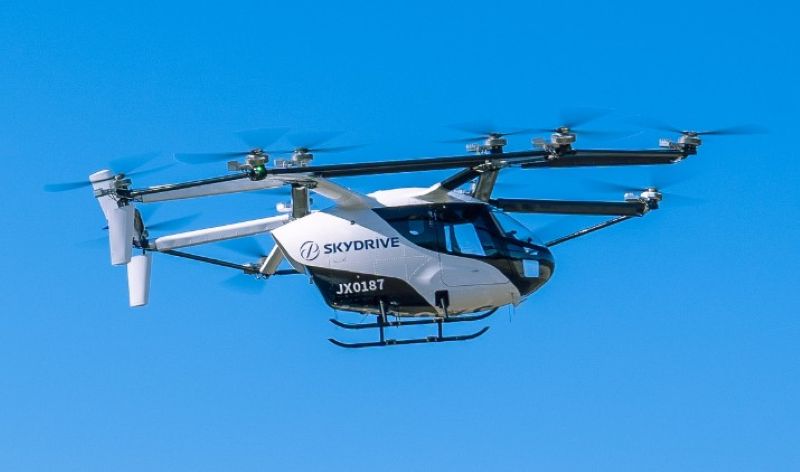
Traffic jams might finally meet their match. SkyDrive’s SD-05 flying car completed its first public demonstration over Tokyo Bay on Tuesday, marking a pivotal moment when urban air mobility shifted from sci-fi fantasy to engineering reality. The battery-powered multicopter stayed airborne for three-and-a-half minutes, covering 150 meters in remotely operated flight—small numbers that represent a giant leap for your future commute.
Real Aircraft, Real Performance
The SD-05 delivers helicopter capabilities in a more compact, electric package designed for urban environments.
This isn’t some garage inventor’s pipe dream. The SD-05 features 12 electric rotors mounted on a carbon fiber fuselage that draws inspiration from bird aerodynamics. Its distributed electric propulsion system provides crucial redundancy—if motors fail, others compensate, keeping passengers safe.
Computer-controlled flight stability handles the complex choreography of keeping 1,400 kilograms airborne while reaching cruise speeds of 100 km/h. The compact footprint means rooftop landings become possible, unlike traditional helicopters that need massive clearance zones. SkyDrive partnered with Mitsubishi Estate and Kanematsu Corp for this real-world testing phase.
Commercial Reality Takes Shape
SkyDrive targets 2028 for passenger service launch, with regulatory approval already in progress.
CEO Tomohiro Fukuzawa isn’t just building cool prototypes—he’s planning actual taxi service. The company pursues certification from Japan’s Civil Aviation Bureau and the FAA. Initial flights require human pilots, though autonomous capabilities are planned.
The range currently caps at 15-40 kilometers with 5-10 minute flight times, perfect for airport shuttles or cross-harbor routes that bypass Tokyo’s legendary traffic snarls. Weather sensitivity remains a challenge—January’s demonstration got canceled due to wind conditions, proving these aircraft still face real-world limitations.
Your Flying Future
Post-2030 fares could drop to twice taxi rates while delivering speeds four to five times faster than ground transport.
SkyDrive faces global competition, including China’s XPeng X2, which completed test flights in Dubai in 2022. But Japan’s regulatory approach and urban density create unique advantages for commercialization. The real test isn’t technical capability—it’s whether you’ll pay premium fares for time savings.
Current limitations include short range and weather dependencies, but the demonstration proves urban air mobility has moved beyond concept phase into operational reality.
The age of three-dimensional commuting just took flight.