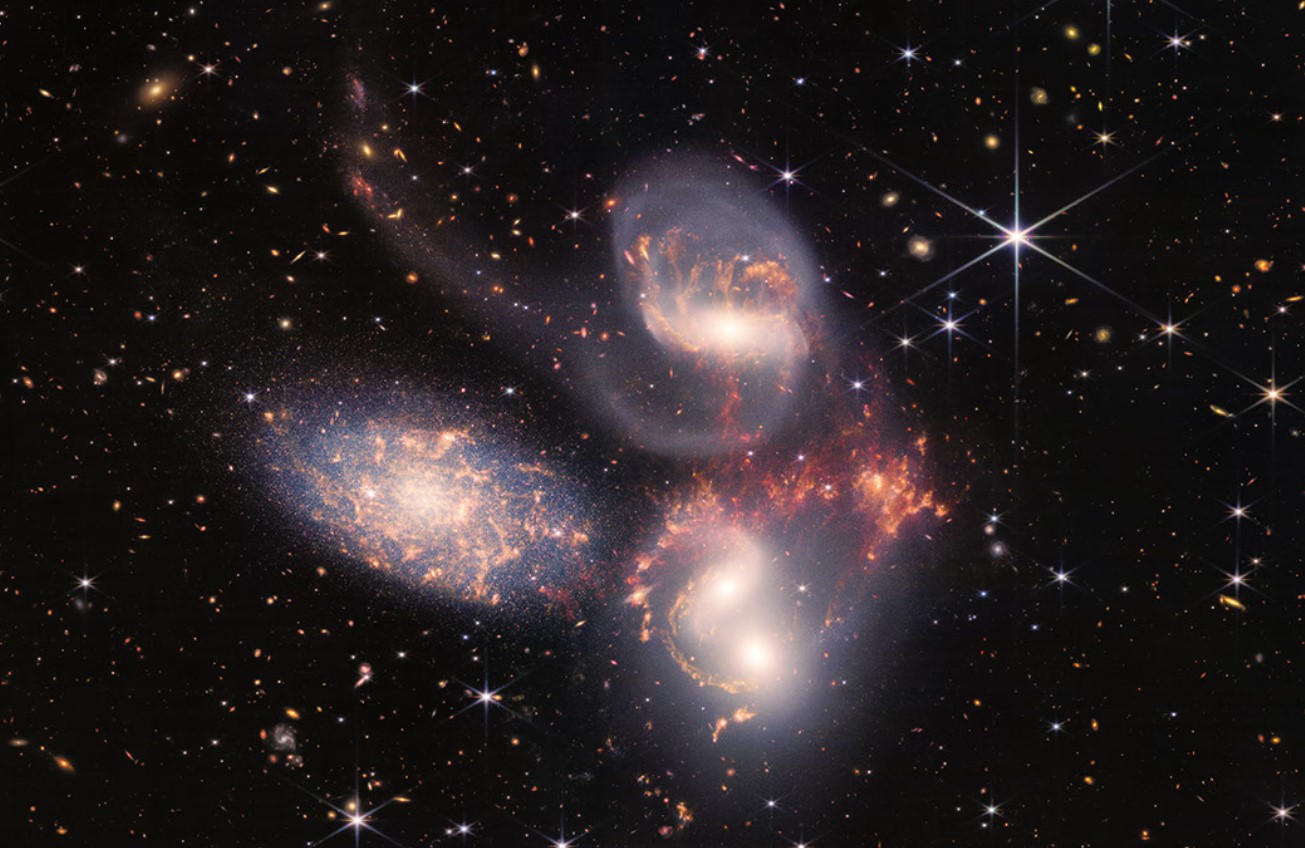
When the universe was barely a tenth of its current age, six young galaxies were already packed together so tightly they appear destined to become one colossal structure. That’s the finding from a new study posted to arXiv — the preprint server where researchers share work before formal peer review — and reported by La República. If the conclusions hold up, you’re looking at something astronomers rarely catch: a massive galaxy being built, not just the finished product sitting there like it always existed.
What Astronomers Actually Found
A compact group of galaxies from the early universe may be assembling into one of the largest structures the cosmos produces.
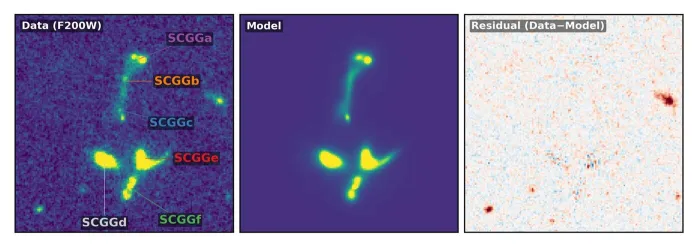
The system dates to 1.2 billion years after the Big Bang. Its light traveled more than 12 billion years to reach modern telescopes, meaning astronomers are effectively watching a construction site from the universe’s deep past. The six galaxies are interacting, crowding each other in a tight formation that reportedly suggests they’ll merge over time into a single, far more massive galaxy — one that would likely qualify as a Brightest Cluster Galaxy, or BCG.
BCGs are the ultra-massive galaxies anchoring the centers of galaxy clusters. They’re thought to grow through hierarchical merging: bigger galaxies bulk up by repeatedly absorbing smaller neighbors. Less like a single explosion, more like a snowball rolling downhill and picking up everything in its path. This system, still a candidate rather than a confirmed classification, reportedly shows six galaxies actively doing exactly that — interacting, tightly packed, and on a collision course with each other across cosmic time. The universe was roughly 9% of its current 13.8-billion-year age when this scene unfolded, and the study remains on arXiv awaiting peer review.
Why the Models Are Sweating
JWST-era discoveries keep finding massive galaxies earlier than theorists predicted, and this system may reveal the assembly process behind them.
This isn’t an isolated surprise. The James Webb Space Telescope and other instruments have already spotted massive galaxies at 540 to 770 million years post–Big Bang, plus others at around 1.4 billion years — timelines that made existing formation models look uncomfortably optimistic. Finding a six-galaxy merger candidate this early is like discovering dashcam footage of a skyscraper assembling itself when everyone assumed it simply materialized overnight.
What makes this system particularly valuable is the process, not just the product. Most early-universe discoveries hand you the finished building. This one reportedly shows the scaffolding still up and the cranes still running.
If peer review validates the candidate, the implications for how scientists model early galaxy formation could be substantial — and the universe’s first billion years will look even more aggressively productive than current models predicted.