Household electric bills might already include a hidden surcharge — one that quietly subsidizes the power appetite of Amazon, Google, and Microsoft. After two decades of flat electricity demand across much of the U.S., AI data centers have shattered that pattern. Hyperscale facilities run by the biggest names in tech are devouring power at unprecedented rates, and utilities have responded by offering these mega-customers discounted bulk rates. The tab for new transmission lines, generation capacity, and grid upgrades gets spread across every household and small business on the same grid.
The Harvard Electricity Law Initiative describes the arrangement bluntly: utilities are “extracting profits from the public.” Think of it as a restaurant where one table orders the entire menu and then splits the check with every stranger in the room. If you’re concerned about paying too much on your monthly bills, this hidden cost is worth understanding.
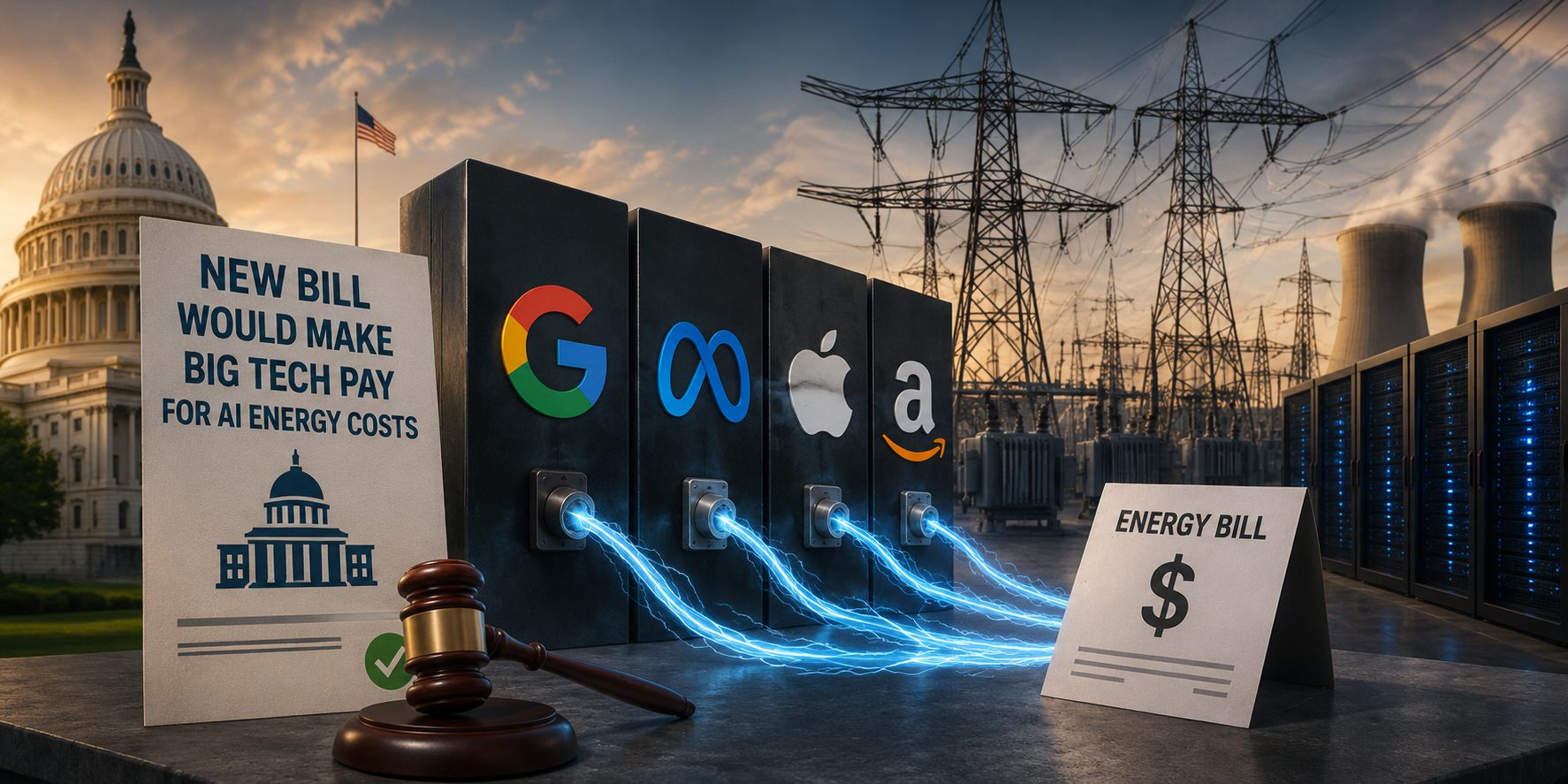
The Ratepayer Protection Act, a bipartisan bill sponsored by Rep. Gabe Evans (R-Colo.) and Rep. Kathy Castor (D-Fla.), aims to end that arrangement. A House Energy and Commerce subpanel is scheduled to debate and vote on the legislation, which would require utilities to establish a “large load standard.” In plain English: treat data centers as a separate customer class and make them pay for the infrastructure their demand creates — new transmission lines, generation capacity, and dedicated interconnection agreements.
Here’s what the legislation would actually change:
- Tech firms including Amazon, Google, Meta, Microsoft, and xAI would directly fund grid upgrades tied to their data centers
- Utilities could no longer spread those infrastructure costs across residential and small-business bills
- State utility commissions would design the specific rules, preserving local flexibility
- The bill codifies elements of Trump’s Ratepayer Protection Pledge, which calls on hyperscalers to “build, bring, or buy” all their energy
- Big Tech firms remain publicly supportive but privately wary of binding federal obligations that vary by state
“Families and small businesses across the country shouldn’t be left to foot the bill for this new development.” — House Energy and Commerce Chair Brett Guthrie (R-Ky.)
The momentum extends well beyond one bill. Senators Josh Hawley (R-Mo.) and Richard Blumenthal (D-Conn.) introduced the GRID Act with identical logic. Sen. Adam Schiff has proposed the Energy Cost Fairness and Reliability Act. Pennsylvania and California are advancing state-level equivalents simultaneously, signaling a broader regulatory shift in how lawmakers treat AI infrastructure as an energy policy problem.
A Long Road Before the Bill Becomes Law
The legislation clears only its first hurdle at the subpanel stage, with a full committee vote, House floor passage, and Senate approval still ahead.
The bill still faces a lengthy gauntlet — subcommittee, full committee, House floor, and Senate votes — before reaching the president’s desk. Politico notes it “still has a long way to go,” with amendments expected over definitions of “large load” and cost-sharing formulas. Tech firms are publicly supportive but privately anxious about rigid federal standards complicating multi-state projects. If the bill does clear those hurdles, expect hyperscalers to accelerate vertically integrated energy strategies: owning onsite generation, co-developing transmission lines, and locking in dedicated long-term power contracts. SoftBank’s proposed $500 billion AI infrastructure project hints at the enormous scale already in play — and at exactly why the question of who pays for all that power is no longer abstract.
When the next data center breaks ground in a surrounding region, the grid upgrades that follow should not appear quietly on monthly utility statements. That is the entire point of this legislation — and why both parties, for once, seem to agree it is worth fighting for.