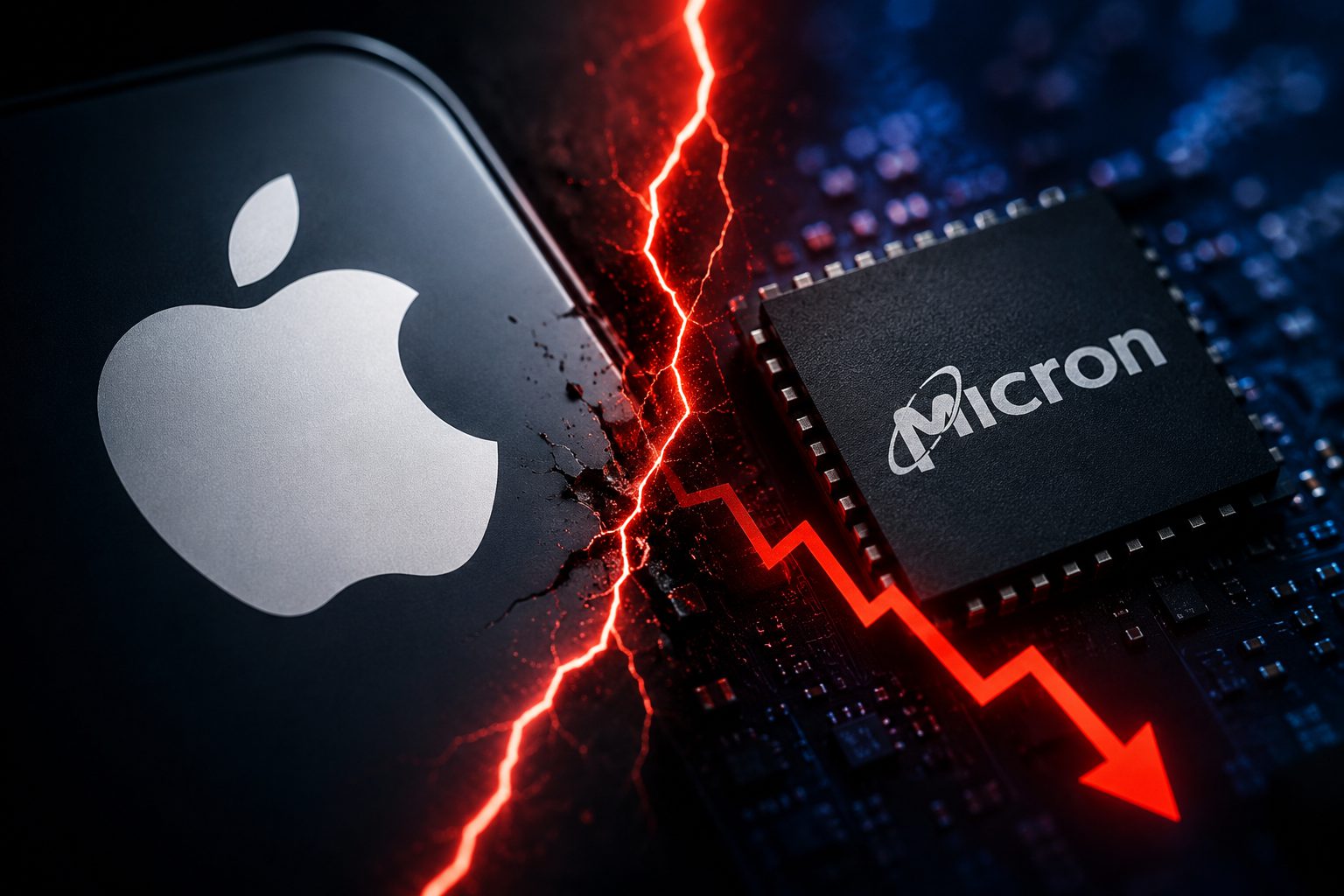
Your next MacBook costs more. Apple says it’s the memory suppliers’ fault. Micron just posted a 346% revenue surge with gross margins approaching 85%, and its stock jumped roughly 15% after earnings. Then Micron’s chief business officer, Sumit Sadana, told the Wall Street Journal that “certain customers” who demanded rock-bottom prices during the 2022–2023 downturn helped kill the very investments that could have prevented today’s shortage. He didn’t say Apple. He didn’t have to. Apple’s aggressive investment in AI chips and custom silicon makes it a natural suspect.
The Downturn That Came Back to Bite
Suppressed margins led to slashed capex, and when AI demand exploded, there was nothing left in the tank.
- Micron’s gross margins went negative during the 2022–2023 DRAM downturn, forcing sharp cuts to capital expenditure
- Sadana says “certain customers” demanded rock-bottom prices, making new investment economically unviable
- When AI infrastructure demand surged, no spare fab capacity existed to absorb it
- Sadana describes current demand as “far above aggregate supply” at levels he has “not seen” in his career
- The crunch could persist beyond 2028, even accounting for massive expansion plans
Here’s Sadana’s argument in plain terms: when DRAM margins went negative, memory makers couldn’t justify building new capacity. “A lot of the industry investments got shut down in 2023 because of really poor pricing and really poor margins,” Sadana said, according to 9to5Mac’s summary of the Wall Street Journal interview. He told aggressive buyers at the time that their approach was “not constructive.” Then AI infrastructure demand arrived, and there were no spare fabs to absorb it.
Apple, meanwhile, is running what Ubergizmo describes as a “buy-all” strategy in mobile DRAM — paying above-market premiums to corner supply and squeeze out competitors. At the same time, Tim Cook is publicly blaming suppliers: “The memory guys are passing along huge price increases… We definitely need memory pricing and supply to return to reasonable levels for consumer products,” he told the Wall Street Journal. That’s not hypocrisy. It’s what any rational actor does when supply gets tight — but it’s a striking posture given Sadana’s comments.
What This Means for Your Wallet
Memory costs could represent nearly half of a flagship iPhone’s component bill within two years.
Analysts cited by JP Morgan and the Financial Times estimate memory could jump from roughly 10% to as much as 45% of a flagship iPhone’s bill of materials by 2027. That’s not an abstraction — it’s showing up right now in higher MacBook and iPad prices, and you may already be paying too much without realizing it. Memory makers are spending hundreds of billions on new fabs, but those facilities take years to ramp. Relief isn’t arriving on your next upgrade cycle.
The uncomfortable reality is that both narratives are correct. AI demand caused the shortage. Aggressive down-cycle pricing made it structurally worse. And if suppliers hold their pricing discipline after this particular lesson, the era of cheap RAM may be gone for good.