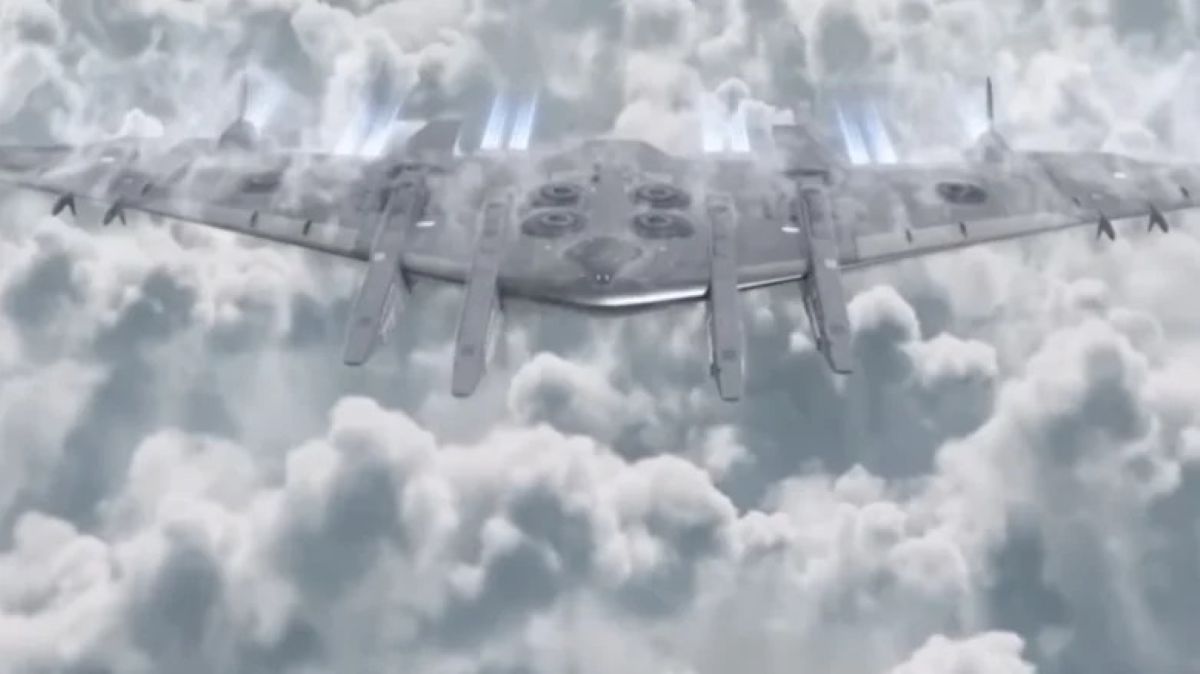
China’s state broadcaster CCTV recently aired concept footage of massive triangular Luanniao motherships patrolling the stratosphere, each deploying up to 88 Xuannu stealth drones. These aerial behemoths measure 684 meters wide—making the USS Gerald R. Ford’s 78-meter beam look quaint by comparison. At 120,000 tons maximum takeoff weight, each carrier would outmass America’s newest supercarrier while operating at the edge of space.
The Luanniao concept emerges from China’s broader Nantianmen Project, launched by Aviation Industry Corporation of China in 2017. You’re looking at mythological naming that’s pure theater—Luanniao references a folklore creature, while Xuannu honors a war goddess. This isn’t coincidence; it’s calculated messaging designed to inspire domestic audiences and unsettle Western defense planners.
Engineering Reality Meets Science Fiction
Experts dismiss the concept while acknowledging China’s advancing aerospace capabilities.
The physics tell a brutal story. Keeping 120,000 tons airborne at stratospheric altitudes would require thrust equivalent to 1,700 F-35 engines or 4-5 SpaceX Starship boosters running continuously. Peter Layton from Griffith Asia Institute notes these carriers would “outclass pretty much everyone” if built, but admits the required technology “doesn’t exist yet.”
Heinrich Kreft calls the concept outright “humbug” and “psychological warfare.” Consider this: the heaviest aircraft ever built, the An-225, weighed just 640 tons. You’re supposed to believe China can engineer something 200 times heavier that hovers indefinitely in near-space.
Propaganda With Purpose
The spectacle masks real advances in sixth-generation fighters and AI-controlled aircraft.
This feels like China’s version of a Marvel trailer—spectacular, impossible, but serving multiple purposes. While you’re debating flying aircraft carriers, China’s developing tangible threats through the same Nantianmen umbrella: the Baidi sixth-generation fighter showcased mockups at 2024’s Zhuhai Airshow, and AI-controlled VTOL fighters are reportedly in testing.
The Luanniao concept functions as strategic misdirection wrapped in national pride. Your attention stays fixed on sci-fi impossibilities while China advances hypersonic missiles, laser weapons, and autonomous combat systems that actually work within known physics. That’s the real story hiding behind the stratospheric theater.