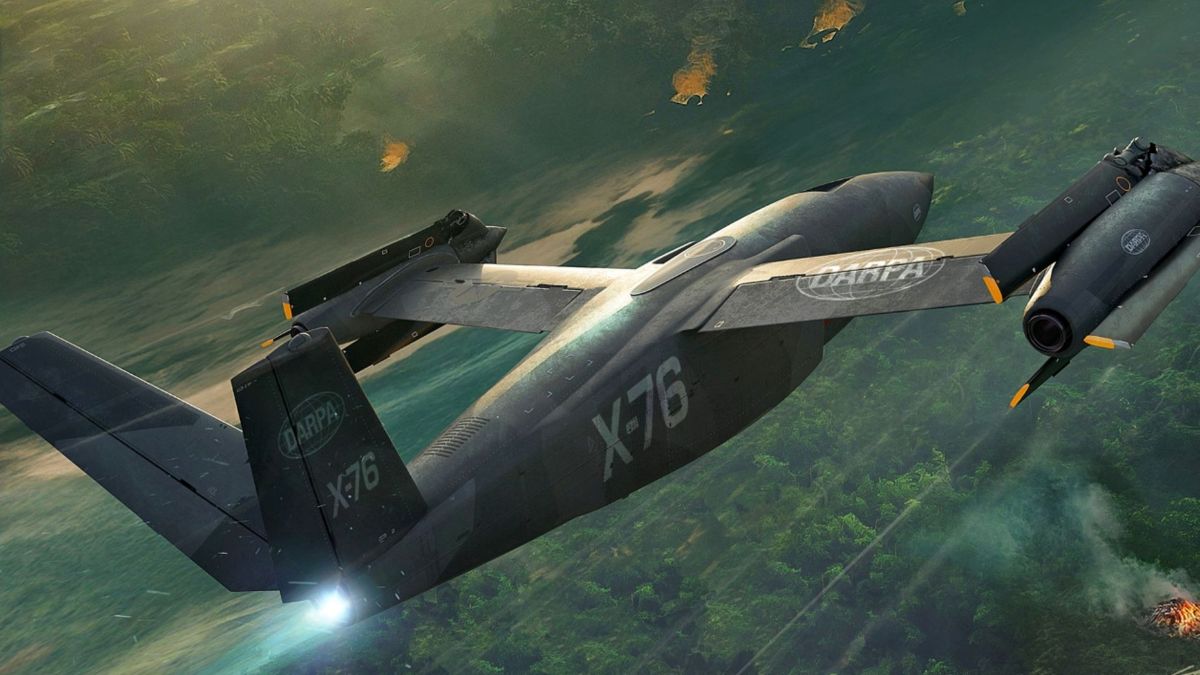
Dead runways spell mission failure in contested zones, but Bell Textron’s X-76 just eliminated that vulnerability entirely. DARPA officially designated this high-speed vertical takeoff aircraft after it passed Critical Design Review in March, advancing a machine that promises 517+ mph cruise speeds while hovering in parking lots. Think of it as deleting the infrastructure dependency that’s plagued aviation since the Wright brothers.
Rotors That Vanish Mid-Flight
The X-76’s “Stop/Fold” system transforms from helicopter to jet without landing.
Here’s where engineering gets elegant: the X-76’s rotors literally stop spinning and fold into streamlined pods once you hit around 150-200 knots. The same turbine engine that spun those rotors now switches to pure jet propulsion, eliminating drag and unlocking speeds that make current tiltrotors look glacial.
Your typical V-22 Osprey tops out at 280 mph—this thing cruises at nearly double that while maintaining the ability to land on a tennis court.
Special Ops Gets Warp Speed
Eliminating runway dependencies could reshape rapid deployment tactics.
Speed without infrastructure changes everything for special operations. “For too long, the runway has been both an enabler and a tether,” according to DARPA’s Commander Ian Higgins. “With SPRINT, we’re building options.” Translation: surprise becomes possible again when you can appear anywhere at jet speeds.
The implications extend beyond military use—imagine emergency medical transport or disaster relief that doesn’t need airports, just clear ground the size of a basketball court.
From Concept to First Flight
Bell continues its X-plane legacy with 2028 testing on the horizon.
Bell brings extensive X-plane experience to this project—they built the X-1 that broke the sound barrier. The X-76 designation honors 1776 during America’s 250th anniversary year, but the timeline ahead is purely practical: ground testing throughout 2027, first flight in early 2028. Wind tunnel tests have already validated stability during those critical rotor transitions, the moment when physics could turn ugly.
The program scales from 4,000 to 100,000 pounds, meaning everything from tactical insertion to heavy cargo could eventually ditch runway dependency. Jason Hurst from Bell calls it “a historic first,” though history will judge that claim when the X-76 actually flies. Until then, it remains the most promising answer to aviation’s oldest constraint.