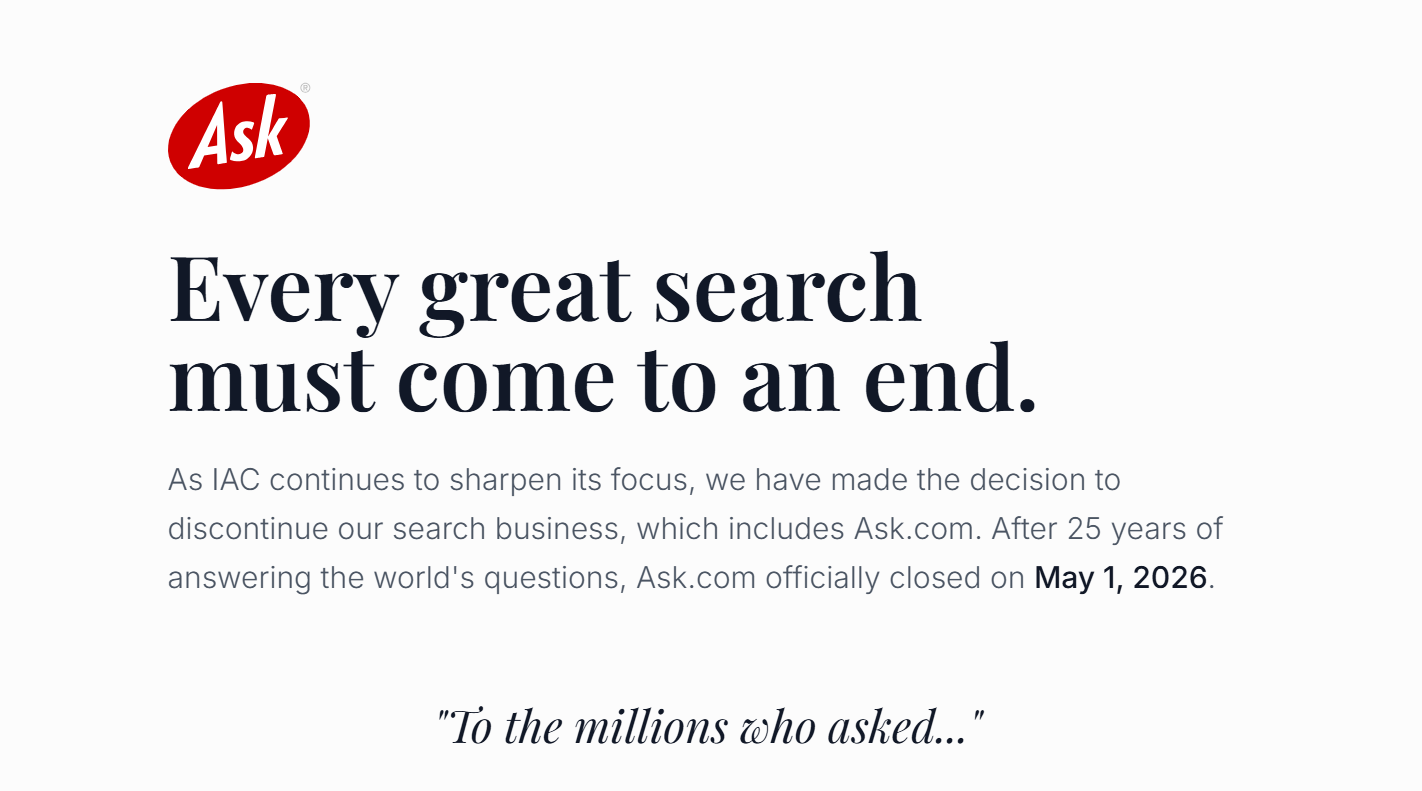
Remember when searching the web felt like asking a real person for help? Ask.com officially closed on May 1, 2026, ending a nearly three-decade run that began when the early internet was still figuring out how humans and computers should talk to each other. The platform that once encouraged you to type actual questions—not just keywords—couldn’t survive in Google’s shadow.
The Butler’s Last Bow
Ask Jeeves launched in 1997 with a radical idea: you should be able to ask your computer questions the same way you’d ask a librarian. The bow-tied butler mascot even appeared in Macy’s Thanksgiving Day Parade during the dot-com boom, when everything felt possible and competition seemed healthy.
IAC, which acquired the company in 2005, announced the closure as part of “sharpening its focus” away from search—corporate speak for admitting defeat against Google’s dominance. The writing was on the wall by 2010, when IAC Chairman Barry Diller publicly acknowledged that Ask.com “was not competitive with Google and was not valued in IAC’s stock.” The company ditched its search technology that year, pivoting to a question-and-answer format that never caught fire.
Ahead of Its Time, Behind the Times
Here’s the brutal irony: Ask Jeeves’ natural language approach now powers every AI chatbot you use. ChatGPT, Claude, and Gemini all built empires on the conversational interface that Garrett Gruener and David Warthen developed in 1996. The difference? Those companies had the computational power and training data that Ask Jeeves never dreamed of.
Your nostalgia isn’t misplaced—Ask Jeeves genuinely felt different from the sterile keyword searches that dominated early internet culture. But good ideas poorly executed get steamrolled by superior technology, and Google’s PageRank algorithm made Ask’s human-friendly questions seem quaint rather than revolutionary.
The Consolidation Continues
Ask.com’s death represents more than corporate housekeeping—it’s the final nail in the coffin of search diversity. The early internet promised endless experimentation and competition. Instead, you’re left with Google controlling over 90% of search traffic while platforms like Ask.com become digital fossils.
The real tragedy isn’t that Ask Jeeves failed, but that its conversational DNA couldn’t be revived for the AI era. With the right timing and resources, that butler could have been your favorite chatbot today.