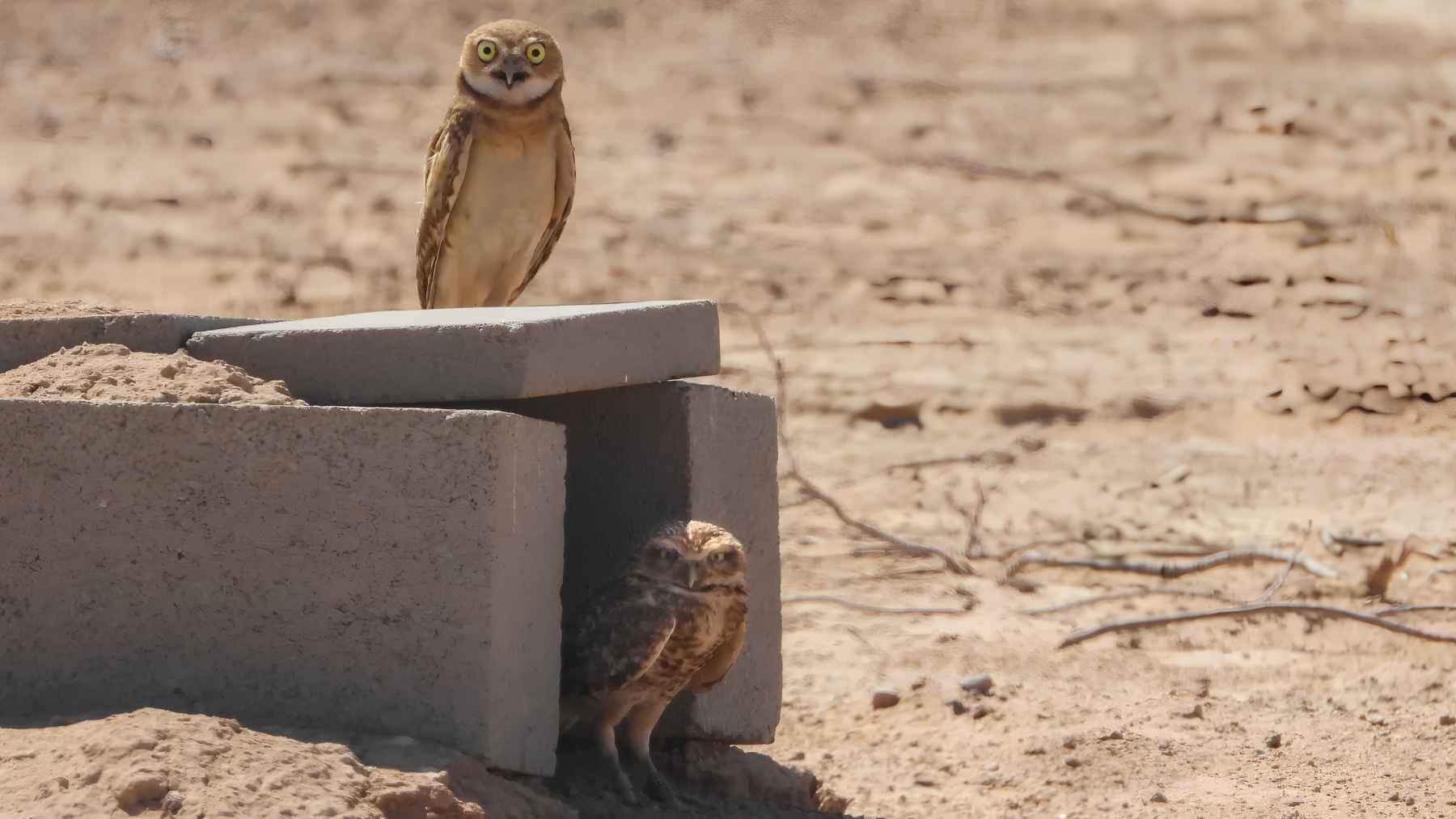
A housing development outside Phoenix destroyed a burrowing owl colony in March 2025. Nineteen adults — nine breeding pairs and one lone male — needed somewhere to go. Wild At Heart, an Arizona raptor rescue nonprofit, and Longroad Energy, which operates the 10,000-acre Sun Streams solar complex west of Phoenix, had an answer: 250 acres of open ground between two sections of the complex, fitted with 40 artificial burrows. Within one month, all nine females had laid eggs. Conservation wins like this don’t happen by accident — they happen when someone funds them.
How a Solar Farm Becomes a Burrow
Sun Streams worked as habitat because burrowing owls need exactly what solar farms happen to provide.
Burrowing owls prefer open, flat ground with long sightlines — ideal for spotting coyotes and foxes before those predators get close. Strip out dense vegetation, lay down rows of panels, and you’ve built something that structurally resembles native desert grassland. The team added motion-activated cameras, artificial lights at night to draw in hunting insects, and drip-irrigated native plants to attract moths and grasshoppers. Owls used panel shade to escape Arizona’s brutal midday heat. Longroad funded monitoring and food augmentation — daily frozen mice — through the entire breeding season. Wild At Heart’s standard protocol at other relocation sites runs about 30 days. This ran longer. That difference mattered.
The results were hard to argue with:
- 19 adult owls relocated approximately 50 miles from their original colony, March 2025
- 36 chicks born; 29 fledged by late summer 2025
- Supplemental feeding stopped by the end of August 2025 — insect remains in droppings confirmed the young owls were hunting independently
- Mid-2026: roughly 40 owls tracked across about 30 open burrows
- Three adult pairs remain on-site; dispersed young have established new colonies elsewhere
“This is working,” Wild At Heart habitat coordinator Greg Clark told Audubon Magazine when all relocated females had laid eggs — understated, but the proof was in the data.
One Success Story, Many Open Questions
The owls thrived because a developer committed resources well beyond standard compliance — and that distinction matters.
Conservation advocates who spoke to Audubon were careful here. Sun Streams required unusual funding and a long-term commitment most solar projects won’t replicate voluntarily. Meanwhile, Wild At Heart relocates hundreds of burrowing owls annually across Arizona, moving colonies 60 to 100 miles as farms sell and suburbs swallow open land. The U.S. Fish and Wildlife Service has documented long-term population decline driven by exactly this pressure — habitat loss from urbanization, intensive agriculture, and the decline of burrowing mammals whose tunnels the owls depend on.
Longroad noted after the season that food availability was the critical variable. Augmented feeding “significantly supported both egg-laying and fledging success,” according to the company’s own account. Whether solar farm microclimates affect owl behavior across multiple generations remains an open question. Long-term survival data, per Audubon‘s reporting, is still incomplete.
The Sun Streams experiment is genuinely promising. It’s also a one-off until wildlife integration becomes a standard permitting condition rather than an optional line in an ESG report. Until that shift happens, Sun Streams remains the exception — and the benchmark.