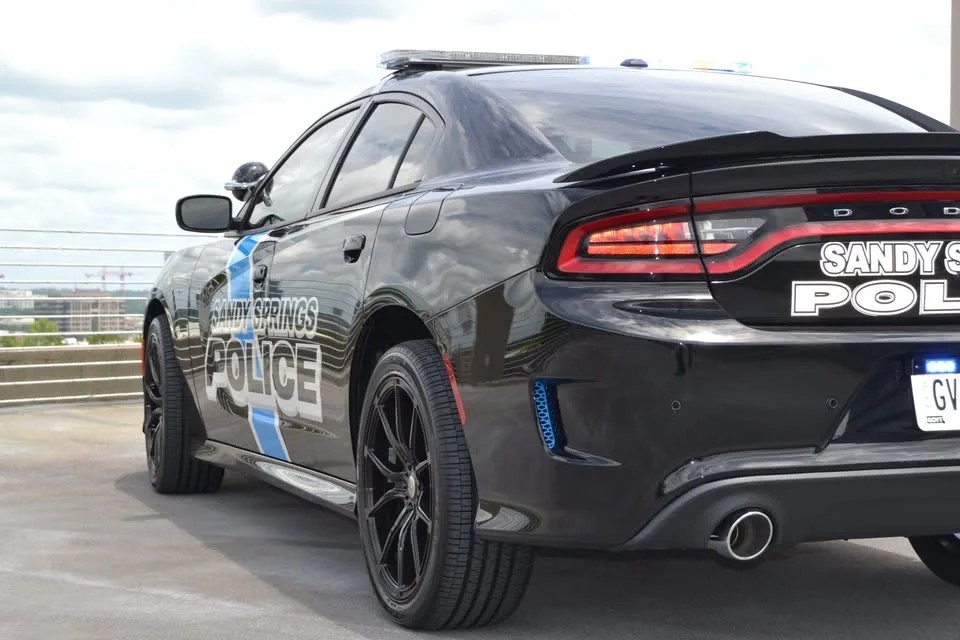
Officers from Sandy Springs’ Street Crimes Unit had been hunting for a truck linked to a peculiar crime spree: someone allegedly ripping Flock Safety license plate reader cameras off their foundations and smashing them. Four cameras, destroyed. On June 4, they spotted the truck on Roswell Road—one of the busiest corridors in suburban Atlanta—and instead of lighting up the sirens, they pulled up behind it and fired a nylon tether at the rear tire. The truck decelerated. The officer keyed his radio: “Fish on, fish on, I repeat fish on.” Caden Dean Armiger was taken into custody without incident, facing charges including:
- criminal damage to government property
- interference with government property
- possession of a controlled substance
The dashcam clip, shared by FOX 5 Atlanta and the department’s own social accounts, promptly went everywhere.
The Grappler and the Flock Camera, Explained
Two pieces of law-enforcement hardware—one mechanical, one digital—collided on a suburban Atlanta road, and the internet noticed.
That tether came from a Grappler Police Bumper. It’s a front-mounted mechanical system that shoots a heavy-duty nylon strap from beneath the patrol car’s bumper, snags a rear wheel, and lets the officer brake the suspect vehicle to a controlled stop. No PIT maneuver. No 90-mph suburban chase. Sandy Springs specifically framed the device as built for crowded roads where traditional pursuits put bystander lives at risk.
The cameras Armiger allegedly destroyed belong to Flock Safety. The company’s fixed roadside units capture still images of license plates—not continuous video—and feed them into a centralized, searchable nationwide database that law enforcement can access, often without a warrant. The ACLU warns the system gives police “all over the country access to your location,” effectively secretly tracking users across jurisdictions. The EFF has documented Flock data being used to monitor protesters and activists. Closer to home, Sandy Springs terminated an officer for allegedly using the city’s camera network, including Flock units, for personal purposes—a concrete reminder that internal misuse is a real concern, not a hypothetical one.
The ACLU has also noted that Flock’s newer AI analytics “shift the company from providing tools for officials to use in investigating suspicion to generating suspicion.”
The Grappler footage carries the energy of a Star Wars tractor beam deployed in a Georgia suburb—cinematic, oddly satisfying, instantly meme-able. “Fish on!” became the internet’s favorite cop quote of the week. But underneath the viral moment sits genuine friction. The alleged vandalism was criminal. The discomfort driving it isn’t fringe.
When Destroying Surveillance Gear Becomes a Felony
The charges against Armiger underscore how deeply embedded Flock’s infrastructure has become in everyday policing.
Flock’s AI is evolving from storing plate reads to proactively flagging “suspicious” vehicle movement patterns—a shift from reactive to predictive policing. Meanwhile, Grappler-style devices are becoming standard gear for specialized units because chase-related liability in dense suburbs is expensive and politically unpopular. Expect incidents like this one to surface in local ALPR policy hearings, cited by both sides.
Every time you drive past a Flock camera in Sandy Springs—or most American suburbs—your plate gets logged. For consumers thinking about home security systems, the ubiquity of such hardware is a striking backdrop. The Grappler catches the person who objects with a crowbar. The policy debate is still catching up to the hardware.