



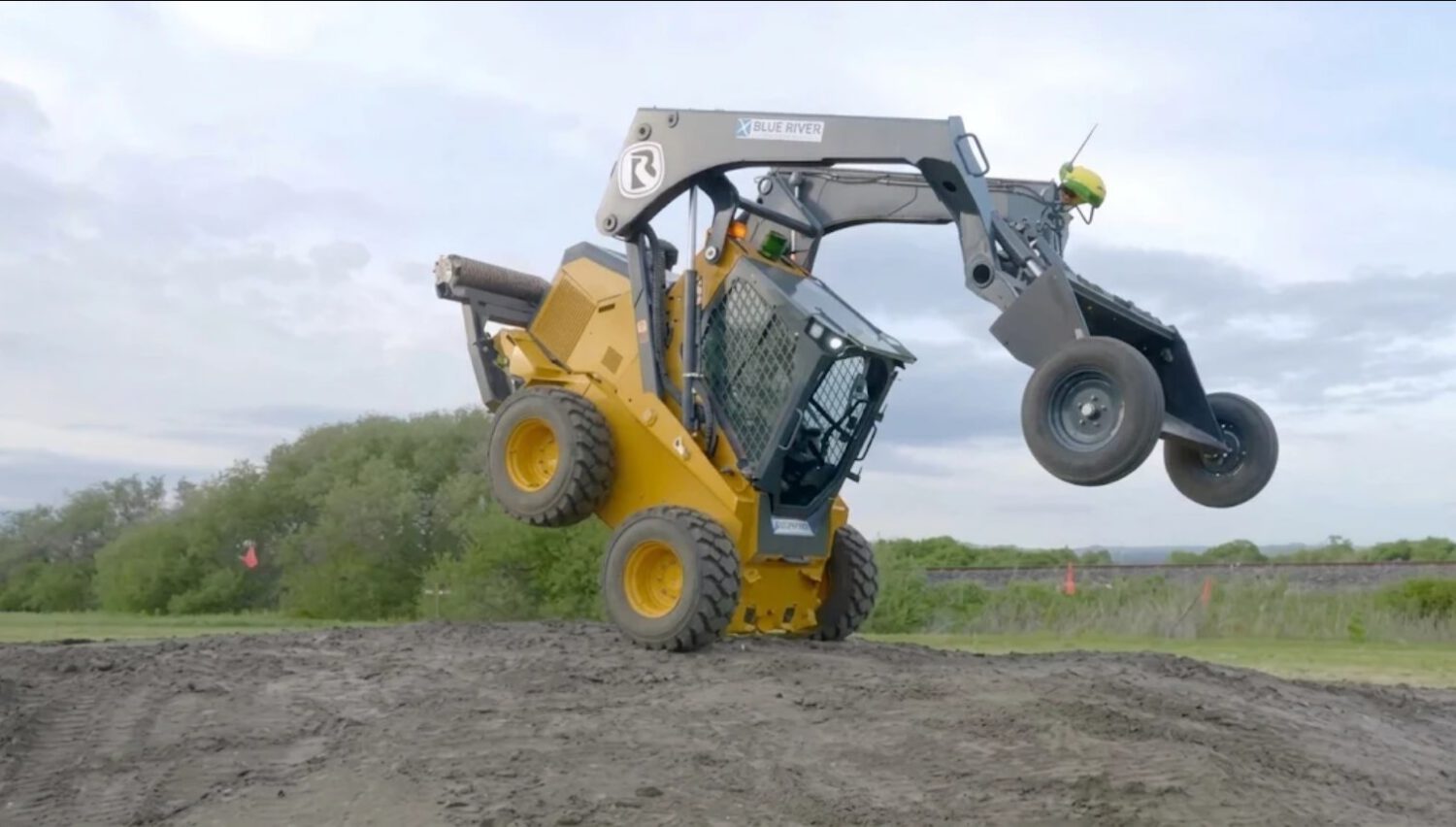
Balancing five tons of construction equipment on two wheels demands the kind of precise, continuous control that most human operators never attempt. Researchers from the United States and Switzerland have demonstrated exactly that, using an autonomous control policy on a real John Deere 332G skid-steer loader. The work appears in a paper titled “Heavy Metal Acrobatics: Learning Dynamic Control for Skid-Steer Loaders,” published on arXiv and reported as subsequently appearing in Science Robotics.
What the Machine Actually Did
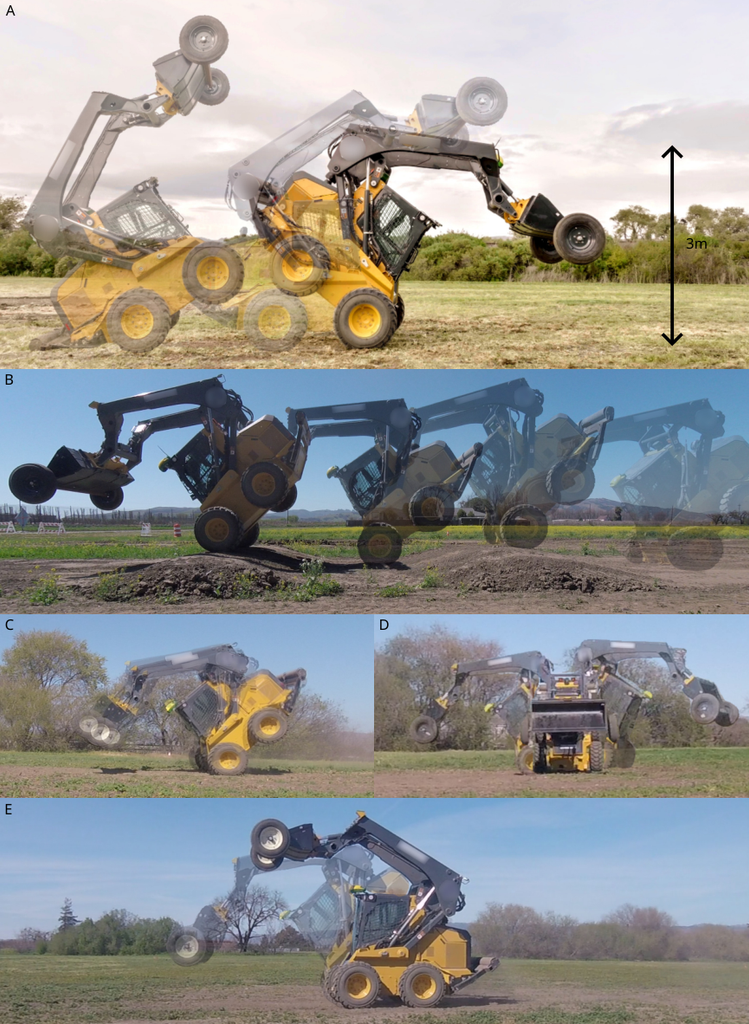
The autonomous system completed a demanding set of dynamic maneuvers during testing, coordinating balance, steering, and hydraulics throughout.
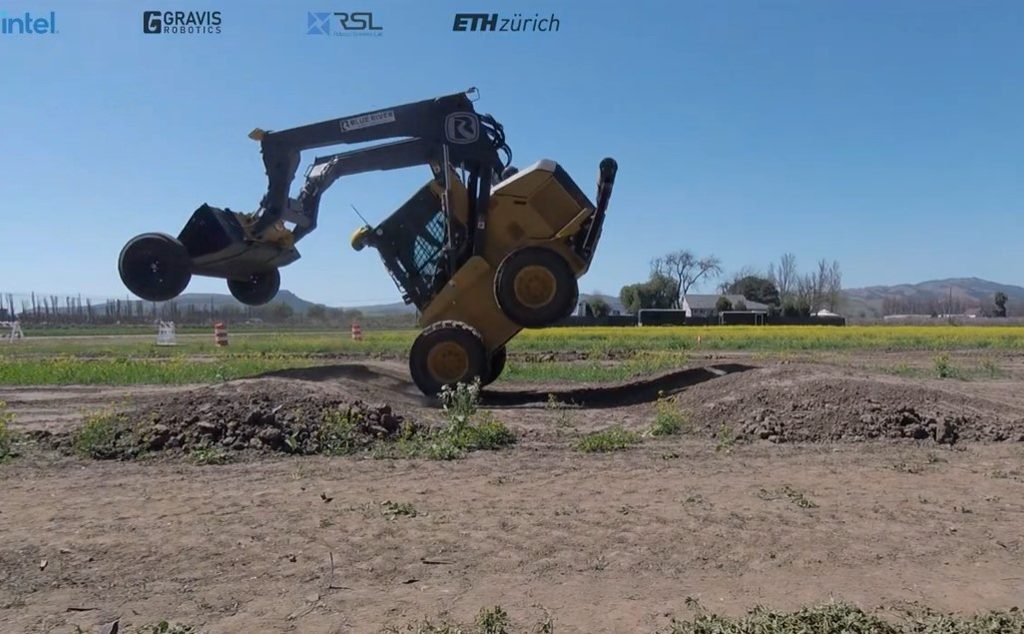
The machine swung up onto its front wheels from a standard four-wheel stance and drove over rough, uneven terrain while holding that two-wheel balance. It also spun, traced specified trajectories, actuated the bucket during the maneuver, and returned safely to all four wheels. These are not slow, scripted movements; they require continuous coordination of throttle, steering, braking, and hydraulics at the same time.
Why Simulation Comes First
Training a control policy through trial and error on a real five-tonne machine would be expensive, slow, and dangerous.
The researchers used reinforcement learning, a method where a control policy earns rewards for desired behavior and penalties for failure. Simulation solves the safety problem by letting the policy fail repeatedly in a virtual environment before it is transferred to the physical loader. The researchers also used real-machine data for system identification and calibration, so the training process was primarily, though not exclusively, simulation-based.
The Result That Actually Matters
The genuine news here is not the wheelie itself but whether a policy trained in virtual physics can survive contact with reality.
Researchers call this sim-to-real transfer. The policy held up when deployed on the real loader, handling terrain irregularities, actuator limits, and the gap between the virtual model and real-world machine dynamics. Bridging that gap is a recognized major challenge in robotics research, and the result supports the case that simulation-trained policies can generalize to heavy physical hardware.
A Human Benchmark, With a Caveat
The researchers compare the maneuvers to feats that only a small number of elite human operators can replicate, citing official world-record performances.
That comparison reflects the researchers’ own characterization. It has not been independently verified against a documented record or formal competition standard.
What This Points Toward
Dynamic autonomous control at this scale could eventually reduce direct operator exposure in hazardous or highly repetitive environments.
The paper identifies potential relevance to construction, mining, and material handling. The same learned-controller approach may also inform future work on recovery systems and terrain negotiation, though those remain potential applications rather than demonstrated outcomes of this study. Such advances also carry implications for workplace safety in environments where human operators currently face significant physical risk.
What This Is Not
The demonstrations took place under controlled test conditions and do not constitute a commercial deployment.
Describing the loader as autonomous means the control policy executes the maneuvers. It does not confirm the machine operated without safety personnel, remote monitoring, or emergency protocols on standby. Commercial deployment of autonomous heavy equipment would require extensive validation, safety systems, certification, and regulatory approval. The paper does not establish any of that.