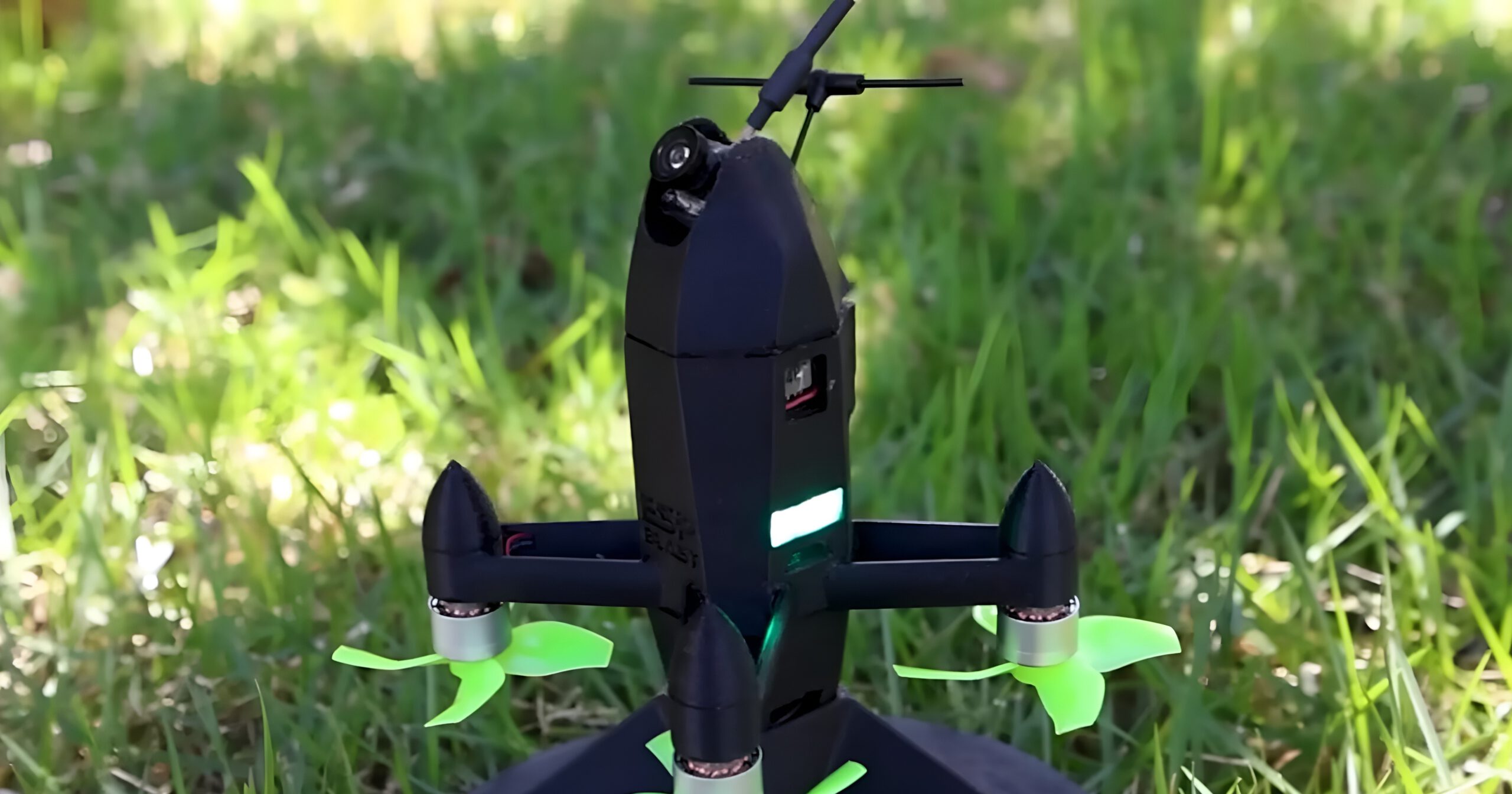
YouTuber Max Imagination just shattered the assumption that high-speed drones require commercial flight controllers and four-figure budgets. His ESP-Blast quadcopter weighs 136 grams, costs $155 in parts, and rockets to 67 mph using an ESP32 microcontroller as its brain.
That speed matters because it places a DIY build in territory typically reserved for expensive racing quads. The ESP-Blast achieves this through smart component choices:
- Four 1104 brushless motors spinning 2.5-inch tri-blade props
- Powered by 8A micro ESCs and a 450mAh 3S LiPo battery
The entire airframe prints in PETG on an Elegoo Neptune 4 Plus, creating a bullet-shaped design that cuts through air while surviving the inevitable tuning crashes. This isn’t just another weekend project—it’s proof that hobbyist engineering can rival commercial solutions when creativity meets smart component selection.
Engineering Magic in a Microcontroller
The real breakthrough lies in pushing the ESP32 beyond its comfort zone. While most ESP32 drone projects hover gently around living rooms, Max Imagination’s custom PCB integrates accelerometer, gyroscope, magnetometer, barometer, and GPS for just $8. Betaflight 10.10 firmware tunes the system for stability at 100+ km/h speeds.
The drone requires eight GPS satellites to arm and launches vertically before transitioning to horizontal speed runs. Flight times range from 2-8 minutes depending on throttle abuse, with WiFi providing 200 meters of control range (expandable via ELRS receivers).
This isn’t just impressive for an ESP32—it’s impressive period. You’re looking at performance that would have required aerospace budgets just years ago, now achievable in any garage workshop.
Standing on Speed Giants’ Shoulders
The ESP-Blast draws inspiration from Benjamin Bigg and Luke Bell’s record-breaking drones that hit 411 mph, but prioritizes reproducibility over pure speed records. Max Imagination consulted with Bigg during development, emphasizing open-source design that anyone with a 3D printer and soldering iron can build.
This philosophy reflects the maker movement’s maturation from novelty projects to performance-competitive hardware. While speed demons chase records in private, the ESP-Blast democratizes high-speed drone technology.
Your garage workshop now has access to builds that challenge the assumption that serious performance requires serious money. The ESP-Blast proves that innovation doesn’t require venture capital—just clever engineering and the courage to push cheap components beyond their intended limits.