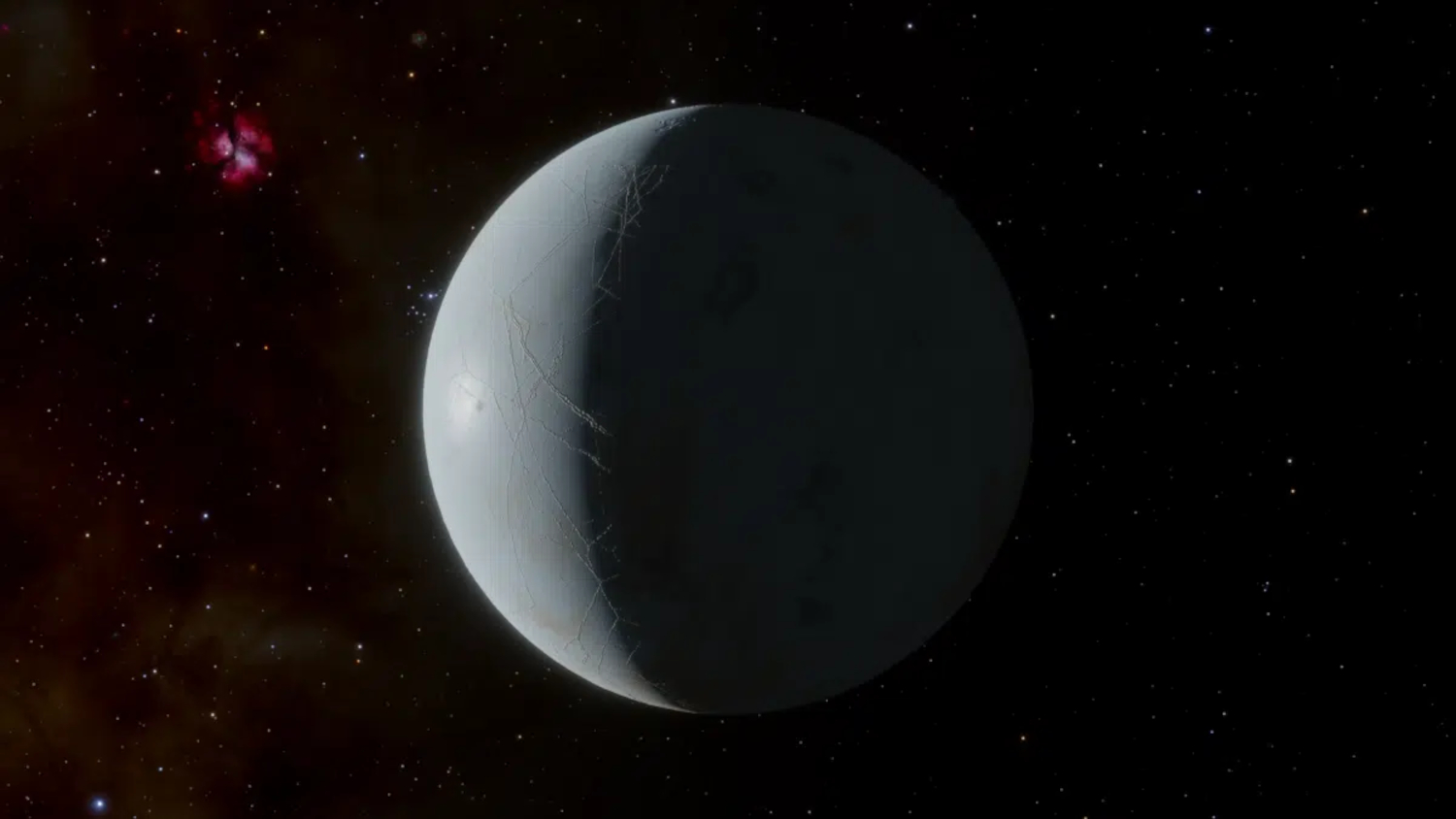
Beyond Neptune, a population of small icy worlds follows orbits that are unusually elongated and steeply tilted relative to the Solar System’s flat plane. Planetary scientists have spent years debating what, if anything, could explain those orbital patterns.
What the Simulations Found
A team of three researchers, Patryk Sofia Lykawka, Pedro Bernardinelli, and Jonti Horner, ran computer simulations spanning 4.5 billion years of Solar System evolution to test competing explanations. Their candidate, labeled Planet X2, would carry roughly one to two Earth masses. It would orbit the Sun at a semimajor axis of approximately 350 to 500 astronomical units, with its closest solar approach near 200 AU.
For context, Neptune sits about 30 AU from the Sun. Planet X2’s proposed orbit would place it roughly ten to seventeen times farther out than the outermost known planet.
The team compared Planet X2 against scenarios involving transient planetary embryos. These are Mars-to-Earth-mass bodies that shaped the outer Solar System early in its history before being ejected. Those embryo scenarios failed to reproduce all observed features and were typically gone within a few million to tens of millions of years, leaving orbital distributions similar to models with no extra planet at all.
Planet X2 performed better among the scenarios tested. Its simulations reproduced the orbital properties of all 11 known extreme trans-Neptunian objects considered in the study, including orbital signatures resembling those of Sedna and 2012 VP113, two of the most distant and puzzling objects known.
Where the Model Falls Short
The researchers tested their results against 96 distant objects in the Dark Energy Survey catalog, using a tool designed to account for observational bias. Planet X2 models matched two key properties: orbital inclination and perihelion distance, meaning the closest point an object reaches to the Sun.
The models did not adequately reproduce the distribution of semimajor axes, meaning the characteristic scale of those distant orbits. The authors acknowledge this mismatch and suggest it may reflect limitations in the initial debris disk used in the simulations, flagging it as a shortcoming requiring further refinement.
Planet X2 Is Not Planet Nine
Planet X2 is a separate hypothesis from the more widely discussed Planet Nine. The study’s Planet Nine proxy carried roughly six Earth masses, and that configuration produced a potential oversupply of highly inclined objects in a comet-supplying region, possibly conflicting with known comet distributions.
The authors treat that comparison as preliminary, noting that Planet Nine was tested in only one configuration.
What This Study Cannot Tell You
No telescope has photographed Planet X2 or tracked it as a moving point of light. Its proposed mass, orbital inclination, and closest solar approach are constraints inferred from dynamics, not direct observation.
The study also does not model how such a planet would have formed, whether in place, through outward scattering, or via an early encounter with another star.
The Next Real Test
The Vera C. Rubin Observatory’s Legacy Survey of Space and Time offers a promising way to test the hypothesis. If Planet X2 is bright enough and falls within the survey’s coverage, Rubin could detect it directly.
Even if the planet remains too faint, the discovery of additional distant icy bodies could reveal whether their orbital distributions carry the gravitational fingerprints Planet X2 predicts. Either outcome, a direct detection or a richer orbital dataset, will help determine whether Planet X2 moves from hypothesis toward confirmed discovery.