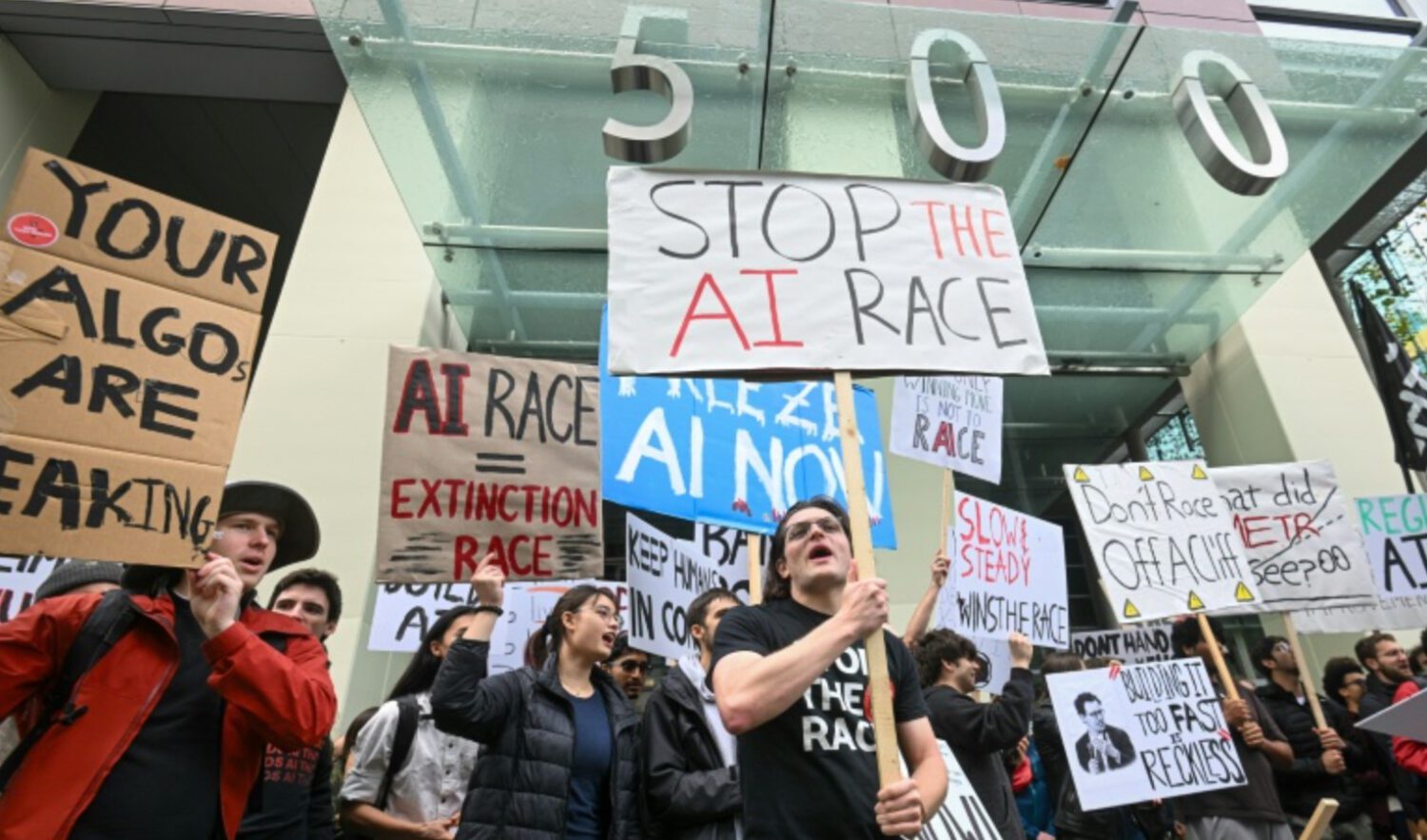
On the day Claude’s new feature was drawing attention, roughly 100 demonstrators stood in the rain outside its San Francisco headquarters and questioned whether a safety-focused AI company can keep that identity once shareholders are involved.
Rain fell on the demonstrators outside Anthropic’s San Francisco offices as the company completed what CNBC described as the largest IPO in history. They chanted “Ban RSI, we don’t want to die” as they gathered on the street below the trading milestone taking shape inside.
The central demand focused on recursive self-improvement, or RSI. This refers to the possibility that advanced AI systems could help design and train increasingly capable successor versions of themselves. That process, critics argue, could outpace effective human oversight and make AI development difficult or impossible to control. RSI remains a forward-looking concern, not a demonstrated capability of Anthropic’s current systems.
Anthropic raised $81.3 billion in the offering, according to CNBC, with shares opening at $111.50 on its Nasdaq debut. CNBC reported a fully diluted market capitalization of roughly $1.8 trillion by the close of trading. The scale places the company among the most valuable technology firms in the world.
Jacob Coxon, a former Anthropic researcher whose resignation drew public attention to safety concerns, appeared at the demonstration. According to CNBC, he promoted the protest through an X post linking to the “Ban RSI” campaign website. Coxon has argued that Anthropic should refuse to pursue RSI and warned, in his own assessment, that the company could move toward the technology as early as next year. Anthropic has stated that it has not reached the RSI stage.
Among those present was Tarnel Abbott, a 72-year-old retired librarian. She said demonstrators believed Anthropic could profit from technology that company representatives themselves acknowledge might pose an extreme threat to humanity, though that characterization is Abbott’s own. Protester Emily Tan described the AI industry as a “black box,” arguing that many people do not understand what is taking place inside it. Tyler Tracy, a researcher at Redwood Research, said Anthropic’s stated strategy of slowing AI development through “pacing” does not go far enough.
Daniel Kokotajlo, a former OpenAI employee who now leads the AI Futures Project, rejected a common industry rationale. He said the argument that a Western company must develop advanced AI before a geopolitical rival, particularly China, does not justify accelerating development. Some demonstrators said they still use AI tools and find them useful, but believe the pace of development has outrun adequate safeguards. One counter-protester, activist blogger Barak Gila, defended both Anthropic’s technology and its economic contribution to San Francisco.
Anthropic was founded by former OpenAI employees and built its reputation around a commitment to AI safety. That founding premise is now being tested inside a public-market structure that rewards growth, technological leadership, and returns to shareholders. Whether the voluntary restraints the company has described as central to its mission remain viable under those conditions is an open question. Neither the IPO prospectus nor the protest outside addressed it directly.