Notre Dame researchers have developed an experimental platform that detected pancreatic cancer, glioblastoma, colorectal cancer, and Alzheimer’s disease with 90–99% accuracy in a small initial study. What that number actually means requires careful context.
Pancreatic cancer and glioblastoma are often caught late, when treatment options are narrowest. A research team at the University of Notre Dame, led by chemical engineer Hsueh-Chia Chang, has built a blood-testing platform designed to change that timeline.
The technology centers on what the team calls immunojanus particles. Each sphere is roughly one micron across, with two distinct sides: one coated in antibodies that capture disease-associated proteins, the other fluorescent and built to blink.
The particles are designed to detect exosomes, tiny particles shed by cells that can carry disease-associated proteins on their surface. When an exosome attaches to a particle, the added mass alters how the particle moves through fluid, changing its blinking pattern. A computer program reads those motion shifts to identify a disease signal.
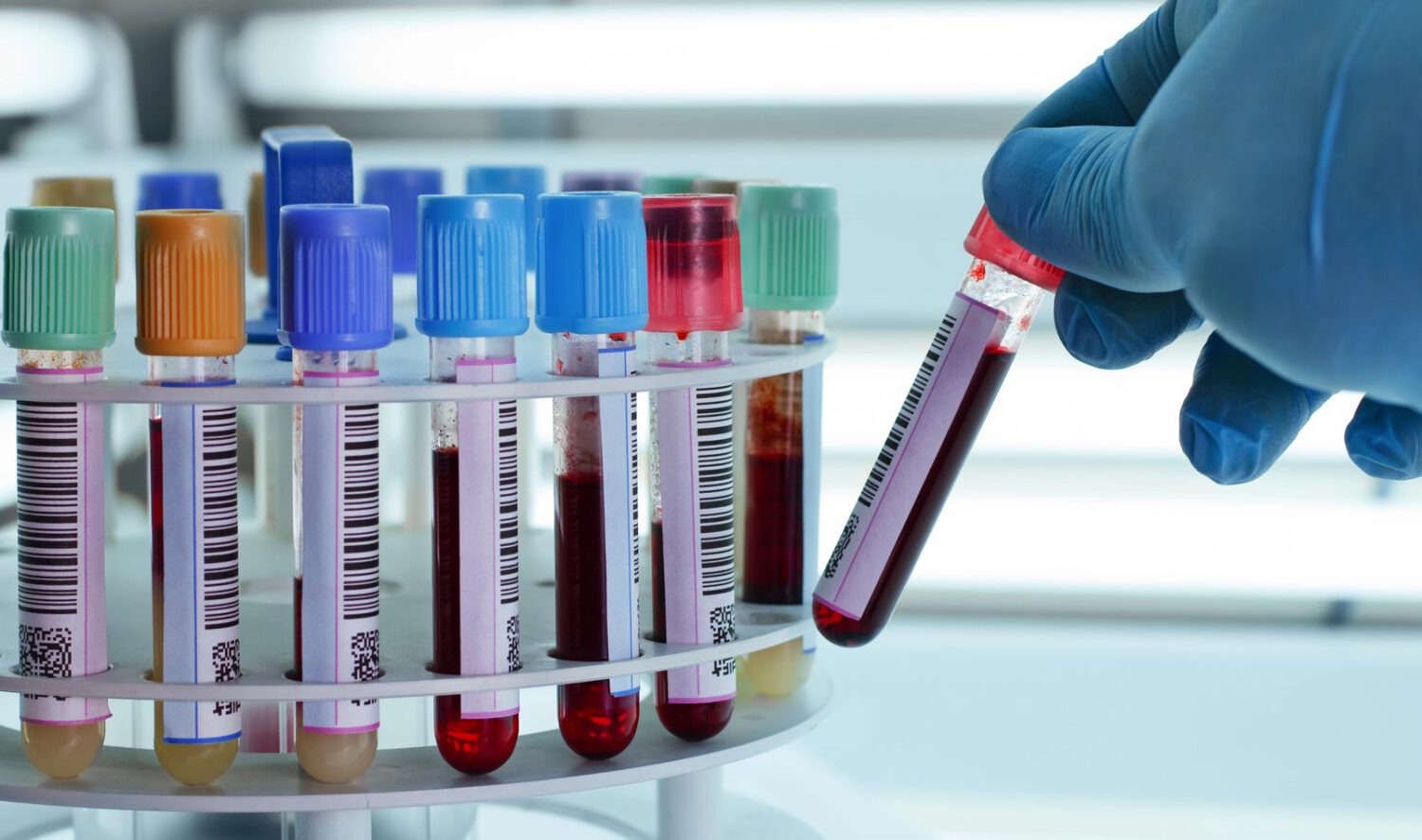
The process begins with a standard blood draw. The lab uses approximately 10 microliters of blood, dilutes it with saline, mixes it with the immunojanus particles, and examines the result under a microscope. Notre Dame reports the mixing and dispersal stage takes between 10 and 60 minutes.

In a blind evaluation of 87 plasma samples from healthy participants and people diagnosed with one of four conditions, the platform reported accuracy between 90% and 99% across pancreatic cancer, glioblastoma, colorectal cancer, and Alzheimer’s disease.
That figure requires careful handling. The sample was small and the cohort controlled.
It does not establish how the platform would perform across diverse populations or community hospitals. The full range of disease presentations clinicians encounter remains untested.
Larger independent studies, unresolved questions about false-positive rates, and regulatory review would all be needed before routine patient use. A high accuracy figure from a research cohort cannot predict what a test will tell any individual patient.
The nearer-term application may be treatment monitoring rather than population screening. Monitoring addresses a specific decision for patients who already have a diagnosis, which could fit more naturally into existing care pathways.
In separate work with colorectal cancer samples, the researchers reportedly distinguished healthy, pre-metastatic, and metastatic disease with 95% accuracy. Combined with a second blood-testing method, that figure rose above 97%, according to the university.
The longer-term vision is an annual blood-based screening test. Each assay uses roughly 10 microliters of blood, and the researchers suggest a single draw could theoretically support testing for many diseases once appropriate markers are identified and validated.
The team has referenced a figure of up to 500 diseases as a future-use projection. That figure reflects the platform’s design logic, not a demonstrated capability.
Practical obstacles remain significant. Unresolved challenges include cost, laboratory infrastructure, instrument standardization, reproducibility across sites, and the clinical consequences of false positives in low-prevalence populations.
What the platform offers, if validation holds, is earlier information. For diseases frequently caught at a late stage, earlier detection means more time for treatment decisions and monitoring. Patients and clinicians gain better information before options narrow.