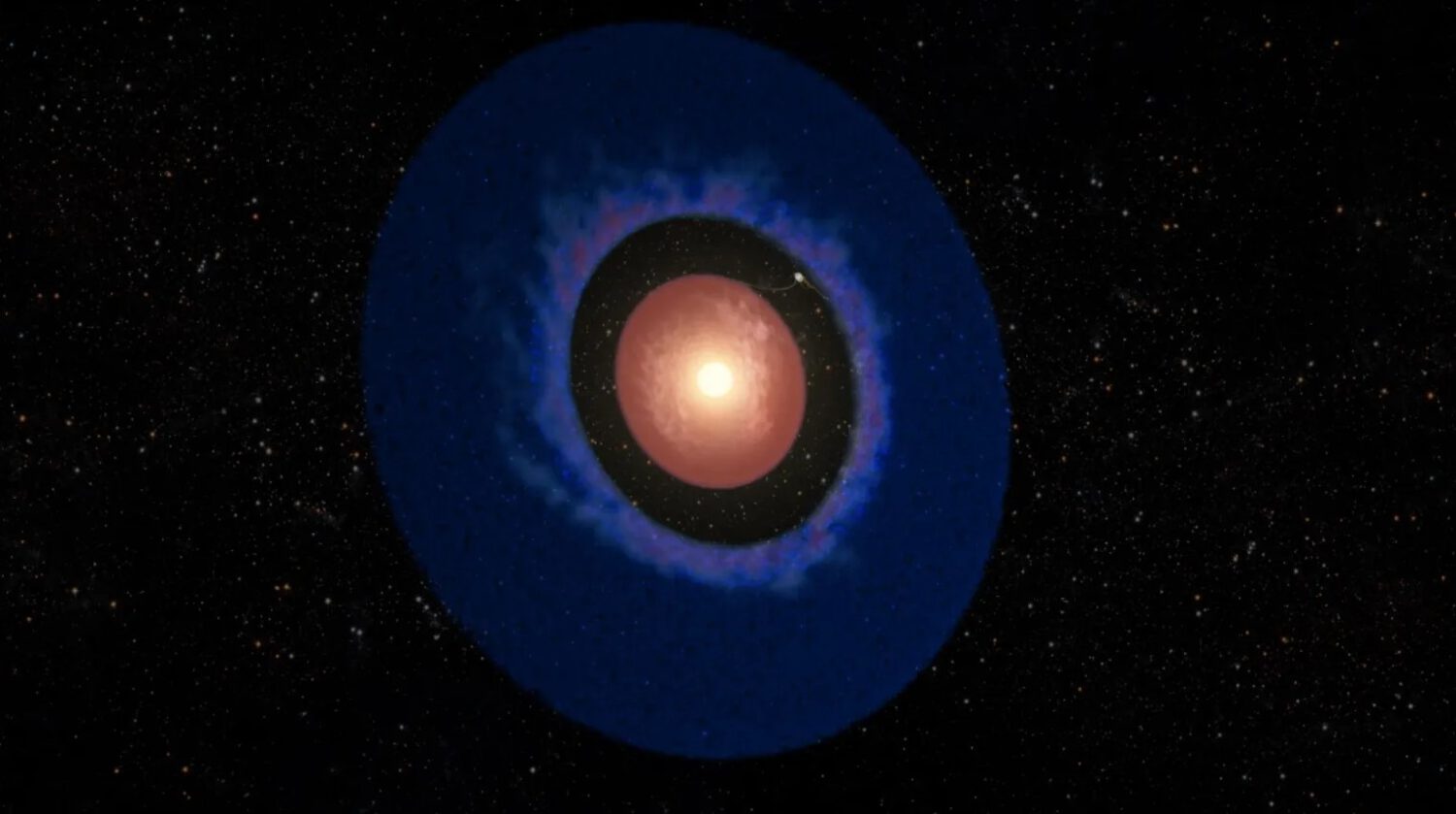
Elias 2-24 b is the youngest known confirmed planet, with an estimated age of less than 1 million years. The previous record holders, four planets orbiting the stars PDS 70 and WISPIT 2, were all older than 5 million years. This new world did not edge past them; it lapped them entirely.
Still Inside Its Birth Environment
The planet sits 55 times farther from its star than Earth sits from the Sun, still embedded in the gas and dust it formed from.
That distance, 55 astronomical units (one astronomical unit equals the Earth-Sun distance of roughly 93 million miles), poses a challenge for models that struggle to form giant planets so quickly at that range. Its host star, Elias 2-24, lies about 450 light-years from Earth, according to NASA Science.
Reading the Gaps
A missing ring of disk material pointed researchers toward a planet forming in that region of the disk.
Planets can carve gaps in protoplanetary disks, the spinning clouds of gas, dust, ice, and rock surrounding young stars, by sweeping up or gravitationally pushing aside material along their orbits. Using the Atacama Large Millimeter/submillimeter Array and the European Southern Observatory’s Very Large Telescope, astronomers identified such a gap around Elias 2-24. Archival data from the W. M. Keck Observatory, drawn from observations in 2018 and 2020, revealed a faint object inside that gap whose movement across the sky was consistent with an orbiting planet rather than a distant background star.
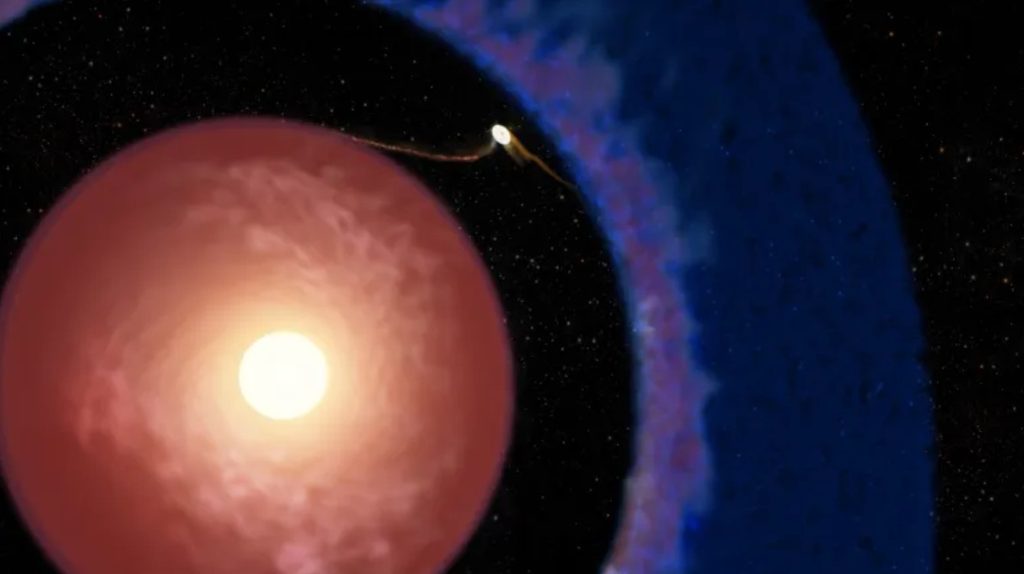
W. M. Keck Observatory/Adam Makarenko
A Team Effort Across Three Facilities
Combining evidence from three separate observatories made confirmation possible.
The study was led by Andrea Bernardi, a doctoral candidate at Universidad Diego Portales in Chile, and published in The Astrophysical Journal Letters. Keck’s coronagraph, an instrument that blocks most of the host star’s glare to reveal faint nearby objects, was central to isolating the planet’s signal, while ALMA and the Very Large Telescope contributed disk and supporting observations.
Formation Theory Under Pressure
A Jupiter-mass world this young, at this distance, challenges existing formation frameworks.
Core accretion is the process by which a rocky core gradually pulls in surrounding gas to build a giant planet. Current models struggle to complete that process at roughly 50 astronomical units within 1 million years, and the discovery suggests core accretion can operate faster, or behave differently at large orbital distances, than those models accommodate.
A Mass That’s Still Moving
Active accretion makes pinning down Elias 2-24 b’s exact mass genuinely difficult.
Because the planet is still pulling in material from the surrounding disk, brightness from that infalling gas can affect mass estimates. Current figures from The Astrophysical Journal Letters range from roughly 1.9 to 4.0 Jupiter masses, a spread wide enough to matter as theorists refine their models.
More Detections on the Horizon
NASA’s Nancy Grace Roman Space Telescope could help determine whether this planet is a rare exception or a sign of something more common.
Roman carries a coronagraph designed to extend high-contrast planet hunting to worlds in tighter orbits, closer to their stars. If future surveys reveal more planets like Elias 2-24 b, the assumption that giant planets require millions of years to assemble may need significant revision.