A rare perceptual condition caused one patient’s brain to transfer facial features between faces he sees in sequence. Researchers say the case offers a window into how the brain tissue stores and retrieves the parts of a face, not just the whole.
Luna Shows Up in Unexpected Places
Luna is often the first face Karl sees each morning, and her features may reappear on faces he encounters later that day.
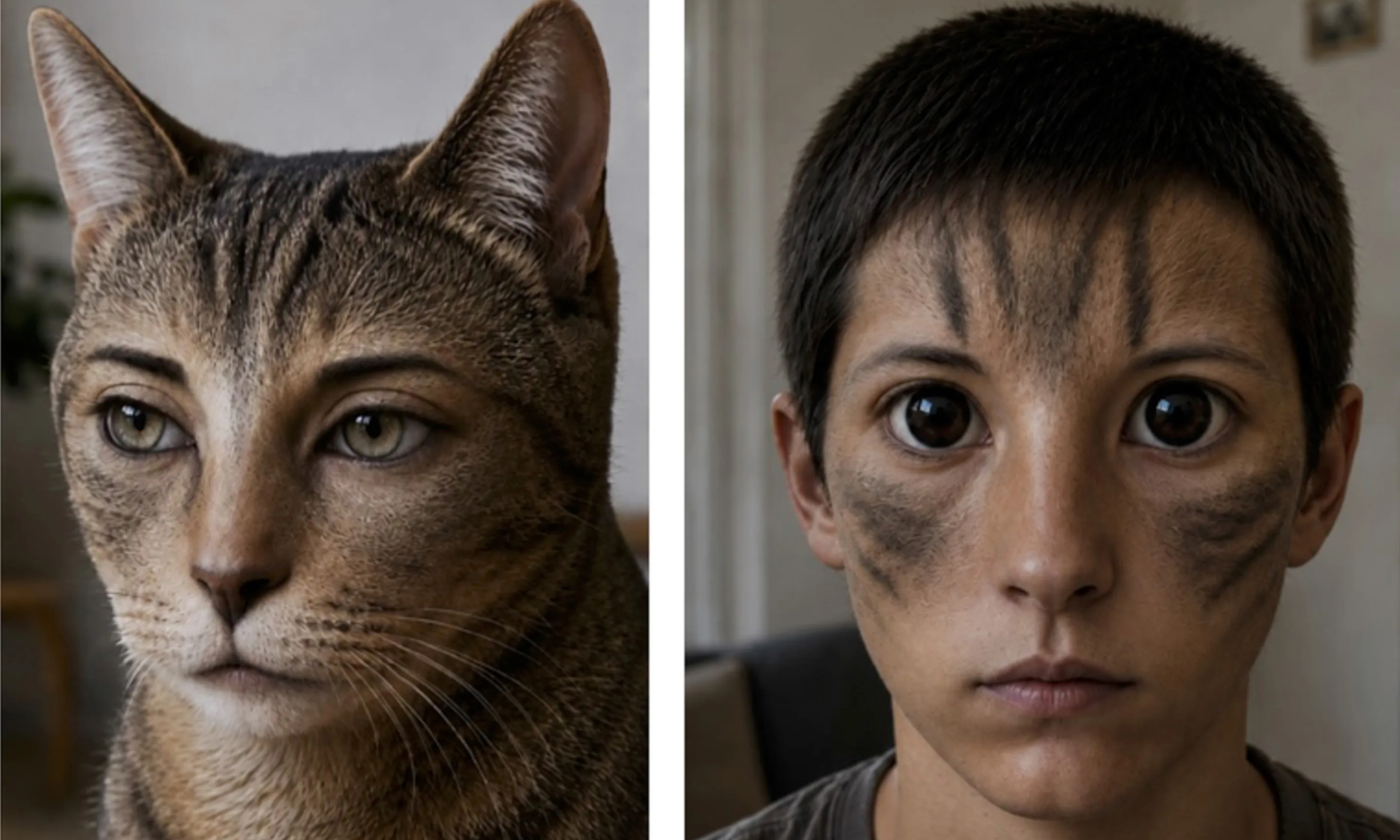
Karl, a 28-year-old man, often looks at his gray tabby cat, Luna, early in the morning, and the effects can follow him for hours. Her almond-shaped eye sockets, enlarged pupils, and facial stripes may subsequently appear on human faces he sees afterward. This is a documented case of two overlapping neurological conditions, reported in the journal Cortex by researchers at Dartmouth College and Brigham and Women’s Hospital.
What the Surgery Removed, and What It Left Behind
Karl’s symptoms developed after surgeons removed part of his right temporal lobe to treat a vascular condition.
Karl’s condition began after surgeons removed part of his right temporal lobe to treat an arteriovenous malformation, an abnormal tangle of blood vessels that raises the risk of brain bleeding. The right temporal lobe plays an important role in face processing. His symptoms were subsequently described as palinopsia, in which a previously seen image or feature persists and reappears during later perception. The facial distortions were classified as prosopometamorphopsia, or PMO, in which faces or facial features appear distorted.
The Effect Runs Both Ways
Features do not only travel from cat to human; they move in multiple directions depending on which face Karl sees first.
The transfer is bidirectional, according to the published report. After seeing a human face first, Karl may perceive that person’s pupils or eye shape on Luna or on subsequent faces he encounters. One human’s features can also appear on another human’s face entirely. Symptoms can last several hours or an entire day.
What This Tells Researchers About Face Perception
The brain processes faces in components, and Karl’s case offers evidence of what happens when that system misfires.
Lead author Brad Duchaine interprets the case as evidence that the brain breaks faces into components, then matches those components against stored representations. According to Duchaine, a stored feature may remain active or be incorrectly matched to a new face. The specific neural mechanism remains an interpretation of this single-patient report, not a settled explanation.
The cross-species dimension makes the case particularly informative. Bidirectional transfer between a cat’s face and human faces implies the perceptual system can move individual features across different face types, rather than simply mistaking one whole face for another. The Cortex paper also notes a historical parallel: a 58-year-old woman temporarily saw a poodle’s face on fellow passengers after a stroke.
AI Images Help, With an Important Asterisk
Generative AI converted Karl’s sketches into photorealistic reconstructions, but those images are approximations of his reported experience, not objective recordings.
Researchers used a generative AI system to convert Karl’s initial line drawings into photorealistic images. They then revised those images with his feedback until he judged them accurate. Those images are collaborative reconstructions of his reported perception, not photographs or direct recordings of brain activity. The research team argues the method could help patients describe unusual visual experiences to clinicians and family members more precisely than words or sketches alone.
Rare, But Likely Underreported
PMO appears infrequently in medical literature, but the Dartmouth lab has documented more contacts with the condition than the published historical count.
PMO is rare, but the Dartmouth laboratory has documented more people with the condition than the total historically recorded in medical literature, suggesting it goes underreported. Karl’s case functions as a natural experiment in how perception, memory, and neural damage can interact. It does not establish a universal theory of facial recognition, but it offers an unusually clear window into how the brain may process faces in parts.