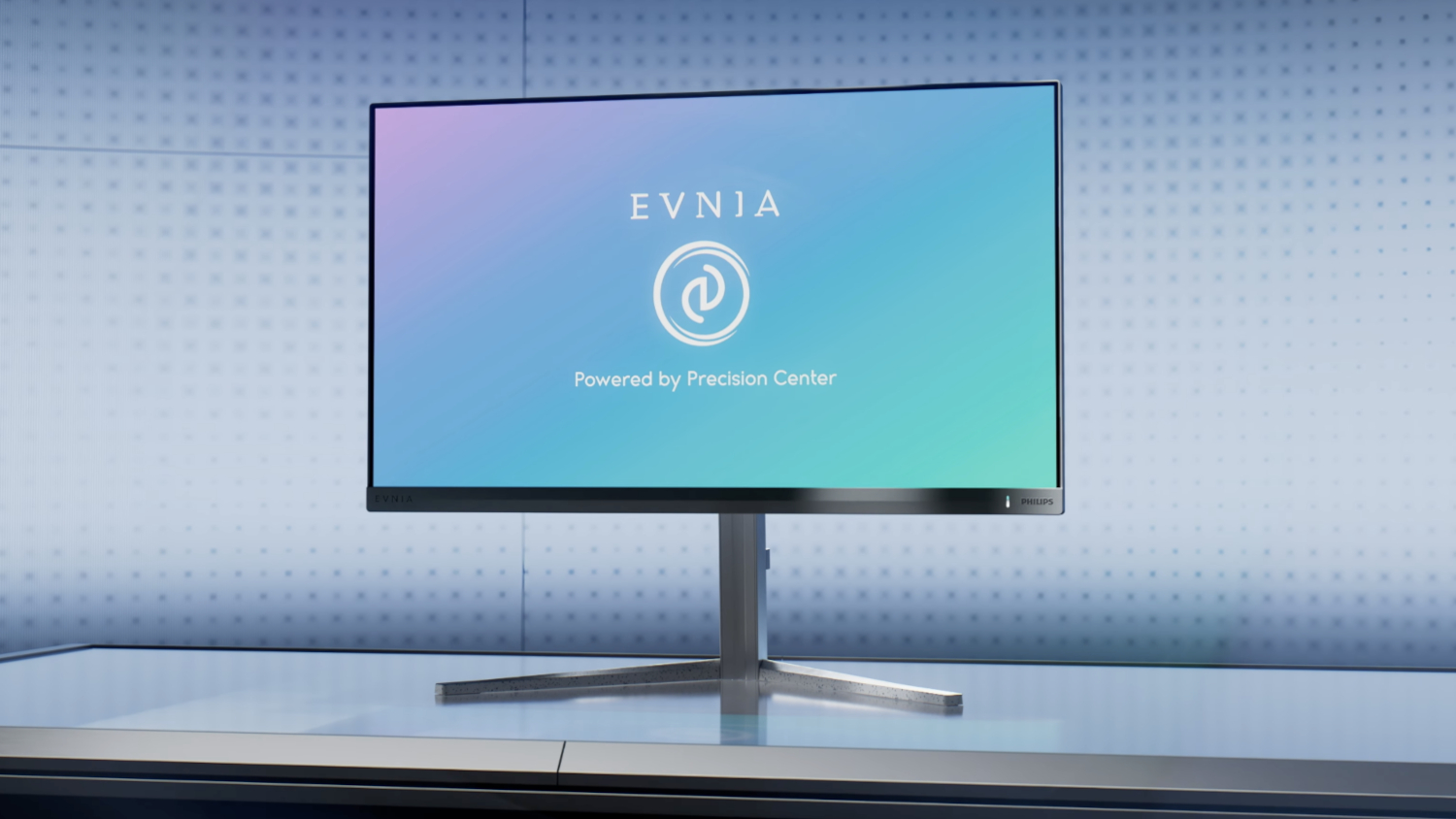
Choosing between a sharp productivity display and a fast esports monitor has long been an either-or decision for PC enthusiasts. Philips aims to close that gap with the Evnia 27M2D5901A, a 27-inch Fast IPS monitor built around a dual-mode design that switches between native 5K resolution and high-refresh QHD.
The native 5K mode runs at 5120 x 2880, with a standard ceiling of 165 Hz and an overclocked maximum of 180 Hz. Switch to QHD at 2560 x 1440 and those ceilings climb to 330 Hz standard and 350 Hz overclocked, according to Philips’ product specifications.
Sharp Detail Versus Raw Speed
Each mode serves a different purpose rather than offering two routes to the same result.
At 5K on a 27-inch panel, text, photography, and game environments render with considerably more clarity than standard 4K at the same size. That mode suits detailed work and slower single-player titles where visual fidelity matters more than frame rate.
QHD reduces the rendering workload substantially, allowing compatible graphics hardware to reach the high frame rates that competitive play demands. These are distinct use cases, not equivalent versions of the same experience.
The GPU Bill Is Part of the Price
Running 5K at 165 to 180 Hz in demanding games requires exceptionally capable graphics hardware, adding cost beyond the monitor itself.
Buyers should factor that hardware investment into their decision before the monitor’s price alone shapes expectations.
IPS Contrast and Entry-Level HDR
DisplayHDR 400 sets an entry-level HDR baseline, not an OLED-class one.
Philips lists a response time of up to 1 ms under its own testing conditions. The monitor carries DisplayHDR 400 certification, which indicates basic HDR support rather than OLED-class contrast, localized brightness control, or deep blacks.
Buyers who prioritize dark-room viewing or rich HDR will find that OLED and advanced mini-LED alternatives outperform edge-lit IPS panels in those areas. Those displays, however, lack this monitor’s dual-mode flexibility.
Connectivity and Features
The port selection and peripheral features position the Evnia 27M2D5901A as a full desktop hub.
Connectivity includes DisplayPort 2.1 and two HDMI 2.1 ports according to Philips’ current product information, alongside USB-C with up to 96 W power delivery. The monitor also ships with a KVM switch, Ambiglow lighting, AmbiScape support, two 5-watt speakers, and a fully adjustable stand offering height, tilt, swivel, and pivot.
A Color Coverage Discrepancy Worth Noting
Independent testing is needed to confirm real-world color accuracy before purchase.
Philips’ current product page lists 98% DCI-P3 color coverage, though earlier product presentations cited different figures, as noted by reporting from basic-tutorials.com. The discrepancy underscores why laboratory testing will matter once the monitor reaches reviewers.
Price, Availability, and a Moving Target
UK pricing and availability are set, but European figures have varied across announcements.
UK pricing is listed at approximately £699, with availability set for December 2026. European pricing has varied across announcements, with figures of roughly €799 and €929 reported for different markets. Both pricing and availability should be verified directly with Philips at launch, as reported figures have differed across earlier coverage.
Promising on Paper, Unproven in Practice
The dual-mode concept is genuinely unusual, but the value case rests on testing that does not yet exist.
At this price, the Evnia 27M2D5901A sits alongside OLED and mini-LED displays that deliver superior contrast and HDR performance, even though those alternatives lack its dual-mode combination. Whether the monitor justifies its premium depends on independent performance testing that is not yet available. Prospective buyers should watch for lab reviews covering contrast, HDR behavior, motion handling, and input lag before committing.