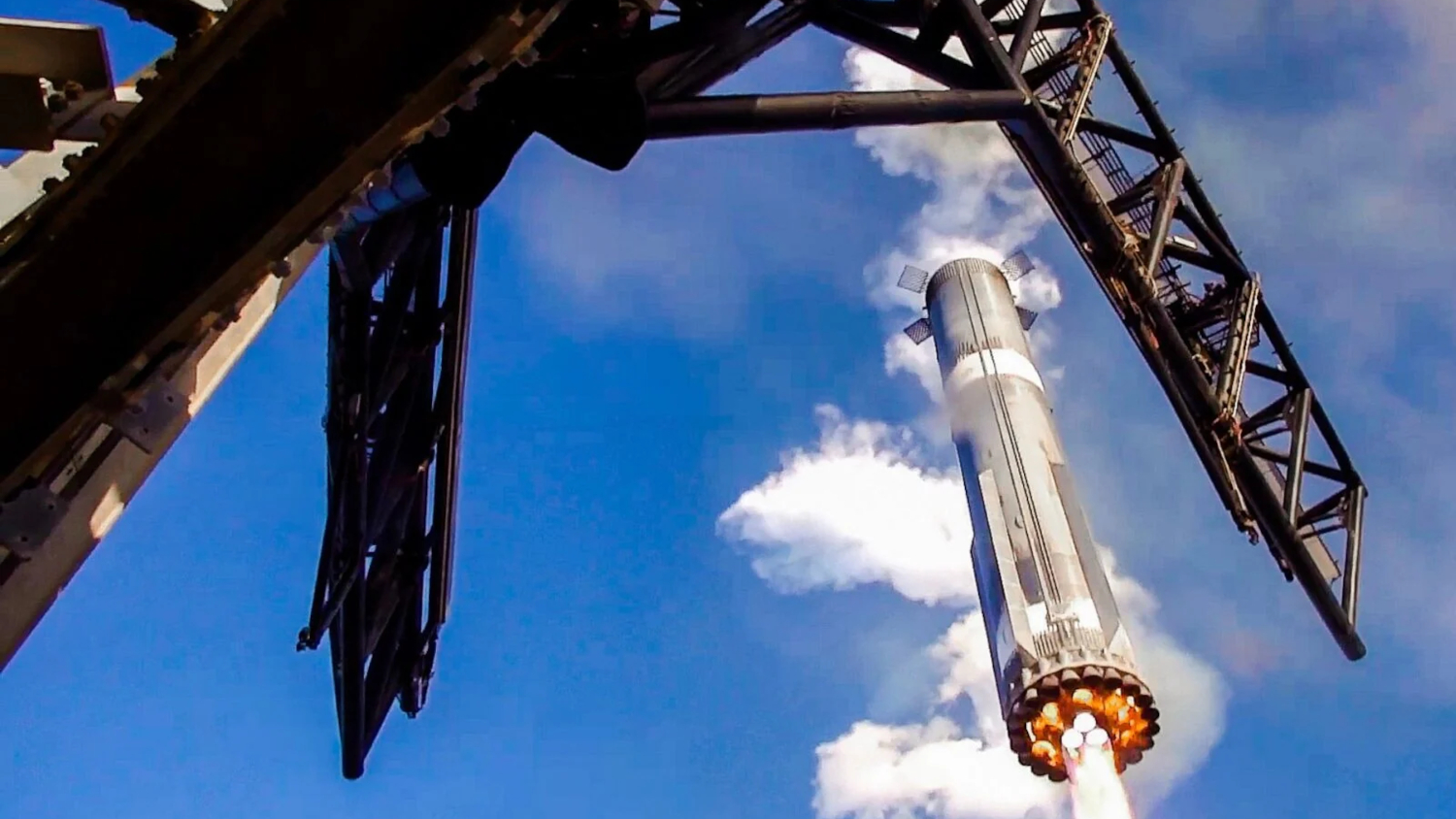
A 75-minute launch window opens at 5:45 p.m. Eastern Time on Friday, November 13, for Starship Flight 15 from Starbase in South Texas. The planned objective is the first attempt to catch both the Starship upper stage and the Super Heavy booster using the launch tower’s mechanical “chopstick” arms on a single mission.
Two Catches, Two Very Different Problems
SpaceX has recovered the booster before, but the upper stage presents an entirely new set of demands.
SpaceX has caught the Super Heavy booster three times; its return comes relatively soon after liftoff, and its path back to the tower is tightly constrained around the launch site. The upper stage is a different challenge: Starship must reach orbital velocity and survive atmospheric reentry. It must then manage its descent using its body and flaps, and arrive at the tower correctly aligned for the chopsticks to close. The recovery attempt also tests the vehicle’s heat shield under real reentry conditions.
What the Mission Profile Looks Like
Flight 15 plans a full orbital stint before Starship attempts its return.
Flight 15 is planned to reach an orbit approximately 275 kilometers, or about 171 miles, above Earth and remain in flight for more than 22 hours across roughly 14 orbits. The upper stage is expected to deploy 26 Starlink V3 satellites during that window, and three of those satellites have been modified to photograph Starship’s heat shield, potentially giving SpaceX data on the vehicle’s thermal condition at a point when ground observation is limited.
What Flight 14 Established and What It Left Open
The previous mission confirmed Starship could reach orbit; it did not test a return to the launch site.
Flight 14 reached orbit for the first time and deployed all 26 of its Starlink V3 satellites, confirming that Starship could complete an orbital insertion burn and carry an operational payload. An engine issue during ascent shortened the planned 10-hour, roughly six-orbit mission to approximately three hours before a controlled deorbit and Pacific Ocean splashdown. That mission demonstrated orbital insertion, payload deployment, deorbit execution, and reentry survivability, but tower recovery of the upper stage was not part of its profile.
The Catch Is Conditional
SpaceX has built in fallback options and can call off the upper-stage catch if conditions are not met.
SpaceX has built abort trajectories and ocean splashdown options into Flight 15’s flight profile. The upper-stage catch attempt can be called off if the vehicle’s condition or mission trajectory falls outside acceptable parameters during flight, so the double catch should be understood as a planned objective rather than a guaranteed outcome.
What Success Would and Would Not Prove
A successful double catch would validate the tower as recovery infrastructure, while leaving the case for routine reusability still to be made.
A successful double catch would demonstrate that both stages can be guided back to the launch complex and secured by the tower in a single mission. That result would support a central design assumption: that the launch tower can serve as recovery infrastructure, potentially reducing the need for separate landing facilities. It would not, however, establish rapid turnaround capability, routine operations, or long-term vehicle durability. Proving those things requires repeated successful flights, post-flight inspections, and demonstrated reflight timelines. Friday’s attempt is a system test; the broader case for reusability still depends on what comes after it.