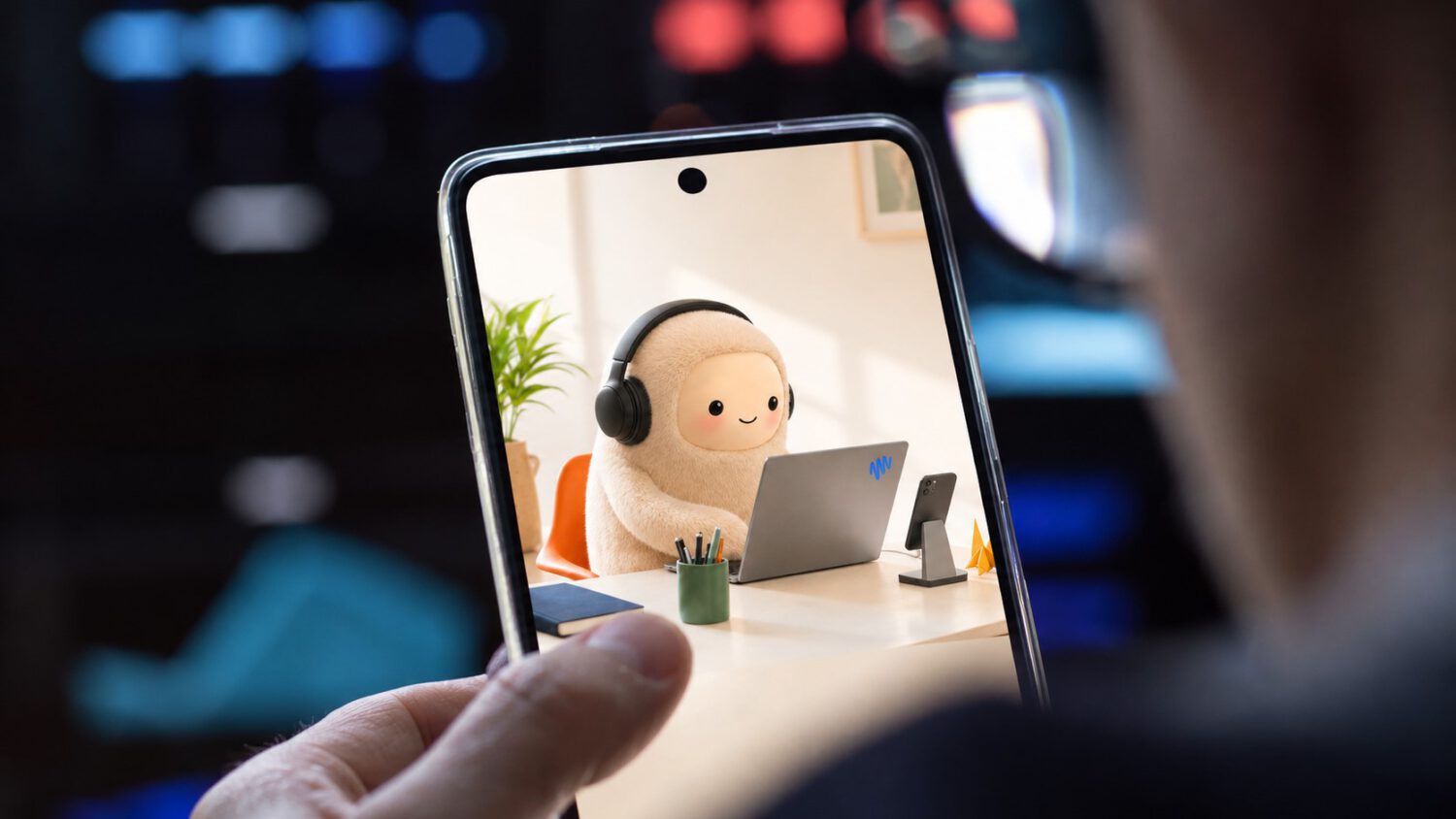
Real-time voice conversation with an animated AI character is now available to U.S. users through the Muse app. The feature launched November 5, 2026, when Meta announced Muse Realtime Voice and Muse Realtime Avatar. It is accessible on mobile, web and Mac, with conversations starting from the phone icon in the upper-right corner of the app.
Three Ways to Face Your AI
Muse supports voice-only interaction, an avatar displayed beside the conversation, or a full-screen face-to-face view.
The system is built for fluid exchange: Muse can respond while the user is still speaking and can be interrupted mid-answer. The avatar uses synchronized expressions and gestures designed to signal that Muse is actively listening and responding.
Meta’s default character has been nicknamed Jolly, though users can customize it into a person, animal or another character. Voice configuration options include preferred speed, style and accent.
A Dog That Monitors Your Meme Habits
Meta’s chief AI officer demonstrated the feature using a Muse configured as a fluffy white dog.
According to TechCrunch reporting, Alexandr Wang promoted the rollout on X, and in that exchange the avatar suggested he add disclaimers to memes that could be mistaken for official Meta endorsements. Wang is Meta’s chief AI officer.
Meta frames the feature as a more natural way to brainstorm, rehearse, plan and delegate tasks, reducing the need to compose carefully worded text prompts. That framing is a product-positioning argument; the visual avatar layer does not, by itself, change the quality of Muse’s answers.
From App to Glasses to Pocket Device
Voice conversations with Muse are planned for Meta’s Ray-Ban glasses and a forthcoming pocket-sized device called Muse Charm.
Muse Charm was previewed at Connect 2026 and is described as a pocket-sized device built around real-time voice interaction with Muse. Meta says additional details are coming later in 2026.
The sequence, establishing an AI persona in the app before extending it to wearables and dedicated hardware, reflects what appears to be a deliberate product strategy, though Meta has not explicitly described it in those terms.
What Meta Has Not Said
The official announcement leaves several questions about privacy and access unanswered.
Meta’s November 5 announcement does not address pricing, data retention policies, conversation review practices, parental controls or expansion beyond the United States. Those gaps are relevant for any user considering how much to share during a voice or video-style session with the platform.
A separate design consideration also warrants attention. Synchronized expressions and gestures may encourage users to attribute humanlike understanding or emotional awareness to a system that remains an AI model, a concern that becomes more pronounced when an agent has a face and responds in real time. Meta has not addressed that dynamic in its rollout materials, and it is a hypothesis rather than a proven outcome specific to Muse. Readers should watch for further details on Muse Charm, which Meta has committed to sharing before the end of 2026.