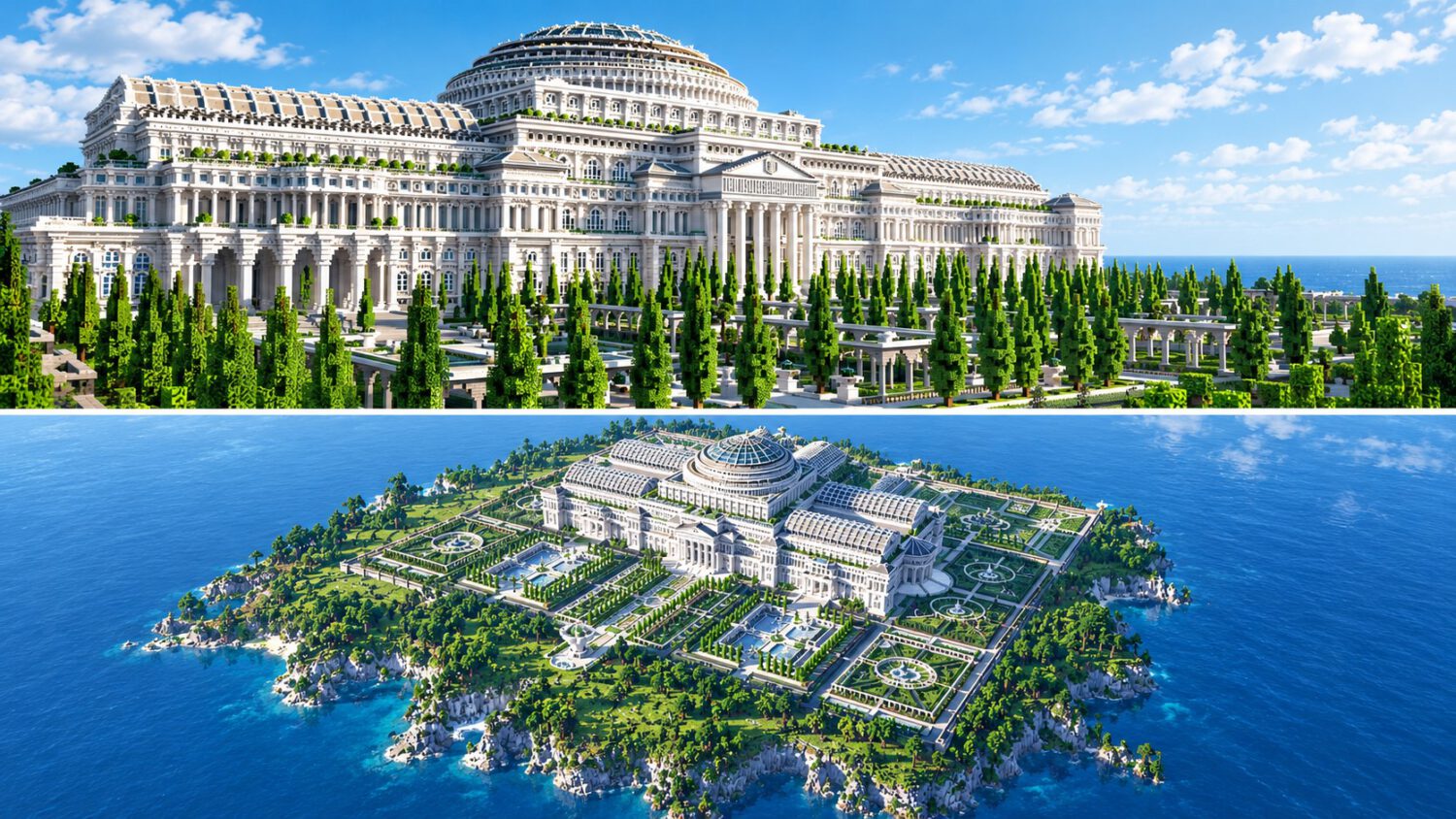
The Uncensored Library launched on March 12, 2020, World Day Against Cyber Censorship, created by RSF in partnership with Minecraft design collective BlockWorks. It returned to mass public attention in late September when Canadian creator Chloe Cotter posted a short video explaining the project; according to the supplied coverage, the video reached 3.7 million Instagram views and 1.7 million TikTok views within five days.
A Reading Room Built From Blocks
The library’s in-game books contain articles and other material about censorship and press freedom that authorities in various countries sought to suppress.
RSF and BlockWorks constructed a massive neoclassical virtual building where players navigate country-specific wings and read suppressed journalism through Minecraft’s in-game book mechanic. The collection spans roughly 300 books across twelve wings, available in English and, where possible, the journalist’s original language.
Original country rooms covered Mexico, Russia, Vietnam, Saudi Arabia, and Egypt. RSF later added Iran, Brazil, Belarus, and Eritrea.
In March 2026, RSF announced a United States room, documenting removed government websites, pressure on media organizations, and other developments the organization characterizes as threats to press freedom. The expansion reflects RSF’s position that press-freedom risks are not confined to states typically labeled authoritarian. A secretly tracking users scandal involving a White House app underscored how government data practices can intersect with press-freedom concerns.
Why a Sandbox Game Works Where a Website Doesn’t
RSF designed the library to use Minecraft as an alternative distribution channel that conventional website blocking might not target in the same way.
Website blocking is a commonly used censorship method in restricted information environments. Minecraft is an entertainment platform, and its game traffic may not trigger the same filters applied to known news domains , a dynamic familiar to those who have studied video games banned for their content in various jurisdictions.
RSF reinforced that approach by making the complete map available as a free download, so users can host and share independent copies beyond the original server. Multiple distribution points make the archive more resilient than a single URL, though access still requires Minecraft, compatible software, functioning internet, and the ability to reach the server or a copy of the map.
This is platform-based circumvention, not a guaranteed workaround in every restricted environment.
Five Million Views and a Bigger Point
A short creator video brought renewed attention to a five-year-old archive that millions of people had never encountered.
According to the supplied coverage, Cotter’s video highlighted the library’s architecture, its multilingual books, the downloadable format, and its continuing expansion. It connected with audiences who had never heard of the project despite its five-year existence.
This is not a fan build or a novelty recreation. The library includes reporting from journalists whose work authorities actively suppressed, and RSF’s current catalogue should be consulted directly to confirm specific journalists or publications represented. The 300-book archive represents years of curation by an organization that tracks journalist imprisonments, killings, and censorship actions globally.
.
The library is accessible through Minecraft’s multiplayer server and as a free downloadable map. RSF built it on the premise that censorship controls designed for the open web may not account for a block-building game where a virtual librarian hands you a banned newspaper. The map costs nothing to download. The reporting inside it cost its authors considerably more.