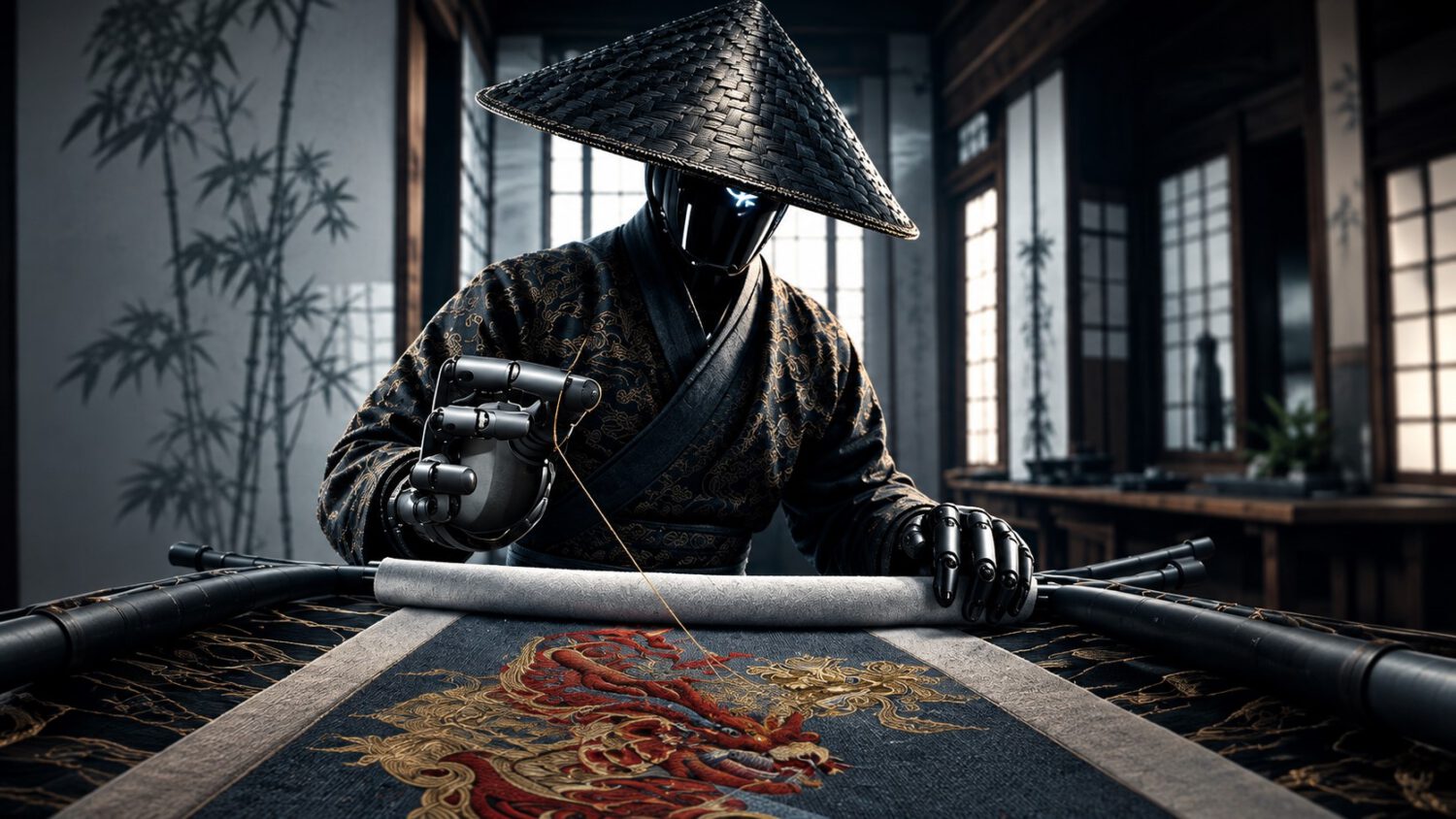
Silk does not cooperate. It bends, slips, and changes shape under the slightest variation in applied force, which is precisely why robotics engineers find it a demanding test material.
AGILINK, a Chinese robotics startup spun out of AgiBot, applied that logic when it demonstrated its OmniHand 3 Ultra performing foundational Suzhou embroidery techniques under instruction from embroidery master Fu Xianghong.
Threading the Needle, Literally
The demonstration walked through a sequence of foundational embroidery skills, each one exposing a different limitation of conventional robotic grippers.
The task sequence included dividing one silk thread into 16 finer strands, threading a needle, securing fabric in an embroidery hoop, twisting thread, and completing initial stitches.
Strand separation was the most technically telling step. One finger pulled individual strands apart while the remaining fingers maintained tension, preventing the silk from collapsing or slipping out of position.
Silk has no fixed rigid form, so the hand must continuously adapt force and finger placement rather than execute a preset motion. That kind of continuous adjustment is what separates deformable-material handling from standard pick-and-place robotics.
The demonstration also reportedly included a twist-and-pick-up movement where the thread landed in a different position each time, requiring the hand to respond to changing conditions rather than repeat an identical motion.
What the Hardware Is Working With
The OmniHand 3 Ultra combines a high degree-of-freedom direct-drive design with tactile sensing across the fingertips, finger pads, and palm.
AGILINK describes the hand as carrying 21 active degrees of freedom in a fully direct-drive architecture, meaning motors sit at the joints rather than pulling tendons through intermediate transmission systems. The company says this provides more responsive control with less mechanical complexity.
The hand is roughly human-hand-sized and weighs approximately 630 grams, according to reporting on the demonstration.
Each fingertip uses a vision-based tactile sensor that detects surface deformation and measures three-dimensional force. The palm adds a distributed contact sensor across a wider area.
According to AGILINK, the hand holds 3 kilograms steadily and lifts up to 8 kilograms. The company also claims actuation in approximately 0.3 seconds, positional repeatability of around 0.2 millimeters, and deformation sensitivity down to 0.08 millimeters. Every one of those figures is manufacturer-reported, not independently benchmarked.
Training combined teleoperation data, where a human operator guided the hand through tasks, with reinforcement learning to refine the resulting control policy.
What This Is, and What It Isn’t
The demonstration covered foundational steps and initial stitches, not a finished embroidery piece or an artisan-level result.
Available reports do not describe a completed embroidery artwork, and nothing in the footage establishes that the system can independently produce work comparable to Fu Xianghong’s own output.
A single controlled demonstration, however impressive the underlying hardware, does not confirm speed, reliability across sessions, or the ability to generalize to unfamiliar thread weights, fabric types, or task sequences.
That last question is the one worth watching. If AGILINK’s sensing and control stack can transfer from a controlled embroidery setup to varied materials and conditions, the implications reach well beyond silk.
Dexterous hands that reliably handle deformable materials could expand robotic use cases into textile manufacturing, light assembly, laboratory procedures, and logistics. Those are precisely the environments where today’s rigid grippers run out of answers. For now, the OmniHand 3 Ultra has demonstrated that it can manage one of the more demanding materials a robotics engineer could choose; generalizing that capability is the next, harder problem.