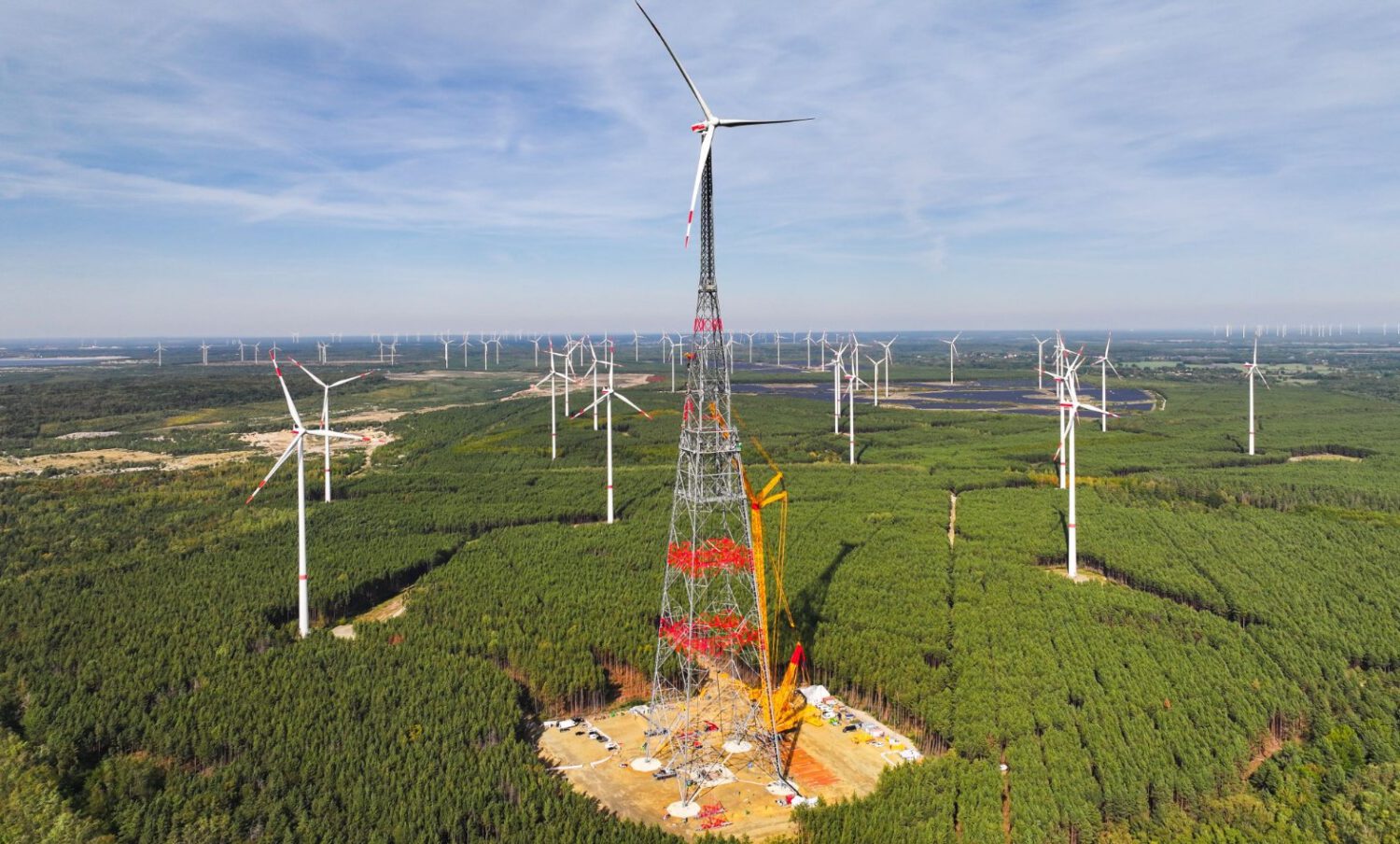
At 365 meters tall (roughly 1,197 feet), the GICON turbine in Schipkau, Brandenburg is now the world’s tallest wind-energy installation. It had not yet entered normal electricity demand as of its structural completion.
That gap between structural milestone and operational proof is the whole story.
German engineering firm GICON reached full structural height on September 28, 2026, on behalf of SPRIND, Germany’s federal agency for disruptive innovation. The turbine’s hub sits at 300 meters, making it Germany’s second-tallest structure overall, trailing only Berlin’s TV tower.
Built From the Inside Out
The turbine’s construction method is as notable as its height, relying on a self-contained telescoping system rather than cranes capable of reaching 300 meters.
Standard turbine installation depends on cranes that can reach the final hub height. At 300 meters, that becomes an engineering challenge most conventional cranes cannot meet.
GICON’s answer is a telescoping steel lattice tower: an inner tower section raised through a surrounding lattice structure and locked into position at its final elevation. The construction method is itself a central subject of the pilot, and its cost, reliability, and scalability under real operating conditions remain to be assessed.
The Performance Claim Worth Watching
The project’s core premise is that stronger, more consistent winds at altitude can meaningfully increase electricity output from the same rotor size.
The underlying premise of the entire project is that wind conditions improve with altitude. Stronger, more consistent winds at 300 meters could increase the turbine’s capacity factor, the share of its theoretical maximum output it actually produces over time.
GICON projects that a high-altitude turbine could generate roughly twice the electricity of a conventional turbine with the same rotor diameter. That figure is a projection, not a measured result, and you should treat it accordingly until commissioning data arrives.
The pilot turbine carries a rated capacity of 3.8 MW. GICON says future versions could exceed 7 MW, though that performance level has not been demonstrated in commercial operation.
High-altitude turbines could, in theory, operate as a second generation above existing wind farms. They would capture stronger upper-altitude winds while conventional turbines continue working closer to the ground.
According to a development estimate from the project team, Germany could accommodate up to 4,000 such turbines within existing wind-farm areas. That would reuse established grid connections without expanding into new land.
That figure is an estimate, not a deployment plan. Actual rollout would require permitting, aviation and radar clearance, safety assessments, and proof that the economics hold.
What November 2026 Actually Means
Reaching full structural height is a milestone, but commissioning data will determine whether the concept has a commercial future.
Reaching full structural height is not the same as flipping a switch. Final construction and commissioning work still lie ahead, with the official target set for November 2026.
If you want to know whether this concept has a commercial future, that is the moment to watch. The operating data that follows will show whether wind at 300 meters produces the energy gains GICON projects. It will also show whether those gains outweigh the added complexity and cost of building and maintaining a turbine taller than the Eiffel Tower.
The structure is already a record. Whether it becomes a model is a question the wind will answer.