Renewable energy has a timing problem. Wind blows when it wants. The sun doesn’t check your thermostat. The gap between when clean electricity is generated and when people actually need heat has derailed more climate plans than any politician. A 5,000-person Finnish town may have just fixed that — using crushed fireplace rock, basic physics, and a very large thermos.
How a Giant Thermos Beats the Grid
Pornainen’s sand battery is unglamorous, effective, and exactly what the grid needed.
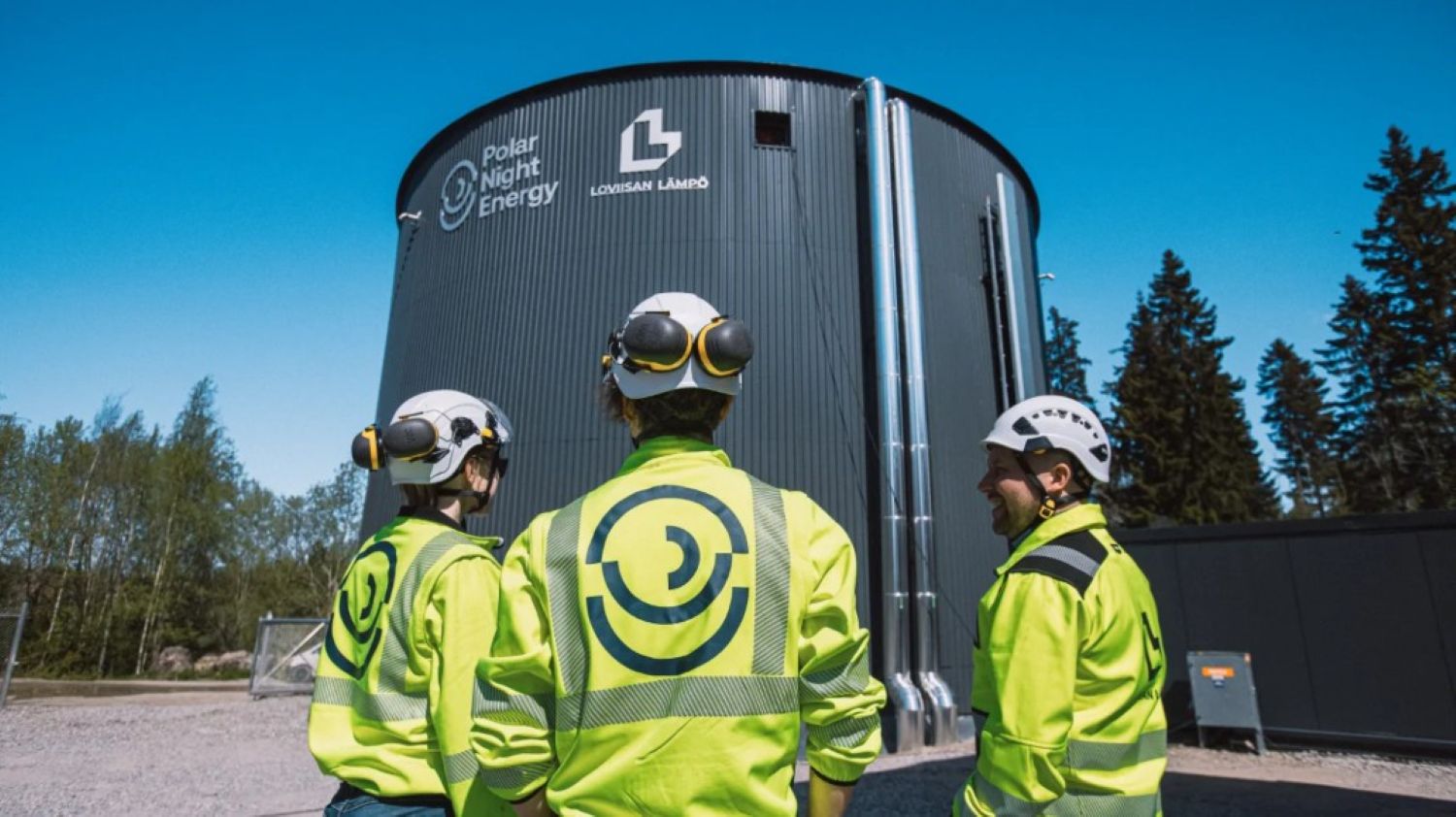
The system Polar Night Energy built for district heating operator Loviisan Lämpö is straightforward enough to explain at a bar. A steel silo — 13 meters tall, 15 meters wide — holds roughly 2,000 tonnes of crushed soapstone, a waste product from Finnish fireplace manufacturer Tulikivi. When wind and solar push electricity prices low on the Nord Pool market, the system charges: hot air heats the stone to hundreds of degrees Celsius. Heat exchangers later transfer that stored warmth to water circulating through Pornainen’s district heating network, serving the school, town hall, library, and homes. Thermal round-trip efficiency sits around 90%, according to New Atlas.
The numbers after one year of operation — commissioned June 2025 — are hard to argue with:
- 100 MWh storage capacity, 1 MW thermal output
- Covers up to one month of summer heating demand; roughly one week in winter
- Greenhouse gas emissions from district heating cut by approximately 70%
- Wood chip use down about 60%; oil eliminated from normal operations
“We need a massive amount of storage” as wind and solar replace centralized fossil plants, Polar Night Energy CEO Tommi Eronen told CNBC, arguing sand batteries could cover “a big portion” of that demand without rare earth materials.
The Business Logic Is Almost Offensively Simple
Buy cheap electricity, store it as heat, deliver warmth later — Costco bulk-buy logic applied to kilowatt-hours.
Loviisan Lämpö buys electricity when renewable output floods the market and prices drop. Store it as heat. Deliver warmth when producing it from the grid would cost significantly more. CEO Mikko Paajanen told CNBC that time-decoupling — separating when you buy electricity from when you deliver heat — is the core commercial advantage. No lithium. No cobalt. Just soapstone, a manufacturing byproduct repurposed at industrial scale.
Jan Rosenow, a professor of energy and climate policy at the University of Oxford, notes that electro-thermal storage like this can hold energy for days or weeks, versus lithium-ion’s typical 2–4 hours, while avoiding critical raw materials entirely, per CNBC.
The Catch – and Why It Still Matters
Sand batteries won’t charge your EV, but they will heat your town.
There are real limitations worth naming. Converting stored heat back to electricity is inefficient and technically complex — sand batteries are heat-first tools, not universal grid solutions. Energy density is lower than electrochemical alternatives. They need space and work best where district heating networks already exist. This technology won’t fix your apartment building’s energy setup or replace short-duration grid storage.
But for cold-climate municipalities currently burning oil and wood chips? It’s the right tool in exactly the right place. Polar Night Energy reports inquiries from teams on every continent, particularly from coal and oil-dependent communities. Finland’s Climate Minister Sari Multala called the project “very inspiring,” per CNBC, noting exploratory work around potential future electricity applications — though those remain unconfirmed. The most scalable climate solution around right now might genuinely be a very large, very hot pile of rocks.