If you’ve ever handed a child a conventional smartphone and immediately regretted it, Freckle is positioning itself as the alternative. The startup is building a connected phone for kids ages 7 to 13 that removes the browser, app store, social media, and YouTube entirely, replacing them with communication tools and outdoor exploration features. It ships in December 2026.
What It Does, and Deliberately Doesn’t
Freckle’s custom ClayOS leaves behind a communication and exploration device by stripping out the open internet entirely.
ClayOS, the operating system Freckle built for the device, is its defining feature. There is no app store, no open browser, no TikTok, and no late-night YouTube rabbit holes.
What remains is deliberately narrow. Children can call and text, but only contacts a parent has approved, according to Freckle’s product page. Parents can reportedly track their child’s location on a map, with safe-zone alerts notifying them when a child leaves a designated area.
Tap to Pay is built in. Parent-set spending limits give kids a controlled way to buy something at a corner store, without access to a full payment account. Two Freckle phones bumped together reportedly activate a walkie-talkie mode, the kind of low-friction, physical interaction that fits a device designed for kids who are actually outside together.
Pushing Kids Toward the World
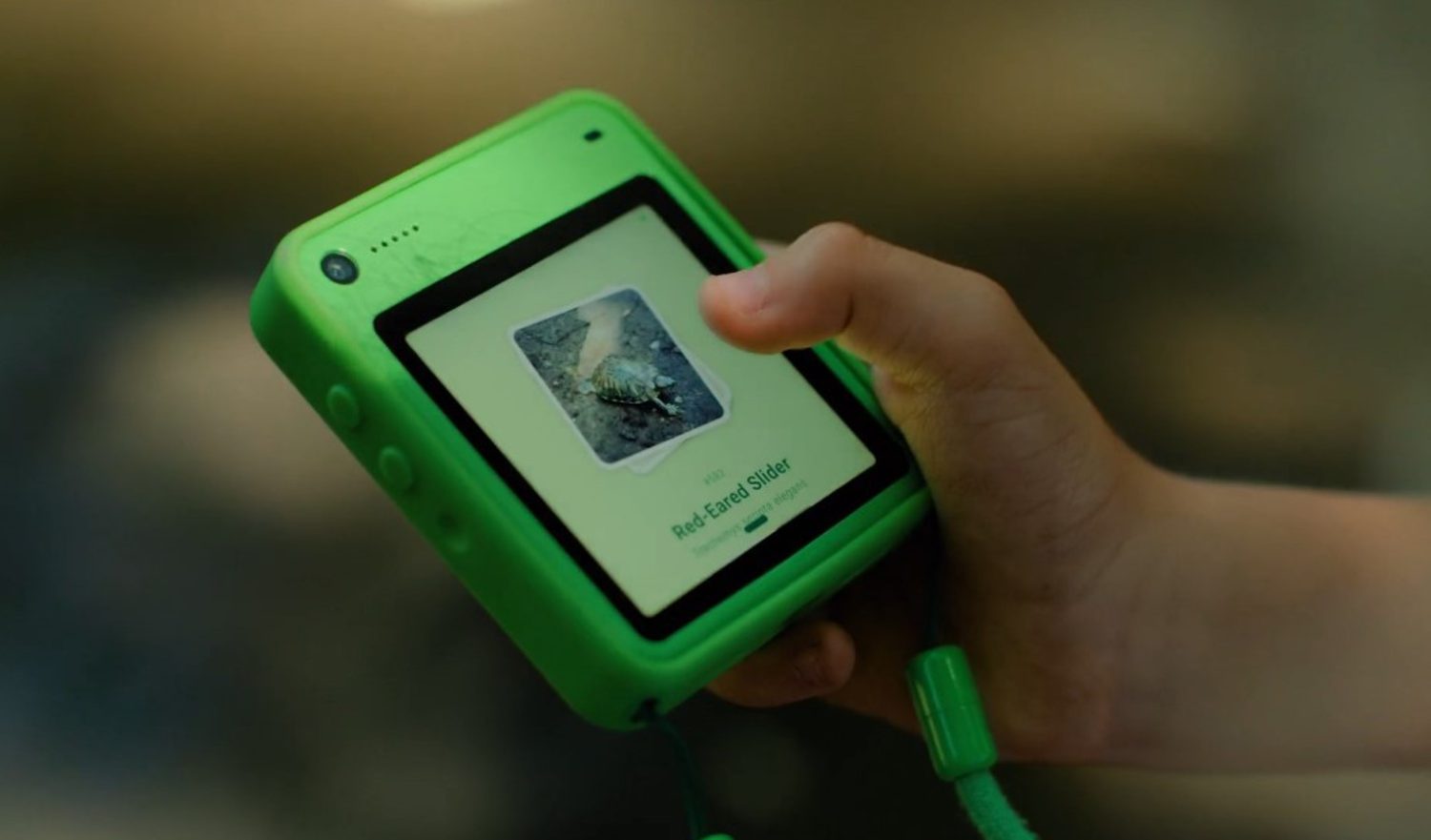
Freckle’s Discovery Camera, Quests, and walking-oriented maps are designed to make the phone a reason to go outside, not a reason to stay in.
The Discovery Camera is built to identify bugs, birds, and plants encountered during outdoor activity, per The Verge and Fast Company. Quests function as scavenger-hunt-style missions that encourage kids to explore their neighborhoods and surroundings.
Maps are oriented around walking, biking, scooters, and skateboards rather than car travel, reinforcing the product’s emphasis on local, independent exploration. A feature called Why Chat offers AI-assisted answers to kids’ questions. Its accuracy, content safeguards, and handling of sensitive topics are unverified pre-launch. These should be treated as open questions until independent testing is available.
Whether that design philosophy governs every hardware decision or primarily shapes the marketing language will not be clear until the device ships and reviewers can test it.
What It Costs and What’s Still Unknown
At $199 plus $25 per month, Freckle asks families to commit to a purpose-built concept before any independent review exists.
The device costs $199, with cellular service running $25 per month, according to Engadget. Reddit co-founder Alexis Ohanian’s venture firm Seven Seven Six has invested in the company, though terms and amounts were not disclosed in available reporting.
No independent hands-on testing was identified in the available research. Battery life, durability, cellular reliability, camera accuracy, and parental-control performance are all unconfirmed. The product has not shipped.
The recurring monthly fee may make the value harder to justify for families who could apply similar communication controls on an existing parent-managed device. That comparison is worth considering before you commit to a preorder.
Freckle is accepting preorders now for its December 2026 ship date. The concept is clearly defined. Whether the execution matches it is a question only the finished product can answer.