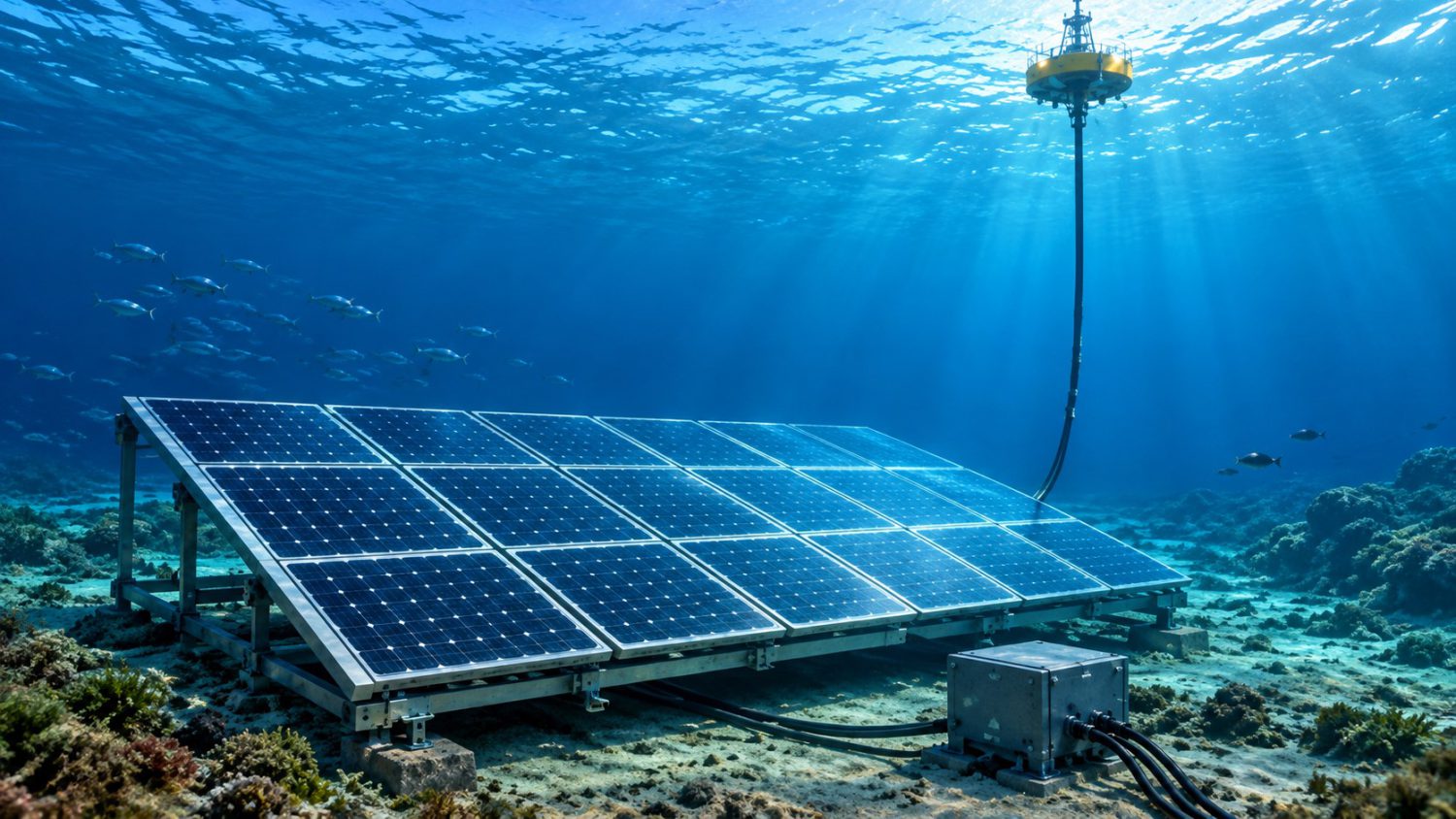
Three stories of ocean above you, and a solar panel still works. Researchers from Yunnan University and the Southwest United Graduate School demonstrated perovskite-based solar cells operating at approximately 10 meters underwater in the South China Sea, according to findings published in the journal Joule on September 11, 2026.
The result is a research milestone, not a commercial product. It addresses a persistent engineering problem: underwater equipment is costly to retrieve, and battery life imposes a hard operational ceiling.
Why Conventional Solar Fails Underwater
Seawater filters sunlight aggressively, leaving only the wavelengths that silicon cells are least equipped to use.
Seawater attenuates red and infrared wavelengths strongly within the first few meters, leaving primarily blue and green light at depth. Standard silicon solar cells are optimized for surface sunlight, not for that narrow filtered spectrum.
Perovskites change that equation. Think of them as solar cells that can be compositionally adjusted to target a specific slice of the light spectrum, making them a better match for the light environment at 10 meters down.
What the Test Actually Showed
The cells reached nearly 35% efficiency under simulated underwater light, more than double their performance under ordinary surface conditions.
Under laboratory conditions simulating the spectrum at 10 meters, the cells reached a power-conversion efficiency of 34.71%, according to EurekaAlert. The same cells achieved roughly 17.08% efficiency under ordinary terrestrial-light conditions, illustrating why matching the cell to its environment matters.
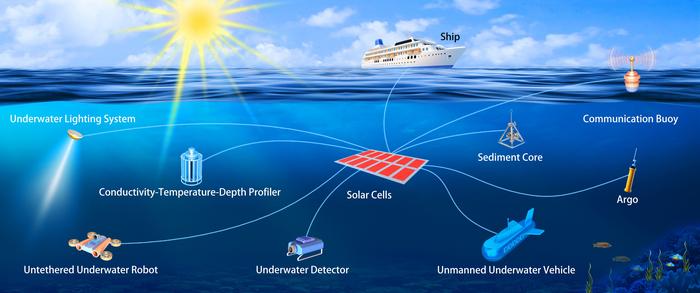
Credit: Simin Ma, Yunnan University
In the two-hour open-water field test, the modules produced 324 milliwatt-hours at 10 meters. Output climbed to 752 milliwatt-hours at 6 meters and 1,416 milliwatt-hours at 2 meters. That gradient tracks the expected reduction in available light with depth.
The modules themselves were small, roughly 115 square centimeters. The energy produced was sufficient to charge lithium-ion batteries and power LED equipment, not large underwater infrastructure.
Lab durability testing showed the cells retained near-full performance after 1,160 hours of simulated underwater exposure. A separate storage test, conducted in a controlled nitrogen-filled environment rather than open water, found approximately 96% efficiency retained after 300 days. The researchers projected an operational lifespan of roughly 5.5 years at 10 meters, based on their test assumptions, not a demonstrated open-sea deployment.
What This Could Actually Power
The most credible near-term applications are small autonomous devices that currently depend on expensive battery retrieval cycles.
The realistic near-term targets are devices already operating underwater on limited power budgets: sensors, inspection robots, environmental monitoring systems, cameras, and autonomous marine vehicles. Previous underwater photovoltaic work generally focused on depths of around 2 meters or less, according to the researchers, making 10 meters a meaningful step forward.
Autonomous underwater vehicles could eventually use this kind of local energy harvesting to extend mission duration. That potential remains speculative until the technology is tested over longer periods in open-water conditions.
What This Is Not Yet
A two-hour test with small experimental modules leaves substantial engineering questions unanswered.
The field test lasted two hours, and the modules were small and experimental. Scaling to more demanding operations would require larger arrays, robust waterproof encapsulation, and corrosion resistance. Managing biofouling, the marine growth that accumulates on submerged surfaces, would need its own mitigation strategy.
Water clarity, currents, weather, and seasonal light variation would all affect real-world output. The two-hour trial could not capture that range of variables. No commercialization timeline or investment announcement has been confirmed.
If the durability projections hold at larger scale and in sustained open-water conditions, the underwater devices you send on timed battery missions could eventually carry their own power source. That shift would push the operational boundaries of autonomous systems considerably further than a cable or a battery swap currently allows.