In a Harvard introductory physics experiment, a custom AI tutor produced more than twice the learning gains of a research-backed active-learning classroom in less time. That result deserves attention. The extrapolations spreading across the internet deserve scrutiny.
This was not ChatGPT versus a drowsy 8 a.m. lecture. Harvard researchers Gregory Kestin, Kelly Miller, and colleagues pitted a purpose-built pedagogical system against one of their own active-learning courses, a format already considered best practice in education research. The study was published in Scientific Reports in 2025.
The experiment enrolled 194 undergraduates in Harvard’s Physical Sciences 2, an introductory physics course for life-science majors. Using a randomized crossover design, students experienced both conditions across two consecutive weeks, covering surface tension and fluid flow. One group attended the active-learning class first while the other completed the AI-supported lesson at home; conditions reversed the following week.
What the Numbers Show
The core findings favor the AI condition on both learning gains and time, according to the Scientific Reports publication.
Students using the AI tutor recorded a median post-test score of 4.5, compared with 3.5 for the active-learning classroom, against a combined pre-test median of 2.75. Median time on task also favored the AI condition: approximately 49 minutes versus 60 minutes for the classroom lesson.
The study’s own framing describes median learning gains with the AI tutor as more than twice as large as those in the classroom condition. A “30% higher” figure circulating in coverage refers to a specific comparison within the data, not a universal result across every assessment in the study.
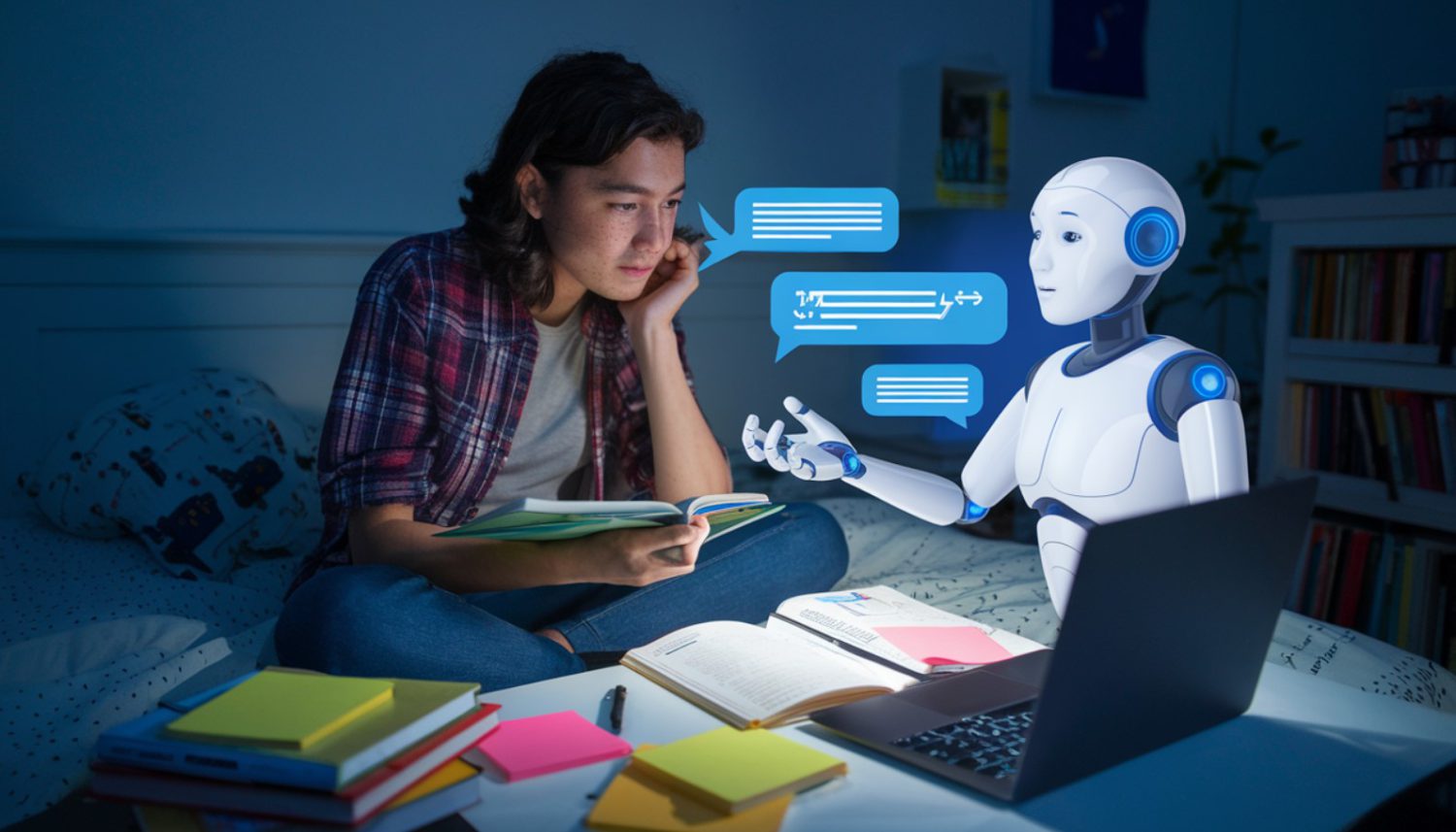
The design of the tutor is central to understanding the result. This was not a general-purpose language model students could prompt-engineer into giving them answers. The system used guided questioning, targeted explanations, and reasoning checks built around established learning science for this specific course.
[Pull quote placeholder: Editor to source a direct verbatim quote from the published Scientific Reports study or Harvard Gazette coverage before publication.]
What the Study Does Not Prove
The experiment’s scope is narrow, and its findings do not extend to the broader functions or value of a university education.
The study measured short-term learning on two physics topics in one course at one institution. It did not evaluate laboratories, research mentorship, peer networks, credentials, long-term retention, or the other functions universities perform.
The results also do not establish whether outcomes would transfer across disciplines, student backgrounds, age groups, or institutions beyond Harvard. Replication across those variables is the necessary next step, not a policy conclusion.
Claims circulating online that universities’ competitive advantages have essentially evaporated are an interpretation, not a finding the study tested or established. The research challenges the assumption that a physical classroom is always the most efficient delivery mechanism for introductory content. That is a meaningfully different, and more defensible, claim.
What the study demonstrates is something both specific and significant. One-to-one instruction, delivered well, measurably improves learning outcomes in this physics context, and a carefully designed AI system can now approximate that experience. Whether universities treat that finding as a threat or a tool is an institutional question the data does not answer. What changes from here depends less on the technology than on who decides to apply it.