Nobody expected the early universe to be full of tiny red dots. When NASA’s James Webb Space Telescope began returning deep-field images, it found a population of compact, intensely luminous red objects that many earlier models had not reproduced. Now a research team led by Vasily Kokorev at the University of Texas at Austin has produced the deepest spectrum reported to date for one of these objects, and the data point firmly toward a supermassive black hole actively feeding inside a dense cocoon of gas.
A Black Hole Wrapped in a Gas Cocoon
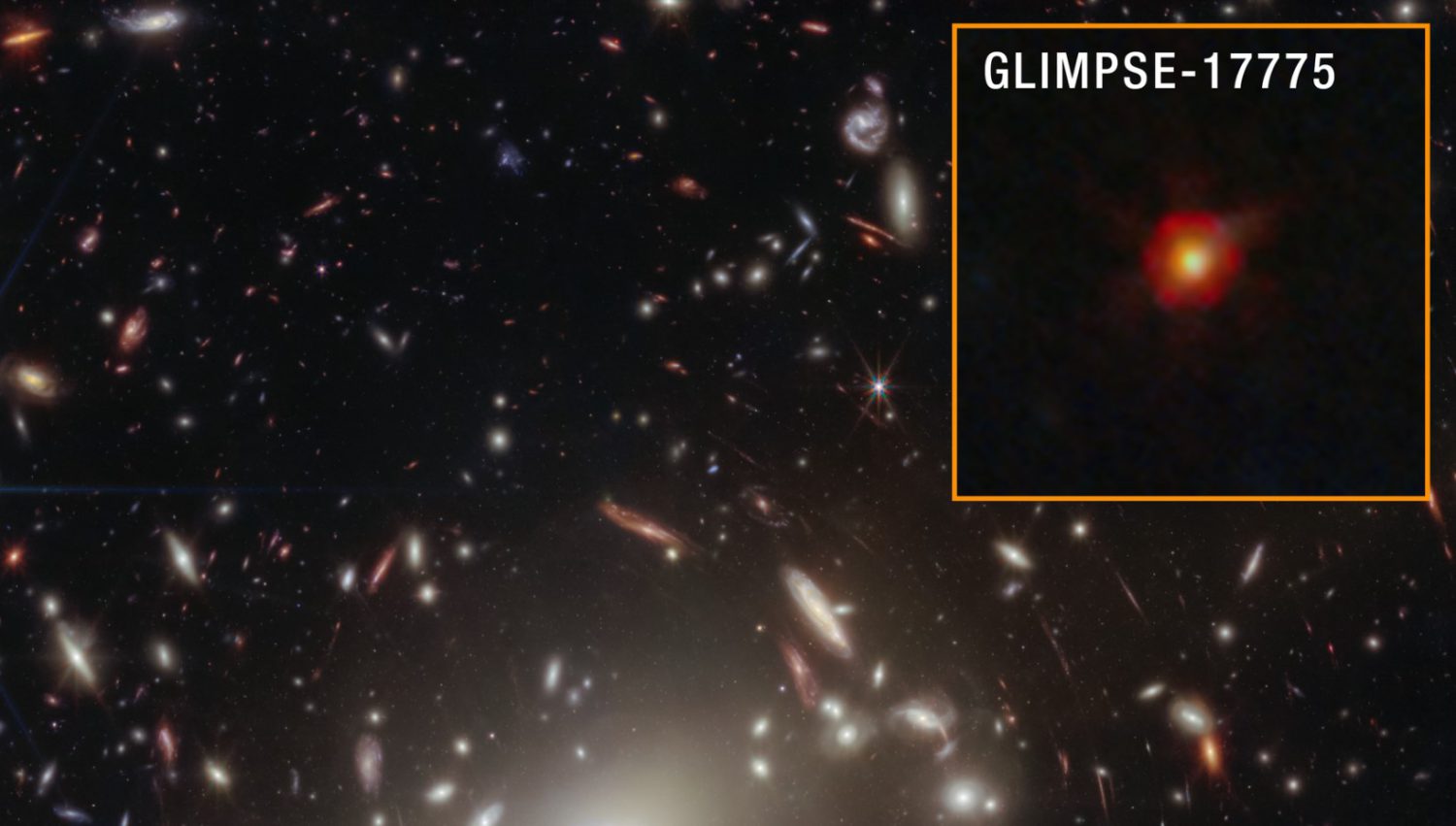
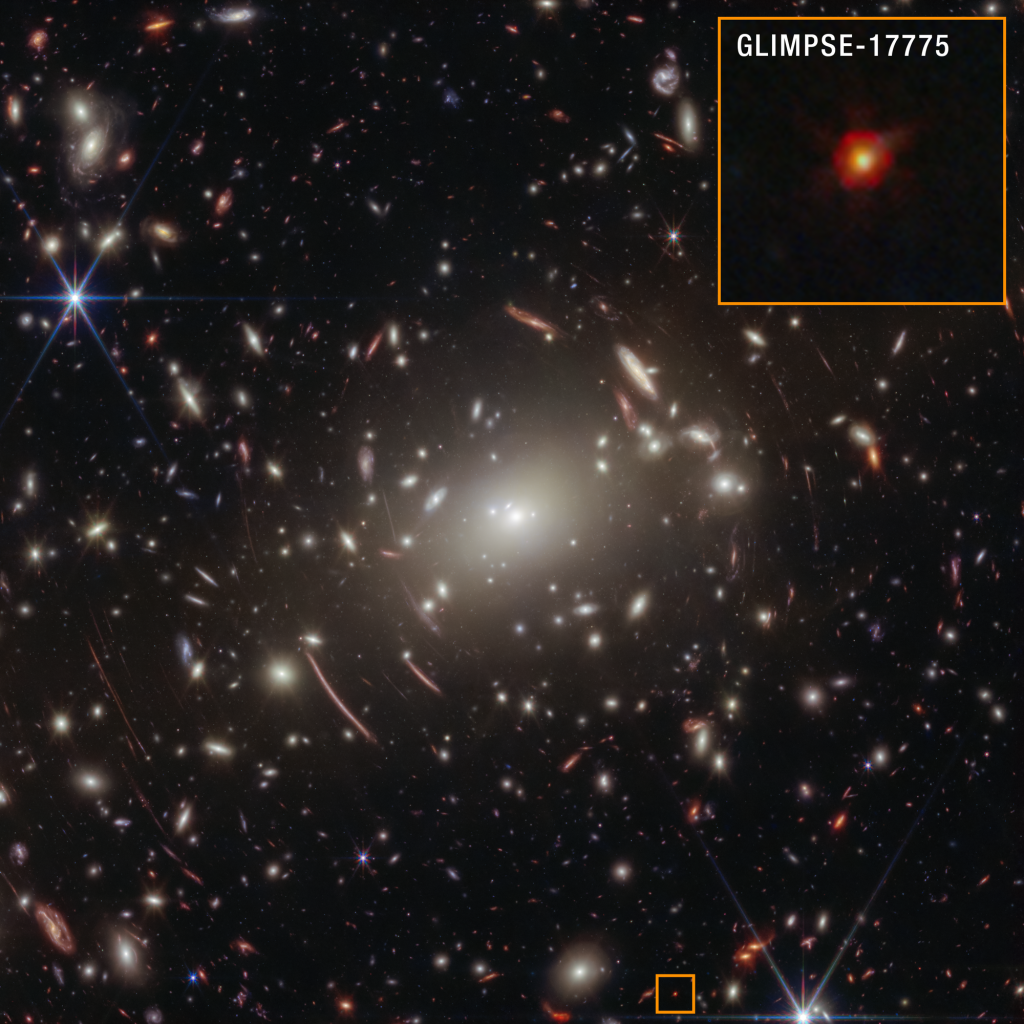
The gravitationally lensed object GLIMPSE-17775 gave astronomers an unusually detailed look at one of the universe’s most confusing light sources.
The object in question, GLIMPSE-17775, sits behind the galaxy cluster Abell S1063. That cluster’s gravity bent and amplified the object’s light through a process called gravitational lensing, turning the cluster into a natural magnifying glass. According to the study, published in The Astrophysical Journal, the program involved about 30 hours of Webb observing time, including roughly 20 hours of NIRSpec spectroscopy; after correcting for lensing magnification, that spectroscopic exposure corresponds to about 80 hours of unlensed observing.
The spectrum contained a complex mixture of emission and absorption features. Those features point to a rapidly accreting supermassive black hole at a redshift of approximately 3.501, placing the object roughly 1.8 billion years after the Big Bang. In this model, a dense, partially ionized gas cocoon surrounds the black hole and reprocesses its radiation. The whole system then appears compact and almost star-like from a distance.
The label “black hole star” describes this appearance, not a settled physical classification.
Why These Objects Broke the Models
Little red dots appeared in numbers that many earlier models did not reproduce, with properties that refused to fit familiar categories.
Before JWST, no major telescope had encountered a population like this. Their compactness, extreme luminosity, and spectral mix challenged the standard categories astronomers use for high-redshift objects. That mix partly resembles ordinary stars and partly matches signatures from active black holes, defying easy classification. Researchers at the Max Planck Institute for Astronomy, the Institute of Science and Technology Austria, and the University of Hawaiʻi are among the collaborators working to resolve what these objects actually are.
The brightness of some LRDs created a specific problem. Treated as ordinary galaxies or stellar systems, certain objects appeared far too massive to have assembled so soon after the Big Bang under standard cosmological models. The black-hole-cocoon interpretation addresses this by attributing the luminosity to rapid accretion rather than to an enormous underlying population of stars.
Still, GLIMPSE-17775 is one object. Its spectrum supports the cocoon model for that specific source, but it does not confirm that every little red dot shares the same structure. Competing hypotheses, including unusual stellar systems and configurations related to globular-cluster formation, remain under active investigation.
Broader JWST surveys and next-generation telescopes will need to test whether the black-hole-star model holds across the full population, or whether “little red dots” turns out to be an umbrella term covering several physically distinct classes of objects. Either outcome would sharpen the picture of how the universe’s largest black holes assembled so quickly in cosmic history.