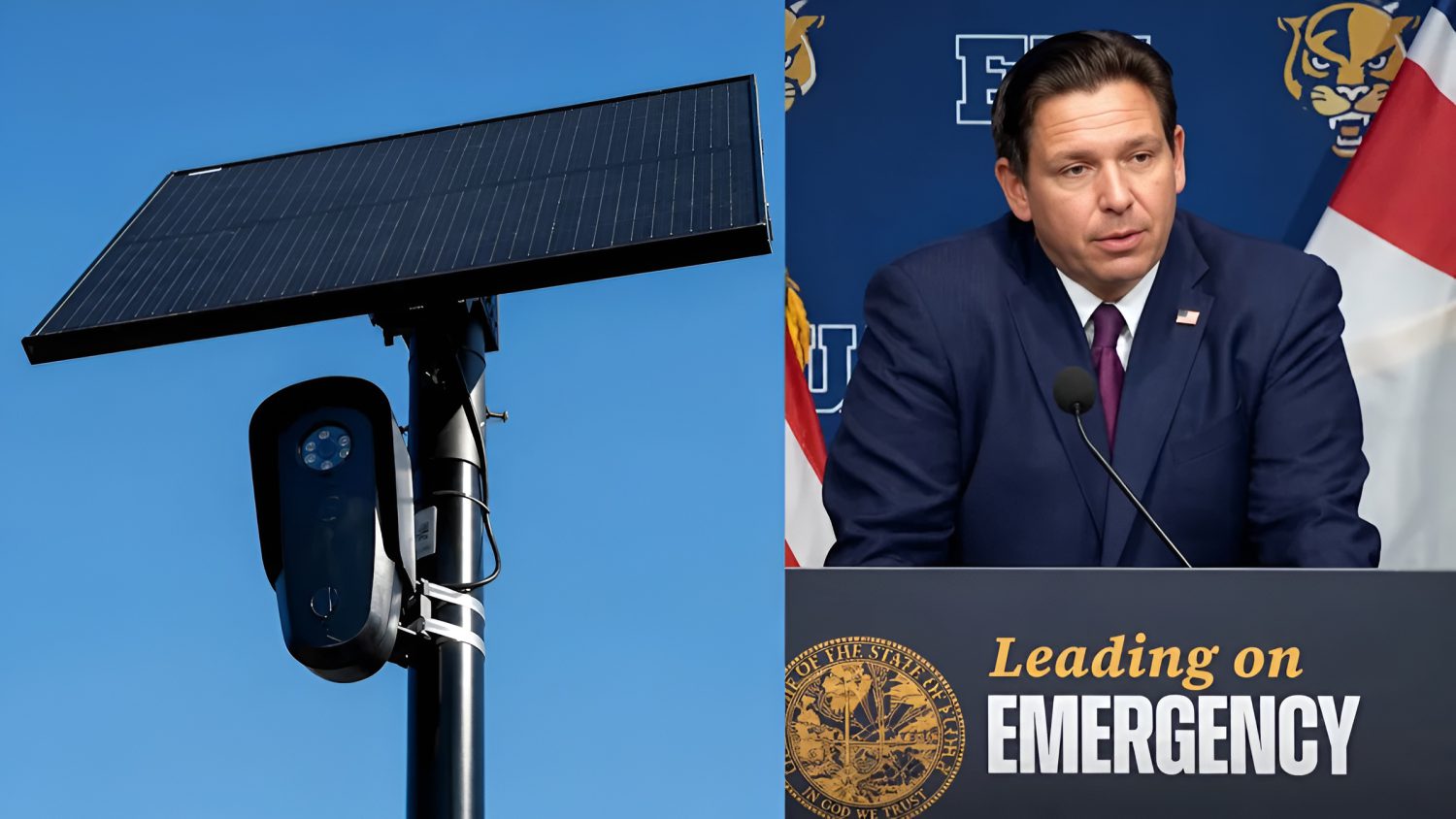
Every time you drive past one of those pole-mounted cameras on the highway, it’s logging your plate, your car color, your bumper stickers, and exactly where you were — much like the surveillance app built to covertly track political dissidents across North America. In most jurisdictions today, police can query that data without a warrant. Former Pentagon AI policy director Mark Beall wants you to know that’s not a hypothetical privacy concern — it’s already happening at scale. “We have to be careful that we don’t go too far to the other direction and create a China-like surveillance state, which is literally what AI capabilities will ultimately enable and are enabling right now,” Beall said on Fox News’ “Saturday in America.” Florida just pulled roughly 700 cameras off state highways. Lawmakers are splintering. The company at the center is scrambling to self-regulate.
How These Cameras Actually Work
Here’s what Flock Safety’s system captures, stores, and hands over — and what’s changed under pressure.
- Flock Safety‘s pole-mounted readers scan license plates, vehicle make, color, bumper stickers, and time-stamped location data on vehicles passing within the camera’s field of view
- That data uploads to Flock’s cloud and becomes searchable by law enforcement — in most jurisdictions, secretly tracking users without a warrant under current U.S. legal standards, though emerging court rulings are beginning to challenge that norm
- Default retention ran 30 days until public pressure forced a reduction to a seven-day default, though agencies can still configure longer storage periods
- Flock’s Audit Assistance system — now mandatory for law-enforcement customers — flags abnormal queries: off-duty officer searches, repeated plate lookups, and pattern deviations; most searches must also be tied to a case code
- Flock CEO Garrett Langley acknowledged the accountability gap plainly, per TechCrunch: “Today, it is too often that in Flock and in other technologies, there’s no regulation. There’s no accountability, and we think that’s wrong.”
China runs facial-recognition networks integrated with behavior profiling and centralized state databases. The U.S. isn’t there — but Beall’s warning isn’t about ideology. It’s about architecture. Continuous movement tracking, centralized data aggregation, AI-driven pattern analysis, minimal judicial oversight. Those structural features are converging here. The Constitution still exists. The question Beall is raising is whether the technology erodes its protections in practice before the law catches up — the digital equivalent of a slow-moving terms-of-service update nobody reads until something goes wrong.
“What we don’t want in the state of Florida is to have a digital AI surveillance state where everything we’re doing is being tracked at all times.” — Gov. Ron DeSantis, August 31, 2026
On that same date, Florida’s Department of Transportation revoked all ALPR permits on state highways, ordering removal of those 700 cameras within 30 days and citing an “exponential increase” in deployments and documented misuse. DeSantis put it plainly: if you want to drive to a store, “it’s really none of the government’s damn business.” Worth noting — the ban covers state highways only. County roads and city streets remain wide open. Some communities haven’t waited for legislation; they’ve physically destroyed camera poles in protest — a dynamic that mirrors San Jose’s Flock problem and the grassroots resistance it has inspired.
Where This Goes From Here
The legislative response is bipartisan, fragmented, and moving fast — with no clear consensus on what comes next.
Sen. Bernie Sanders calls for an outright ban; Rep. Tim Burchett wants federal installation funding cut. Beall occupies a middle ground, advocating regulated deployment with mandatory court oversight rather than prohibition — and explicitly acknowledging that the technology does help solve stolen-vehicle cases and locate missing persons. The cameras aren’t disappearing. The rules governing them are being written right now, largely without public input, and the outcome will determine whether your daily commute stays your own business.