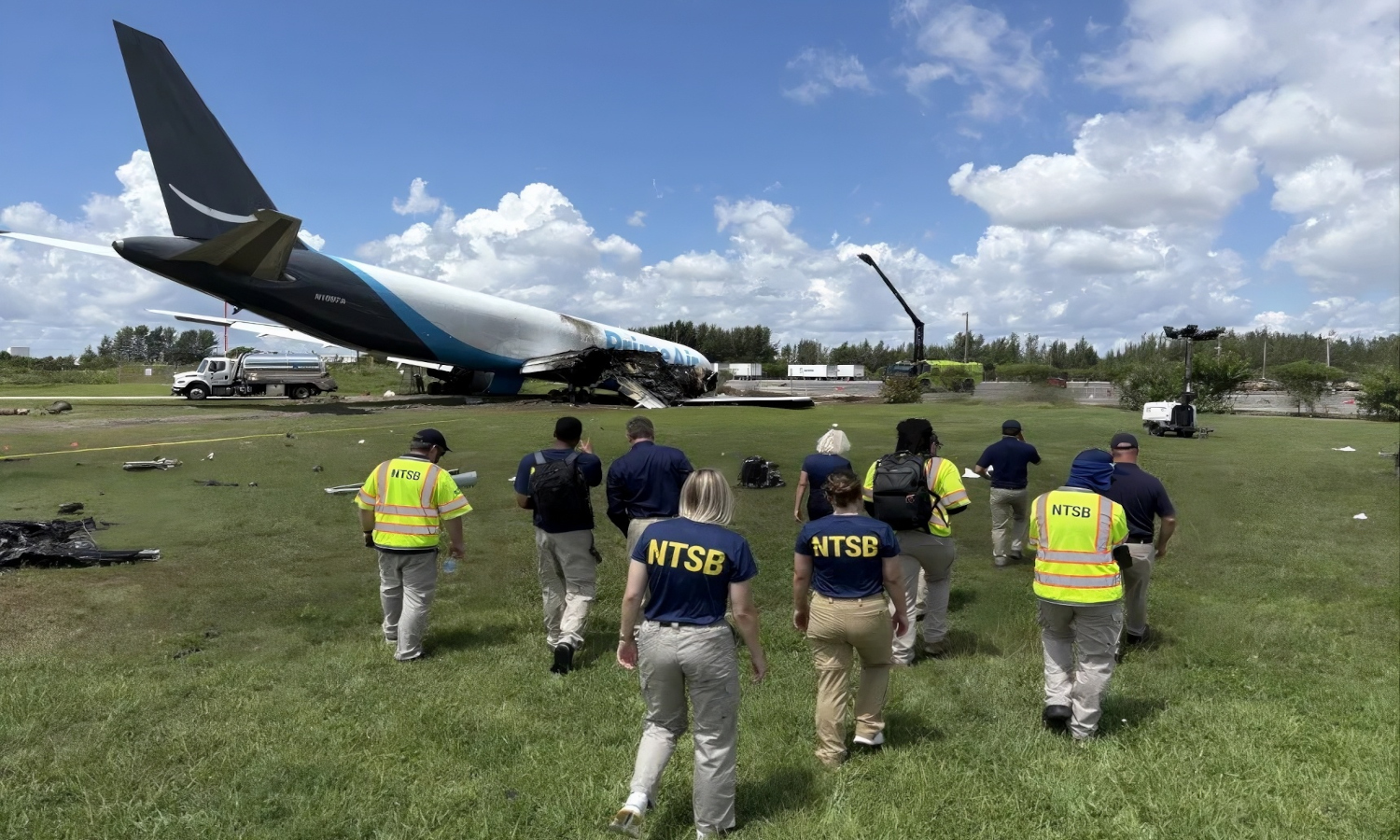
A truck driver near Miami International Airport heard a boom, then felt an explosion shake the lanes just feet from where he was sitting. What followed was a cargo plane — Amazon Air markings still visible through the smoke — burning in a field off Runway 30.
21 Air Flight 7598, inbound from San Juan, Puerto Rico, overran the runway at approximately 2 p.m. on September 6, crossed into a roadway, struck multiple vehicles, and caught fire. Five people were killed. Five others were hospitalized — three in critical condition, two with less severe injuries. Both pilots survived, rescued by firefighters from a trapped cockpit.
200 Firefighters, One Burning Runway, Open Questions
The scale of the emergency response reflected the severity of what unfolded at the runway’s edge.
Miami-Dade Fire Rescue deployed approximately 200 firefighters and more than 60 units to battle simultaneous fires in the aircraft’s engine compartments and the struck vehicles. Fire Chief Raied Jadallah confirmed that victims were trapped in vehicles and required specialized technical rescue teams for extrication. Authorities have not released the identities of those killed, and it remains unclear how many fatalities occurred on board versus on the ground.
The essential facts:
- The aircraft was a Boeing 767-300 freighter, registration N1997A, 32 years old and converted from passenger use in 2015
- Operated by 21 Air — a North Carolina and Miami-based carrier flying under Amazon Air/Prime Air branding
- Flying a route from Luis Muñoz Marín International Airport in San Juan to Miami
- The crash triggered a full airport ground stop, delayed roughly 250 flights, and forced the closure of all four runways before two reopened by approximately 5 p.m.
Amazon described itself as “heartbroken” at the loss of five lives and pledged full cooperation with investigators. 21 Air CEO Keith Winters said the company was “devastated” and confirmed it is working with federal authorities. Both companies issued statements expressing grief and pledging cooperation with federal investigators. The identities of those killed have not yet been released.
Old Plane, Missing Safety Feature, Familiar Grief
Federal investigators are examining every factor — mechanical, environmental, and structural — while cautioning against early conclusions.
The FAA confirmed the overrun and launched an investigation. NTSB Chair Jennifer Homendy is dispatching a team to examine mechanical factors, environmental conditions, runway configuration, and crew performance. No cause has been established, and officials are urging against speculation.
According to CNN’s reporting on the crash, aviation experts noted that MIA lacks a specific runway-end safety feature that could help prevent aircraft from crossing into a public roadway during an overrun — an infrastructure question the NTSB will almost certainly examine.
The crash draws an uncomfortable parallel to the Fine Air cargo accident near MIA nearly 30 years ago, which also killed five people in a cargo flight gone wrong at the same airport. Fine Air Flight 101 in 1997 involved a DC-8 that crashed shortly after takeoff due to mis-loaded cargo — a different failure mode, but the same grim casualty count and the same airport. History doesn’t repeat precisely, but the parallel is hard to ignore.
The Logo and the Distance Behind It
The aircraft carried Amazon branding; the operator was a contractor — a distinction that matters legally, far less so to anyone watching the footage.
Amazon’s logistics network — the infrastructure behind rapid delivery promises — stays largely invisible until something goes wrong. This is one of those moments. The NTSB investigation will take months, and any safety recommendations on runway-end infrastructure or cargo contractor oversight will follow only after findings are released. Five people are dead on a road next to an airport, and the name on the plane belongs to a company that didn’t fly it.