February 29, 1968. A teenager at Cupertino Junior High leaves a handwritten note for science fair judges explaining how to operate his demonstration circuit. He reminds them — twice — to “please unplug” everything when they’re done.
That’s not mythology. That’s a kid who understood that leaving circuits powered too long burns out components.
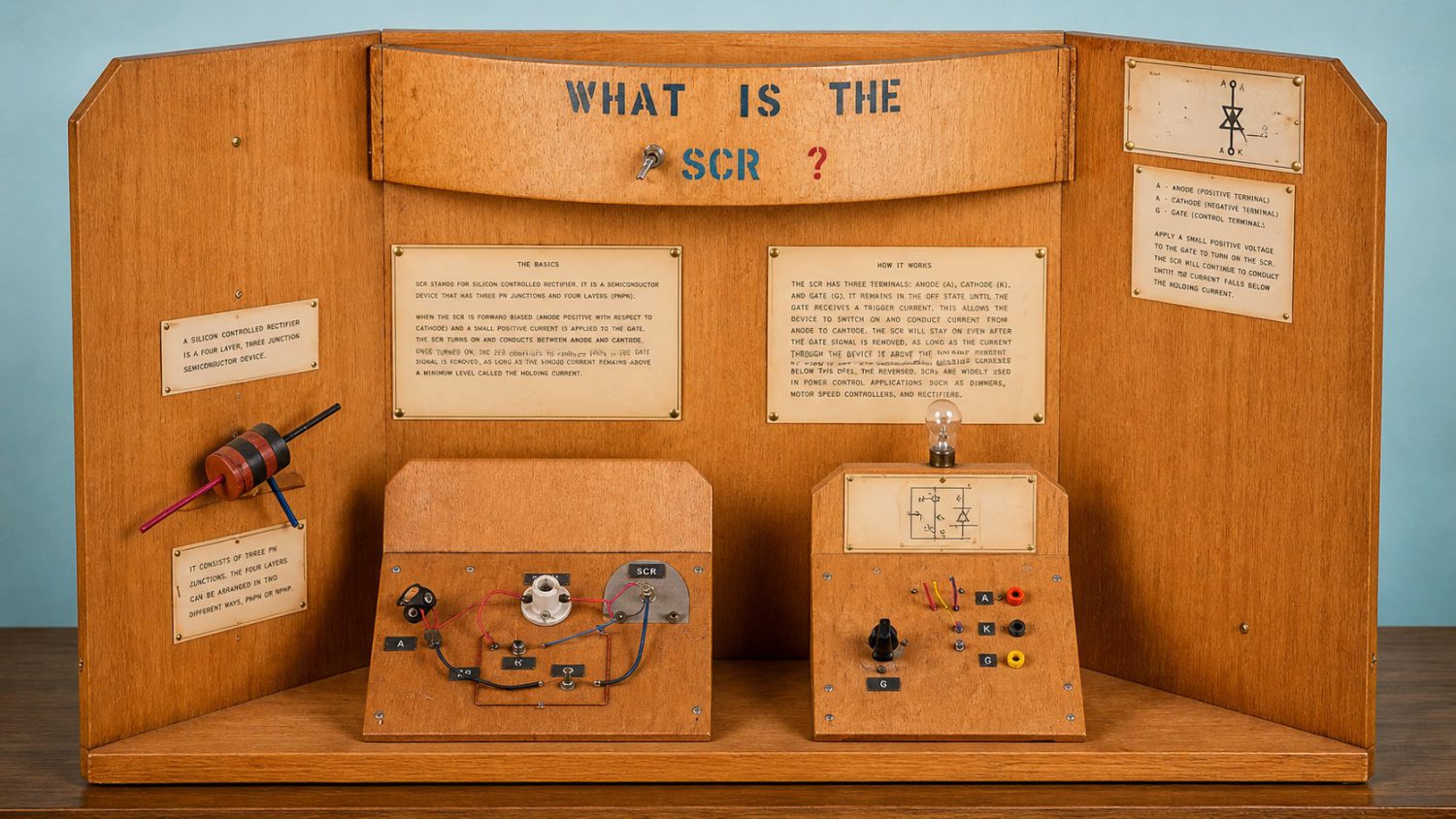
The project, titled “What Is the Silicon-Controlled Rectifier?”, is now heading to auction as part of RR Auction’s “Steve Jobs & the Computer Revolution: Apple 50th Anniversary Auction (Part Two),” closing August 20, 2026. It’s been sitting at the Jobs family property in Los Altos for nearly 60 years.
What Jobs Actually Built
Plywood, Hand-Drawn Diagrams, and Serious Semiconductor Knowledge
The exhibit dissects a four-layer power semiconductor with two live circuits, a wooden model, and ten pages of typewritten explanation — not bad for eighth grade.
The physical artifact is a 32-inch plywood tri-fold display. It houses:
- Two demonstration circuits
- A 10-page typewritten report
- Hand-drawn circuit diagrams
- A wooden model showing the internal structure of a silicon-controlled rectifier — a four-layer semiconductor that controls electrical power in applications like motor speed control and light dimming
What makes the project striking isn’t the ambition. It’s the specificity. This isn’t a baking-soda volcano. One circuit demonstrates the SCR’s basic properties; the second shows practical application. Jobs even noted the oscilloscope settings for the judges — specifying that it should already be set for two to four stationary cycles. Careful. Methodical. More future hardware engineer than visionary CEO.
The Auction’s Bigger Picture
From $20,000 Science Projects to $2.4 Million Checks
The science fair project is the human anchor in a sale that spans Apple’s entire origin story — from a garage-built computer to a classified iPod prototype.
RR Auction estimates the project will exceed $20,000, with bids climbing past $8,000 in the days before closing. That number lands differently once you know Apple’s first corporate check — signed by Jobs and Wozniak — sold for approximately $2.4 million in Part One of this same series.
The rest of Part Two matches that energy. The “Neumark” Apple-1, a fully functional 1977 machine restored by Apple-1 expert Corey Cohen and housed in a modified Smith-Corona typewriter case, is expected to exceed $300,000. There’s something almost absurdist about one of the most consequential personal computers ever built living inside a typewriter shell — a reminder that Apple’s earliest hardware required buyers to supply their own cases, power supplies, and displays.
Then there’s the Apple P68 “Stealth iPod” prototype, estimated at $50,000. Built by Apple’s Special Projects Group during original iPod development, it’s an oversized cream-colored decoy — exposed wiring, engineering switches, barcode labels — designed to conceal the real device’s dimensions during internal development. Jim Dumont, the fifth engineer hired to the iPod project, preserved it. It’s essentially Apple’s version of a movie prop: a deliberate misdirection made physical.
What the Unplug Warning Actually Means
From a plywood SCR board to a device that put 1,000 songs in your pocket, this auction draws the line more vividly than any biography.
The sale traces a clean arc across Apple’s entire trajectory. For collectors and Apple historians, each lot offers documented provenance tied directly to pivotal moments — and as surviving artifacts grow scarcer, demand shows no sign of cooling. What the “please unplug” note actually signals isn’t genius. It’s discipline. That combination, it turned out, mattered more than anyone in that Cupertino gymnasium could have guessed.