You open Netflix to watch something you bookmarked last month. Gone. No warning, no explanation — just a licensing deal that expired somewhere between your couch and your remote. Subscription streaming’s uncomfortable truth: you don’t own anything. You’re renting access to a library that rearranges itself while you sleep, and the titles you actually want have a habit of vanishing right when you want them most. Which makes it deeply satisfying that someone is fighting back with a can of blue paint and a rescued newspaper box.
From Newsrack to Neighborhood Hub
The movement started with one repainted newsrack — and a screenwriter who wrote Seven.
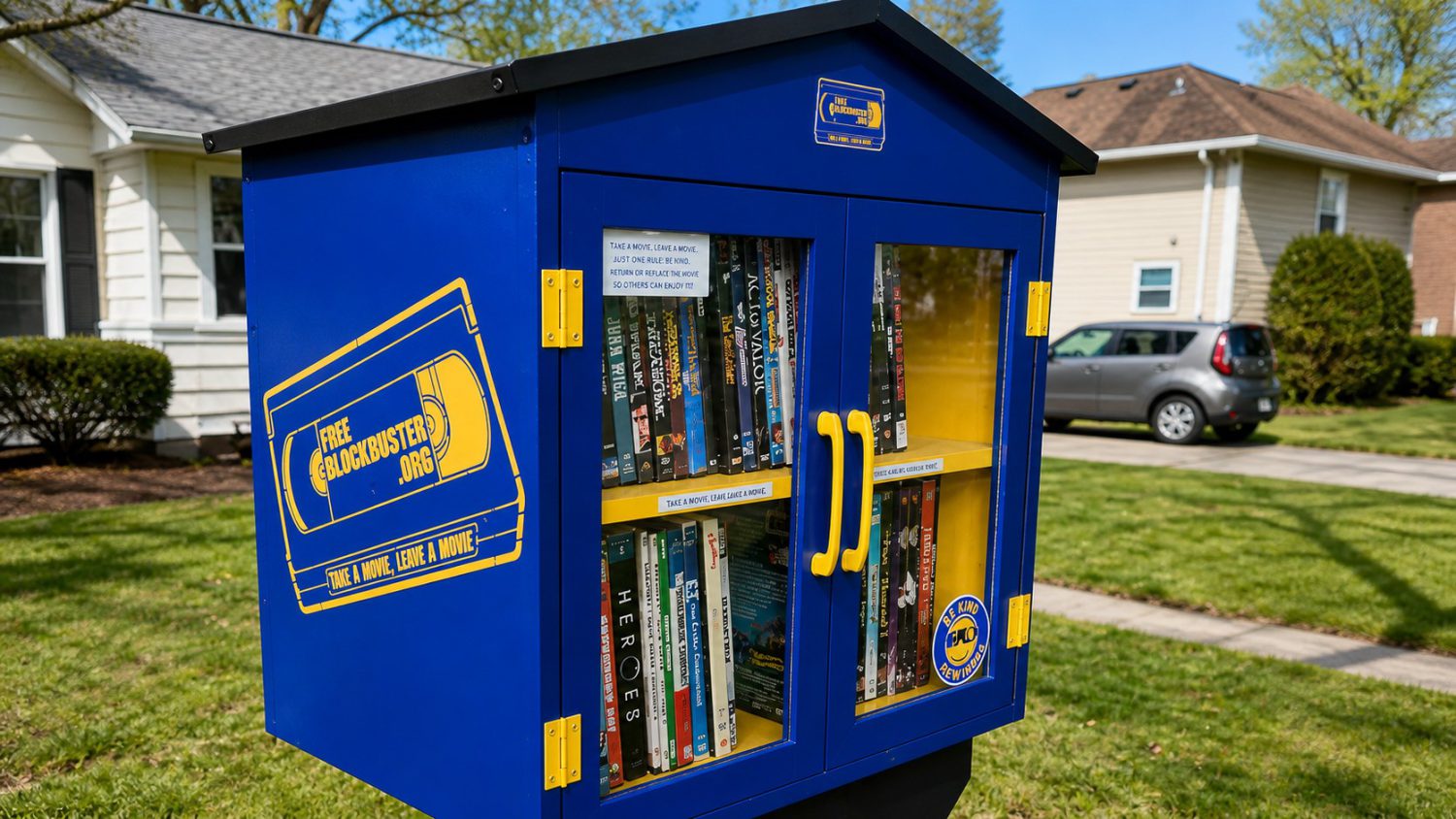
On February 27, 2019, former Blockbuster employee and VHS collector Brian Morrison unveiled the first Free Blockbuster in Los Angeles — an abandoned Los Angeles Times dispenser, repainted in Blockbuster’s blue-and-yellow, stocked with tapes and discs, and left for the neighborhood. Among the first borrowers: screenwriter Andrew Kevin Walker, the man behind Seven and Sleepy Hollow, as reported by PopSci and Thrillist. The vibe was set immediately.
The operating logic is identical to a Little Free Library: take a movie, leave a movie. No account. No late fees. No algorithm deciding what you’re in the mood for. Boxes stock whatever the community donates — VHS, DVDs, Blu-rays, video games, even VCRs and DVD players. Locations are intentional, usually near a volunteer’s home or a high-foot-traffic spot like a transit stop or shopping strip.
“Combat the myth of scarcity” — a Free Blockbuster founder, describing the mission to offer free entertainment as broadly as possible, per Thrillist and the organization’s own mission statement.
Hundreds of Boxes, One Gray Legal Area
Dish Network owns the Blockbuster trademark — and appears more amused than alarmed.
Early coverage counted around 69 documented boxes across the U.S., Canada, and Australia. Estimates from organizers and local reporting now exceed 200 locations worldwide — across the U.S., Canada, the U.K., Mexico, and Australia — with documented clusters in:
- The Twin Cities
- North Carolina’s Triangle region
- Louisville
- Anchorage
- Valley Stream, NY
The network is decentralized and not every box gets registered on the official interactive map, so the real number is probably higher. Think of it as a Little Free Library that discovered lo-fi aesthetics and never looked back.
Blockbuster LLC, owned by Dish Network, did send a letter about trademark usage. Free Blockbuster responded by requesting a license, and the dialogue has remained non-adversarial rather than hostile — the organization’s FAQ describes it as an ongoing cooperative exchange. With exactly one official Blockbuster store remaining — in Bend, Oregon, now a pop-culture pilgrimage site — the rights holders appear more bemused than threatened.
VHS enthusiasts describe tapes as “an art form,” according to Fox Business — the same tactile pull driving vinyl’s broader resurgence over purely digital formats.
Want your own box? Rescue an abandoned newsrack and repaint it in the blue-and-yellow, or buy a pre-painted one directly from the organization for around $420 with free shipping. Register it on the interactive map at freeblockbuster.org, and your sidewalk becomes part of an international analog distribution network. New volunteers are welcome — the decentralized model means there’s no waitlist, no franchise fee beyond the box itself, and no corporate approval required.
Streaming wins on convenience. It cannot promise permanence. A movie sitting in a blue-and-yellow box on your block will still be there next Tuesday — no licensing deal required.