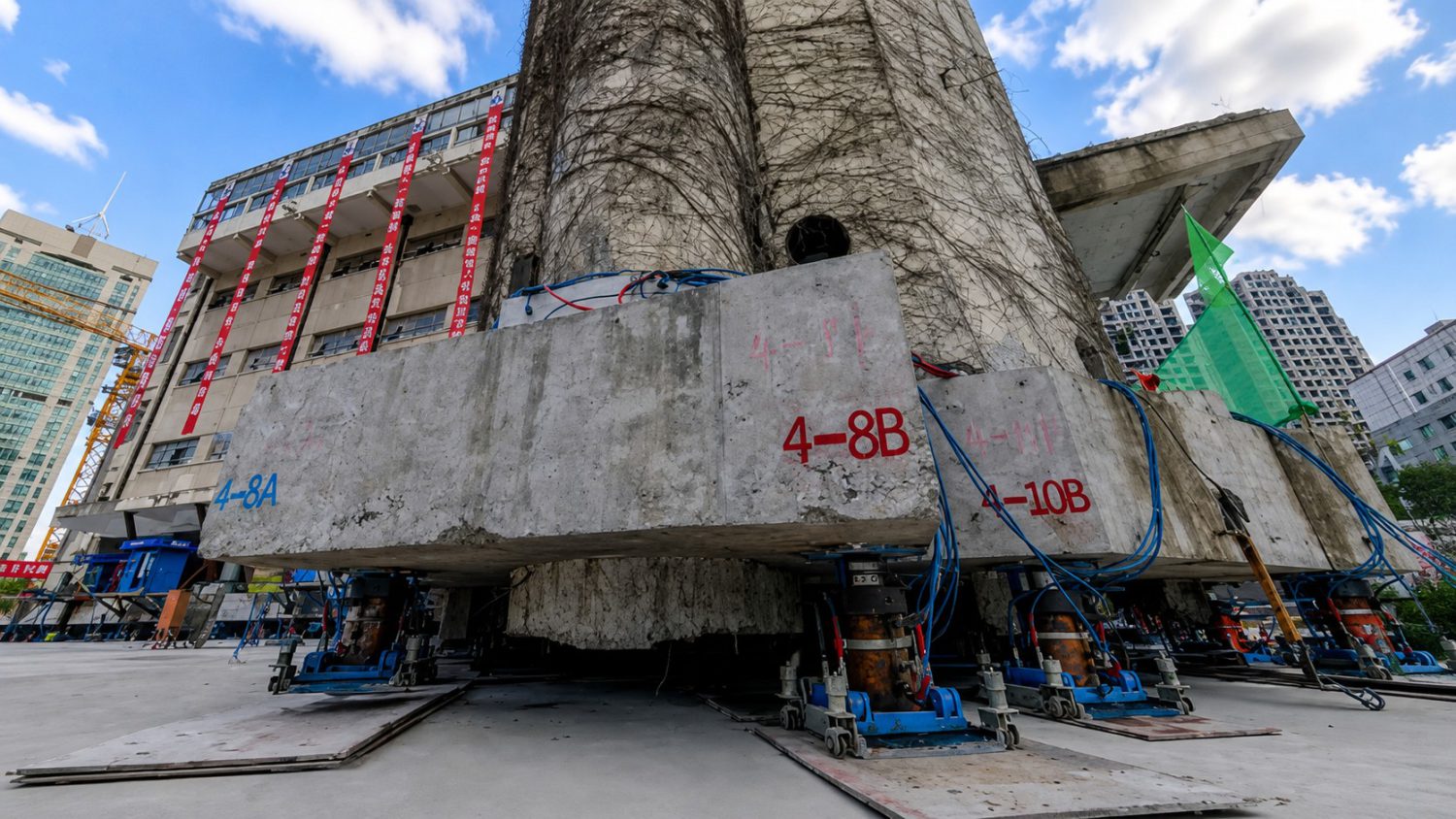
A five-storey building creeping across a city block at 3 meters per day on mechanical crutches. Not a rendering. Not a concept video. This actually happened in Shanghai in 2020, when engineers decided that a 1935 primary school was worth saving — and handed the problem to a construction-tech startup with 198 robotic hydraulic supports and a very different idea about what “moving day” looks like.
Demolition was the easy answer. This wasn’t it.
Walk This Way: How 198 Robot Legs Moved 7,600 Tonnes
The walking-machine system turned a demolition problem into an 18-day feat of sensor-guided engineering.
The basics, cleanly: Lagena Primary School, built in 1935, five storeys, T-shaped plan, weighing 7,600 tonnes. Shanghai Evolution Shift installed 198 mobile hydraulic supports — the “walking machine” — beneath the foundation. The supports split into groups: one set holds the building steady while the other lifts, advances slightly, and sets down. Then they swap. Sensors monitor load and position throughout, keeping the whole mass level. Over 18 days, the building traveled 62 meters along a curved path and rotated 21° to meet its new orientation — roughly 3 to 3.5 meters per day.
The T-shaped footprint and curved relocation path made rails, dollies, and flatbed trucks essentially useless. Those methods need a straight line to work. The walking machine steers, curves, and rotates mid-move. According to project supervisors cited by The Urban Developer, it cut the schedule by roughly 20% compared to traditional rail-based methods — per Evolution Shift project documentation. Think of it as the difference between needing a straight highway and having a car that can parallel park a skyscraper.
“Like giving the building crutches so it can stand up and then walk,” project technical supervisor Lan Wuji told CNN.
Beyond the Spectacle: What Walking Buildings Mean for Cities
What looks like a viral stunt is actually a blueprint for how dense cities can modernize without erasing themselves.
Shanghai has a history of demolishing older neighborhoods for high-rise development. This project marked the first time the walking-machine technology relocated a historical building in the city — confirmed by a Huangpu District government statement — not a stunt, a signal. The former school is slated for renovation as a cultural education and heritage center, ringed by the commercial development that necessitated its move.
Since then, similar robotic-support systems have moved other historic Shanghai structures, including Shikumen blocks. Urban-tech observers have linked the concept to Archigram’s 1960s “Walking City” — architectural science fiction that suddenly has a working proof of concept — and Reddit’s verdict was succinct: “back in my day I walked to school, not the other way around.”
If costs hold and reliability scales, the technology could move:
- flood-prone buildings
- structures blocking new transit lines
- entire heritage blocks without a wrecking ball in sight
You don’t need to demolish history when you can simply redirect it.