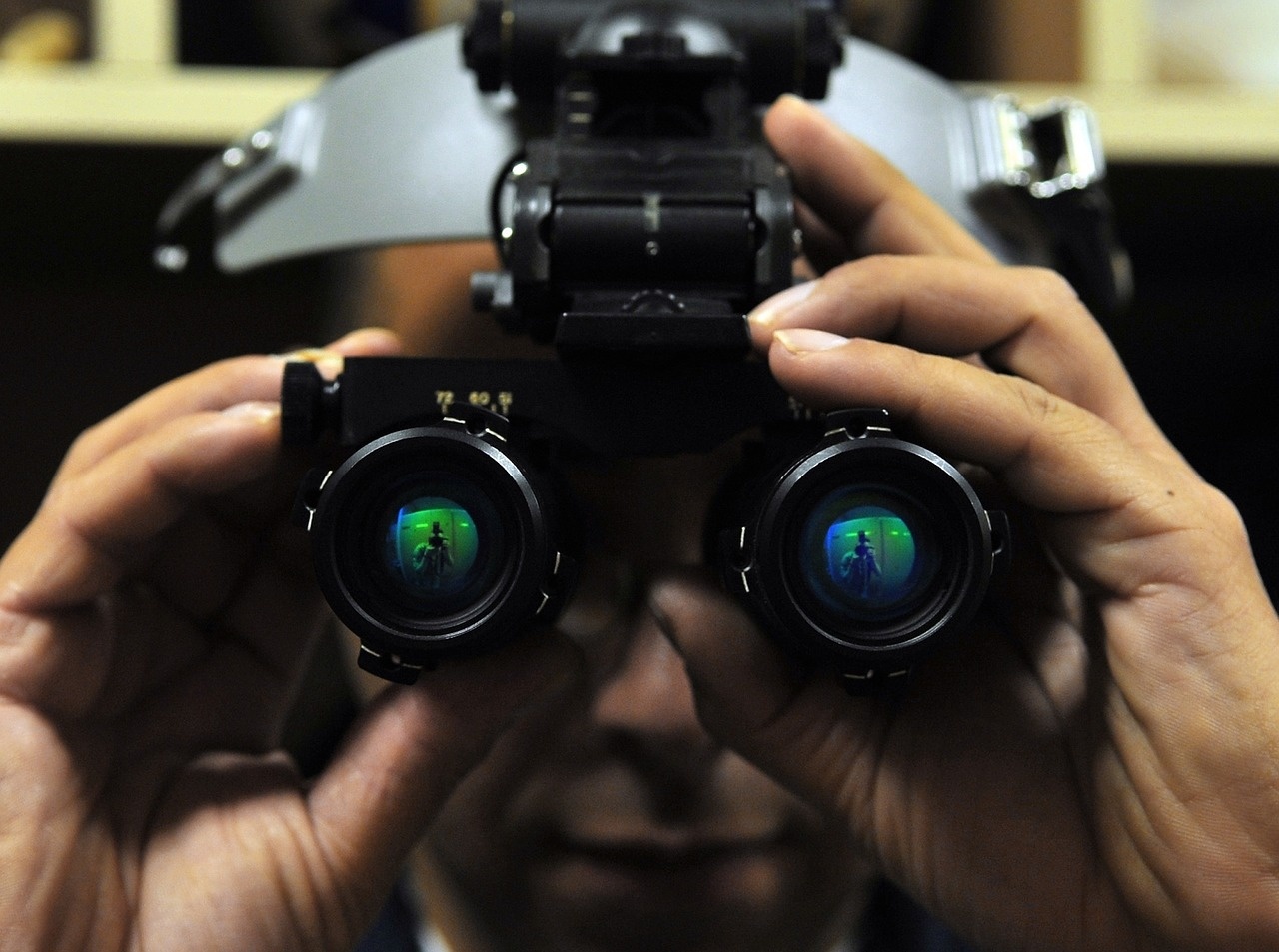
You know that Call of Duty thermal-scope aesthetic — everything rendered in flat, grainy green, where a human and a shrub look basically identical? That’s not a stylistic choice. That’s a hard ceiling in how traditional night vision works: amplify brightness, render monochrome, hope the viewer figures out the rest. Researchers at the Beijing Institute of Technology just punched through that ceiling. Their prototype night-vision eyeglasses translate infrared signals into visible color — not reconstructed after the fact by software, but converted directly at the hardware level.
How Color Replaces Green Murk
The lens doesn’t just see in the dark — it tells you what it’s seeing.
Here’s the mechanism, without the PhD. A thin layer of mercury telluride quantum dots — nanoscale particles that convert light wavelengths — absorbs incoming infrared. Above that sits a dual-layer OLED:
- Weak infrared signals produce red light
- Stronger signals push output toward cyan
- Shorter infrared wavelengths generate more charge in the quantum dots, adding rough wavelength discrimination on top of intensity encoding
The result is a scene rendered in hue, not just brightness.
The sensitivity gap is the real gut-punch: the team calculated color detection at 0.11 mW/cm² versus 23.71 mW/cm² using brightness alone — roughly a 200-fold improvement, according to their published findings in Nature.
That number matters because of how your visual system actually works. Distinguishing tiny brightness differences is genuinely hard for human vision — hue differences, far less so. The researchers describe the system as one that “transcend[s] the monochrome paradigm by translating infrared spectral and intensity signatures into discernible color variations rather than mere brightness changes.”
Cool Lab Trick or Something More?
From rotating letters to retinal responses, the prototype’s range is surprisingly wide.
In wearable tests, the eyeglass lenses shifted deep red through orange to yellow as infrared illumination increased. Lab demos included tracking moving targets and rendering rotating letters. Then the team went further: they taped the device over the eyes of mice and human subjects. Infrared pulses alone triggered zero response. With the converter active, measurable retinal and brain activity appeared.
Limitations deserve the same airtime:
- The system requires external power and an infrared illuminator
- Mercury telluride presents engineering hurdles that need resolving before any real-world deployment
- This remains firmly lab-stage hardware
Meanwhile, AI-based color night vision approaches do exist, but they reconstruct color computationally after capture. Because this device converts infrared to color directly at the sensor level, it represents a meaningful architectural difference, even if practical applications remain years away.
Color night vision targets a genuine perceptual bottleneck — one baked into human biology. Solving it at the hardware level, rather than patching it in software, is the kind of foundational work that tends to age well. Near-term, expect this technology to show up in research instrumentation and specialized sensing long before it ever reaches consumer shelves.