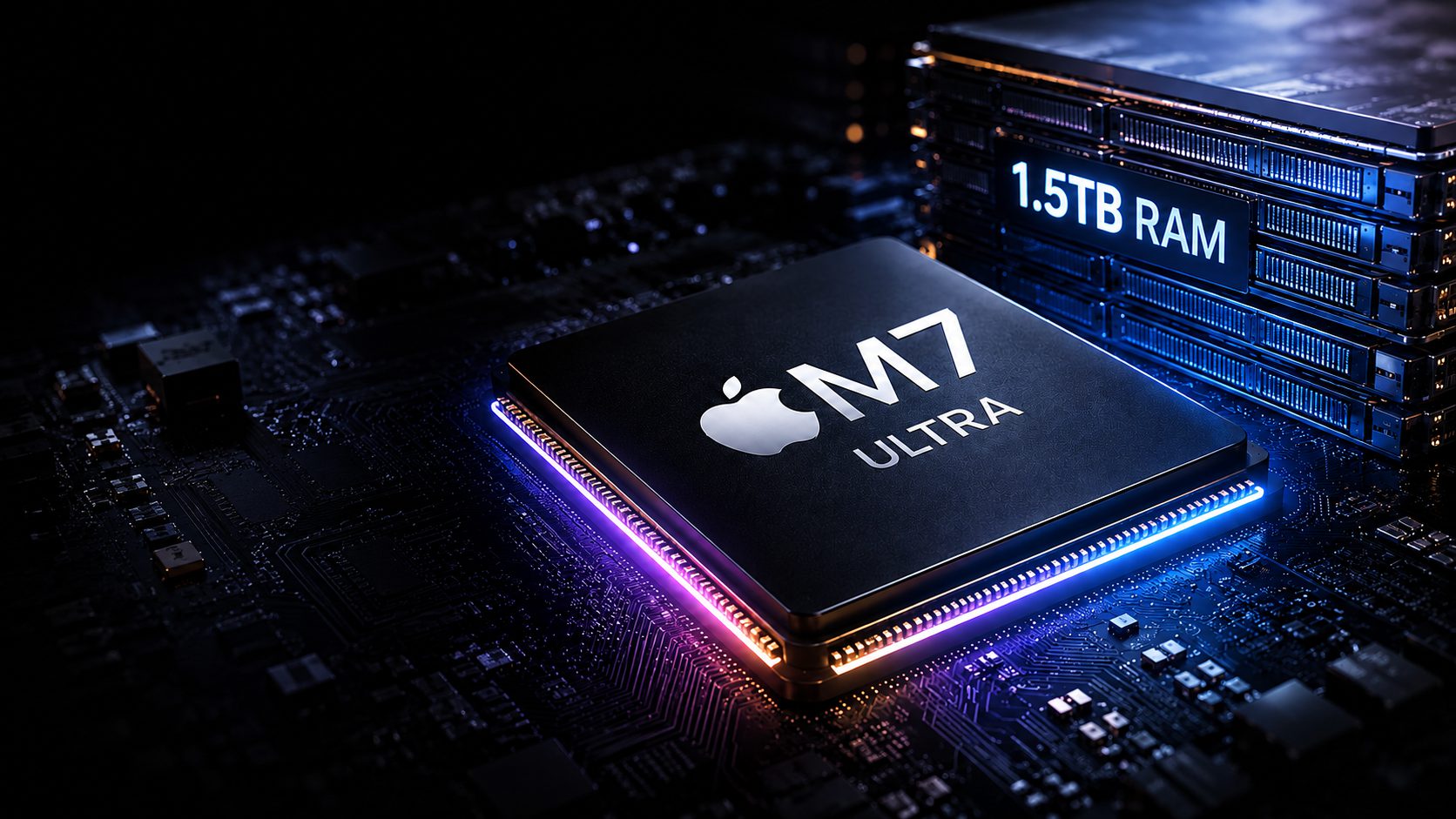
Somewhere in Cupertino, engineers are reportedly designing a chip that could run a trillion-parameter AI model on your desk. Bloomberg’s Mark Gurman reports Apple is building the M7 Ultra to support up to 1.5TB of unified memory — roughly double the planned M5 Ultra ceiling and triple today’s M3 Ultra maximum. The ambition is AI chips performance approaching Nvidia’s Blackwell datacenter accelerators. The reality is more complicated than the headline suggests. None of this has been officially announced by Apple, and whether the 1.5TB configuration ever ships remains genuinely uncertain.
The Memory Leap in Context
Apple Silicon’s RAM ceiling is about to get a dramatic expansion — if the numbers hold.
Here’s the progression that matters:
- M3 Ultra (current): 512GB max
- M5 Ultra (planned): 768GB max
- M7 Ultra (design target): 1.5TB
That top figure matches what the 2019 Intel Mac Pro offered with twelve DIMM slots. But the M7 Ultra would deliver it as unified memory on a single package, where CPU, GPU, and Neural Engine all share the same high-bandwidth pool simultaneously. That architectural difference matters more than the raw number.
The Case for a Desktop AI Monster
For local inference and private AI, the specs read like a checklist for serious local AI ambitions.
Unified memory eliminates the data-shuffling bottleneck that plagues traditional multi-chip setups. With 1.5TB available — reportedly enough headroom to load trillion-parameter-class models — you could run large-scale inference locally, no cloud required. Apple is also reportedly building an M7 Ultra server variant, targeted around 2029, to power its own Apple Intelligence backend. The estimated Mac arrival sits around 2028.
Where the Hype Outruns the Hardware
Matching Nvidia’s memory capacity is not the same as matching Nvidia’s datacenter playbook.
Nvidia’s Blackwell systems rely on NVLink, InfiniBand, and multi-GPU scaling engineered for thousands of concurrent users across vast server farms. Nothing in Gurman’s reporting describes an equivalent AI infrastructure fabric. Apple’s AI software stack remains ecosystem-focused — useful for Core ML workflows, but well behind the CUDA dominance powering enterprise AI infrastructure at scale.
According to Bloomberg’s Gurman, whether Apple ships the 1.5TB configuration “will depend on the state of the industry” — a direct nod to worsening global memory shortages. Macworld notes this tier may never reach consumers at all.
Then there’s pricing. At Apple’s current rate of roughly $25 per additional gigabyte, upgrading from 128GB to 1.5TB would cost over $35,000 in RAM alone. Total system cost? Firmly in workstation-server territory.
The honest read: M7 Ultra looks like a credible “local AI datacenter in a box” — transformative for private deployments, power users, and Apple’s own infrastructure. Replacing hyperscale GPU clusters? That’s a very different conversation.