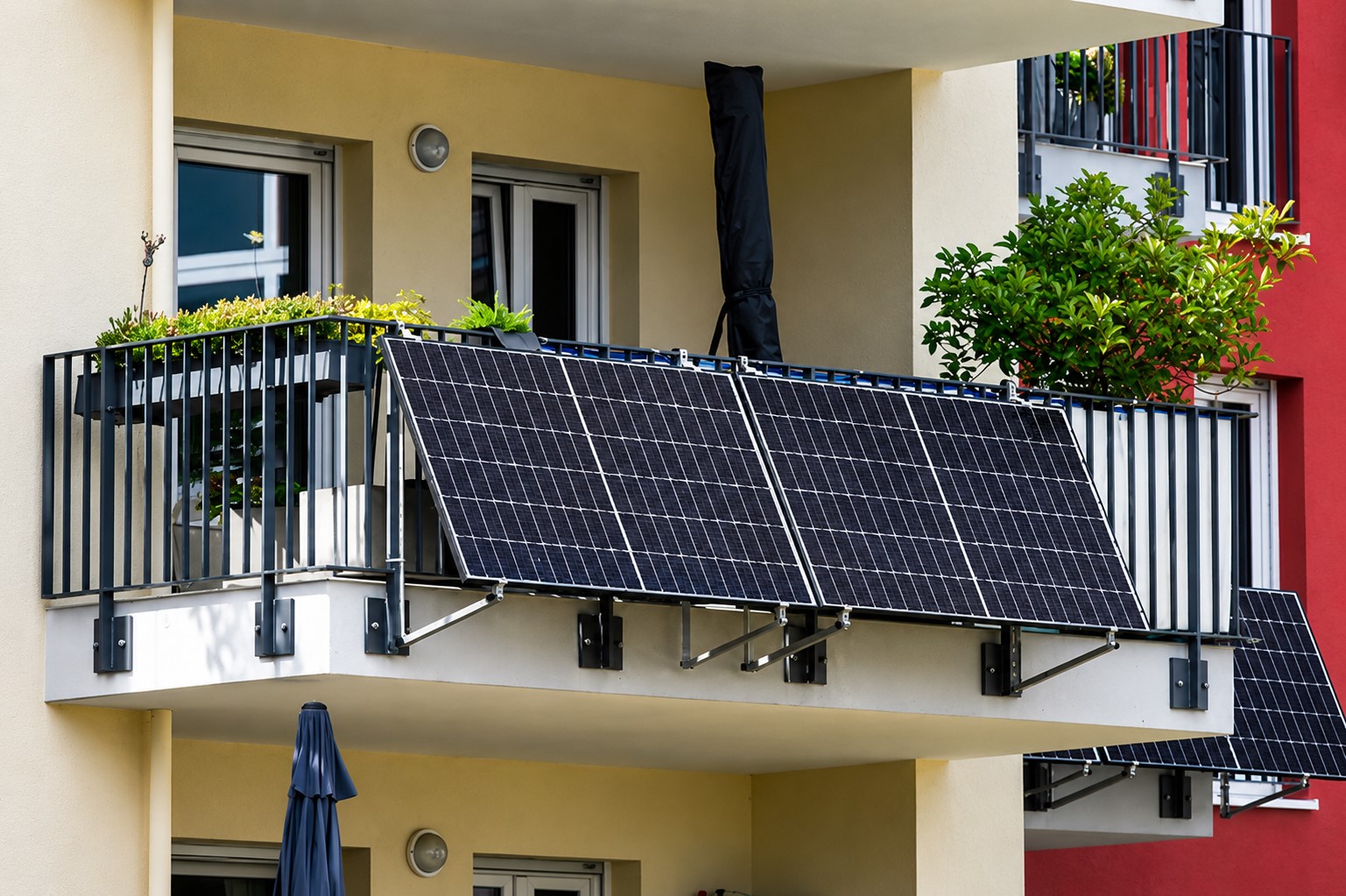
Rooftop solar runs $15,000 to $30,000, demands permits, licensed contractors, and a roof that actually cooperates.Plug-in solar kits cost $400 to $2,000 and connect to a standard wall outlet. The IKEA flatpack of renewable energy has arrived — and no, it won’t power your whole house. These small systems exist for people the traditional solar industry has quietly ignored: renters, apartment dwellers, and homeowners whose roofs are shaded, aging, or structurally unsuitable. Rising electricity rates and new state laws — following Germany’s earlier, widely watched adoption — are accelerating the trend stateside.
Small Panels, Real Math
The technology is straightforward, and the savings are modest but genuinely measurable.
Each kit pairs one to three panels with a micro-inverter that converts DC sunlight into AC power at 120 volts, feeding it through your existing outlet. Output ranges from 200 to 1,600 watts — enough to quietly offset always-on loads like your fridge, router, and laptop. According to analysis from EnergySage and exspenditure.com, an 800-watt system covers roughly 15 to 25 percent of a typical apartment’s annual electricity use.
At $500 to $1,500 for a 400–800W kit, monthly savings of $15 to $50 put payback at two to seven years, per EnergySage — faster in high-rate states with time-of-use tariffs. Rooftop solar’s payback often stretches six to twelve years, despite delivering far more power and offsetting a much larger share of household demand. If you suspect you’re paying too much on your energy bill already, plug-in solar doesn’t eliminate your bill. It just starts arguing with it.
The Catch (There’s Always a Catch)
Limited savings, no backup power, and a state-by-state regulatory patchwork make due diligence non-negotiable.
Three honest limitations deserve a clear look:
- No net metering means excess power earns you nothing.
- Anti-islanding rules shut the system down the moment your grid fails — think of it as a streaming service that stops working the second the internet goes out.
- Performance also swings hard depending on shading, panel orientation, and local sun hours.
For renters who’d otherwise have zero solar options, those trade-offs remain acceptable.
Before buying, check your state’s rules:
- Utah explicitly permits plug-in systems without permits.
- Maine, New York, and Vermont require mandatory certification even at low wattages.
Many kits sold online haven’t obtained formal U.S. UL safety certifications, according to Solar United Neighbors — a real concern, since back-feeding into poorly wired circuits can cause overheating. Stick with UL-compliant systems. Utilities across the country are watching this space closely, and interconnection rules are still evolving.
From Construction Project to Appliance
Plug-in solar is following the path of home EV chargers — infrastructure becoming something you simply buy off a shelf.
If certifications and state laws converge, these kits could sit next to window air conditioners at your nearest big-box retailer within a few years. Germany’s experience — where balcony solar kits moved from niche to mainstream consumer product after regulatory clarity arrived — suggests that timeline is realistic, not wishful thinking. That’s the real signal here: solar is becoming a retail product category, not a renovation project — much like the smart gadgets that have quietly become household staples. For anyone locked out of rooftop solar by cost, lease restrictions, or an uncooperative roof, that shift is worth paying attention to.