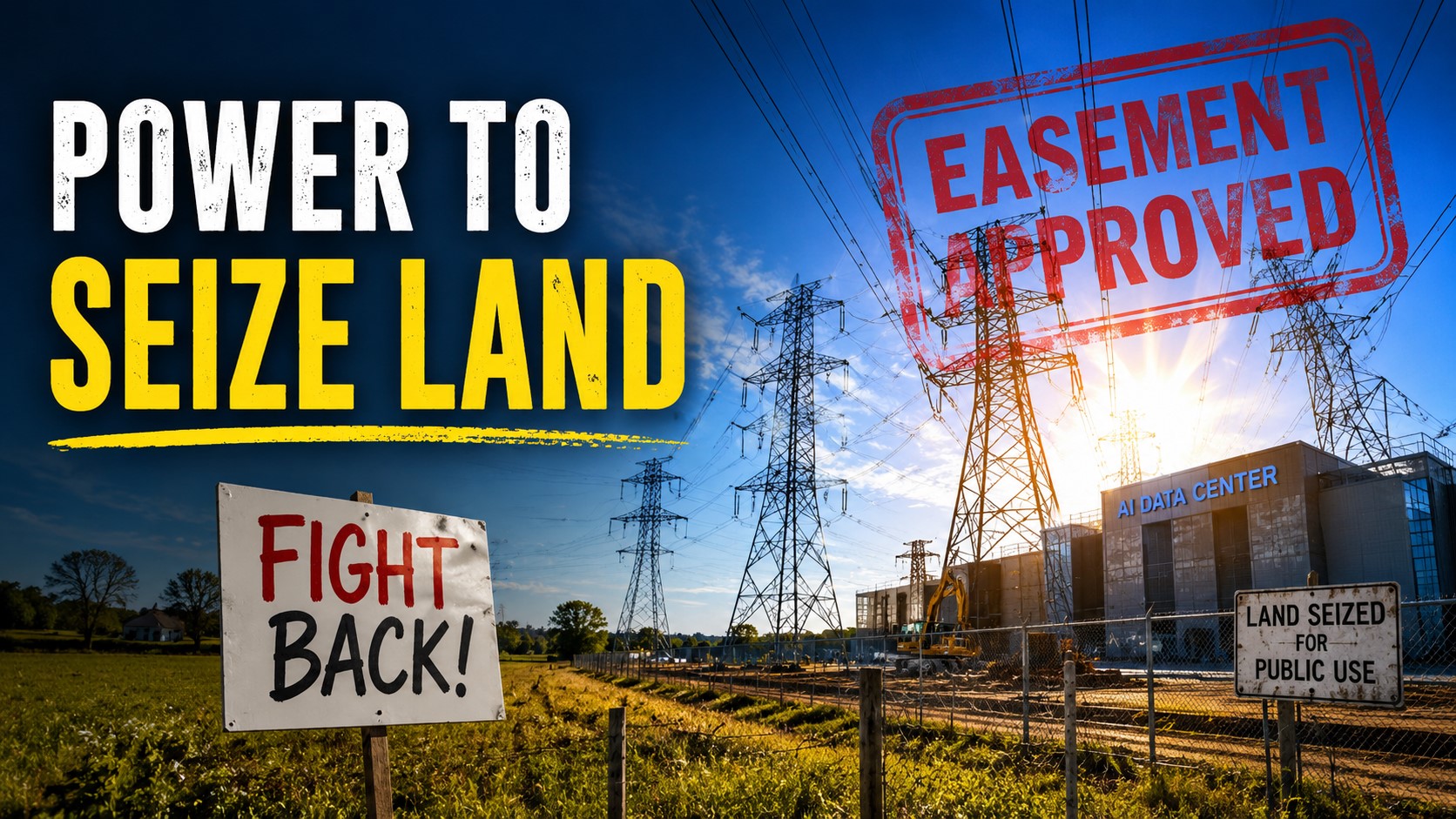
Survey stakes appear in your backyard. A form letter arrives from the utility you’ve been paying for twenty years, explaining it needs a permanent easement across your property for a new high-voltage line. The reason? AI data centers are hungry, and the grid can’t keep up. Data centers consumed over 4% of U.S. electricity in 2024, with roughly 1,500 more facilities in development. That appetite is now landing directly on private land — and the legal framework enabling it deserves your full attention.
The Utility Gets the Power. You Get the Notice.
Data center companies can’t condemn your land, but their utility partners can — once state regulators say yes.
A critical distinction: private data center developers have zero eminent domain authority. They buy land through voluntary sales or walk away. Regulated utilities are a different story. They can condemn property after obtaining a Certificate of Public Convenience and Necessity from the state public utility commission — and that certificate triggers condemnation power under state statute. The utility must attempt a voluntary purchase first. Only when negotiations collapse does a condemnation lawsuit follow. Most cases seek a permanent easement: you keep the title but lose the right to build, plant, or meaningfully use the land beneath the wires.
If you face condemnation proceedings, four legal grounds exist for challenge:
- Public use — argue the line primarily serves private data centers, not local customers
- Necessity — argue viable alternative routes exist that don’t require your parcel
- Compensation — contest the appraisal and present your own comparable sales
- Procedure — challenge failures in notice, hearings, or statutory requirements
Even when a project can’t be stopped entirely, Community Benefit Agreements can lock in noise limits, vegetation buffers, and local tax contributions.
“Takings framed as improving grid reliability are likely to be upheld — especially if in-state customers benefit,” according to a legal analysis published by Fortune. Georgia’s Project Wansley illustrates the stakes: a 35-mile, 500-kV transmission corridor affecting at least 330 properties, built to power four AI-focused data centers. Georgia Power describes condemnation as a “last resort.” The families losing backyards might choose stronger language.
When the Legal Case Gets Shaky
The “public use” argument weakens significantly when most of a line’s capacity feeds private tech customers — and courts have taken notice.
Here’s where things get legally interesting. Reports indicate 70 to 80 percent of that Georgia line’s capacity will serve private data center customers. Whether that satisfies Georgia’s “public interest” requirement remains unsettled. The Kelo v. City of New London decision in 2005 — property law’s landmark ruling that prompted 45 states to pass reforms — expanded “public use” to include economic development. But many state constitutions now explicitly restrict takings that primarily enrich private entities. A 1984 Mississippi Supreme Court ruling rejected condemnation outright because a transmission line offered zero benefit to in-state customers. That precedent matters here.
Polling cited by legal scholars puts opposition to AI data centers in local communities at roughly 70 percent of Americans. The fight starts at the commission hearing, not the courthouse. By the time condemnation papers arrive at your door, the leverage has already shifted.