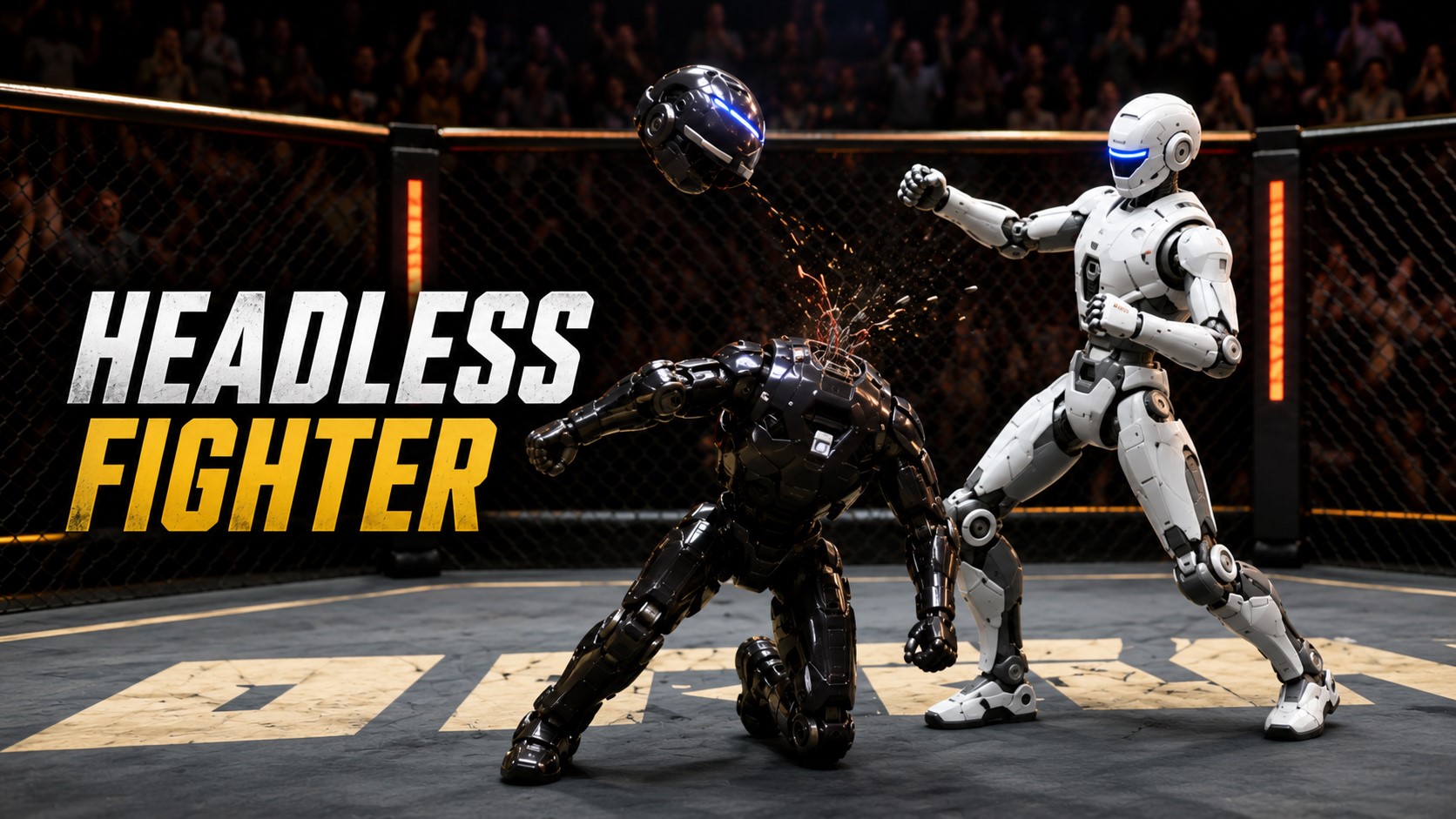
A five-foot-eight humanoid robot takes a high kick to the skull. The head wobbles. Then dangles. Then separates completely — and the robot keeps throwing punches anyway. That’s not a deleted scene from a streaming sci-fi series. That’s opening night of URKL (Ultimate Robot Knock-out Legend), a full-contact humanoid combat league launched in Shenzhen by EngineAI. The same class of bipedal robot being prepped for warehouse floors just fought to the near-death on live camera.
Meet the Fighters
EngineAI’s T800 is an industrial humanoid built for logistics — now moonlighting as a cage fighter.
Every URKL team uses a standardized T800. The robot stands ~173 cm tall with ~29 degrees of freedom, LiDAR and camera-based perception, and up to four hours of runtime, according to Robots International. Mass production is targeted around mid-2026, per New Atlas. At roughly $40,500 per unit, these aren’t toys. Opening night pitted White Eagle against Matador — and things got interesting fast.
By the numbers:
- Height: ~173 cm — roughly average adult human size
- Joints: ~29 degrees of freedom for human-like motion
- Sensors: LiDAR and stereo/RGB cameras (general news reports also cite 360-degree radar, though this remains unconfirmed in engineering documentation)
- Runtime: up to 4 hours per charge
- Prize: gold championship belt valued at ~10 million yuan (~$1.44 million)
White Eagle landed a roundhouse kick to Matador’s head. The connector loosened. Both robots kept exchanging strikes while Matador’s skull swung like a wrecking ball from its mount. Matador fell, crushed its own dangling head against the floor, and when it tried to stand, the head separated completely. White Eagle then performed a celebratory flexing dance for the crowd.
The fact that Matador continued fighting headless suggests core compute and power live in the torso rather than the head module — consistent with standard humanoid architecture, though EngineAI hasn’t confirmed this publicly.
EngineAI frames URKL as promoting “technological innovation and global collaboration.” But a head flying off tells you something more useful: these are pre-commercial prototypes stress-testing under conditions no warehouse spec sheet anticipated. That’s valuable data on modularity, mount reinforcement, and control recovery. The real question for you: does a combat league help or hurt EngineAI’s credibility with industrial buyers evaluating the T800 for workplace safety in logistics work?
Robot Combat Has History — But Not Like This
BattleBots fielded wheeled destruction machines since the late 1990s; URKL fields bipedal humanoids throwing roundhouse kicks.
BattleBots has fielded tracked, wheeled destruction machines since the late 1990s — purpose-built to shred, not to walk. URKL is categorically different: bipedal humanoids executing martial-arts combinations, with a tiered season structure running from a July–August opening stage through November–December finals. You’ve seen robots walk before. You haven’t seen one lose its head and refuse to quit.
Whether URKL matures into a legitimate sport or stays a high-visibility marketing vehicle, the T800’s performance under real impact stress will feed directly back into its industrial design — better modular repairability, reinforced mounts, smarter fall-recovery algorithms. The head came off. The robot kept fighting. That’s either terrifying or impressive, depending on how you feel about what walks into your workplace next and shapes today’s tech.