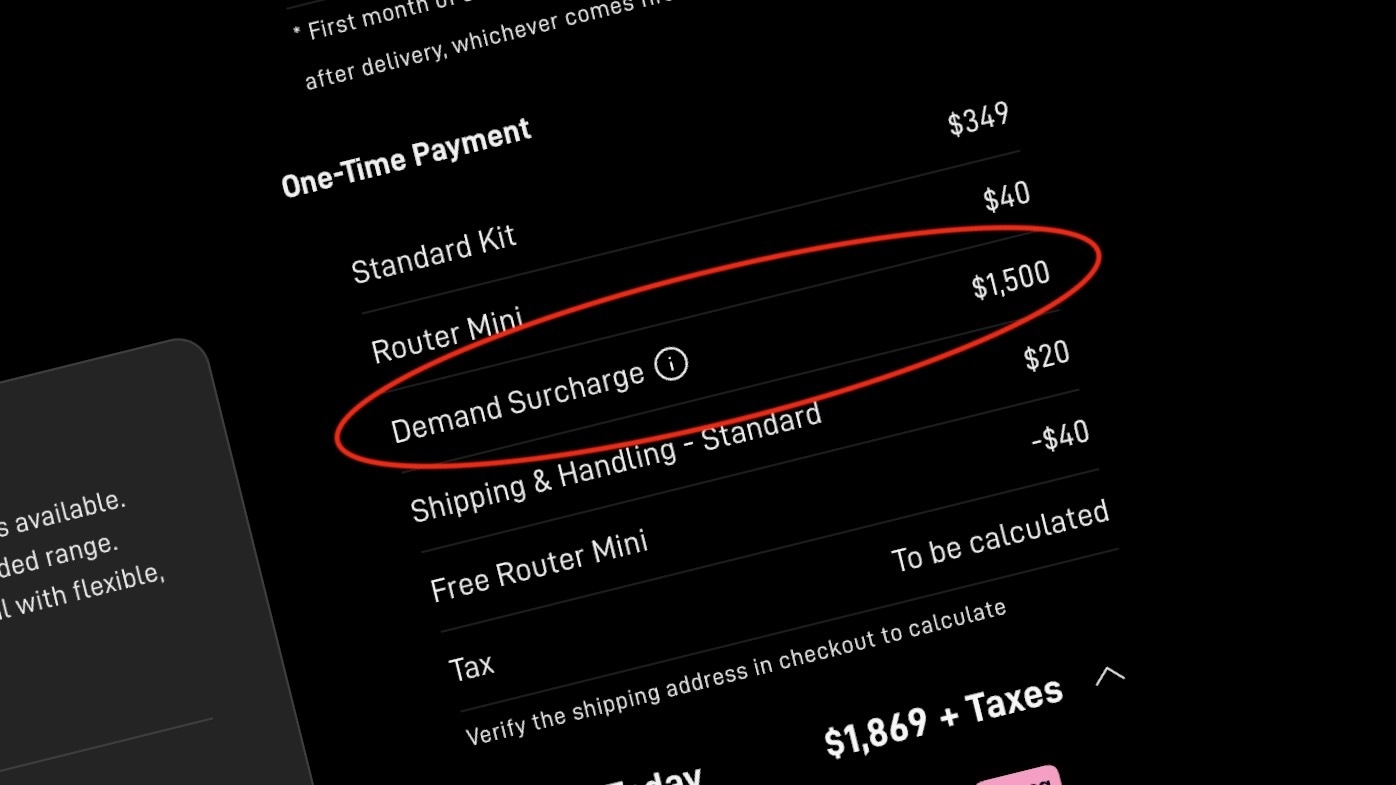
A three-year Starlink customer recently got hit with a $1,500 charge for verifying their address. No move. No new equipment. Just a routine account confirmation that triggered what SpaceX calls a “demand surcharge” — a one-time congestion fee that has quietly ballooned from roughly $100 in 2024 to $1,500 in the most overloaded cells by mid-2026, according to PCMag. This is the internet equivalent of a concert venue’s “convenience fee,” except the concert is just your email loading — and you may already be paying too much without realizing it.
What Triggers the Fee (and How to Dodge It)
Knowing exactly what sets off Starlink’s surcharge could save you from a four-figure billing surprise.
Starlink’s own support page confirms the surcharge kicks in when you:
- Sign up at a high-demand address
- Activate a new plan
- Change your service location
- Reactivate from standby in a cell that got crowded while your dish collected dust
Tiers run $100, $250, $500, $750, and $1,500 — determined by address and plan, with each service line evaluated separately. Only residential plans get tagged, and moving from a high-demand zone to a quieter one earns you exactly zero refund.
The physics driving this are blunt. Each Starlink satellite cell covers a finite geographic area with limited bandwidth, and more subscribers in that cell means slower speeds for everyone. SpaceX uses price as a velvet rope. Karl Bode frames it plainly: Starlink is “too congested to handle meaningful load at scale” and is “quietly hitting people with $750–$1,500 ‘demand surcharges.’”
“I have been charged 1,500 dollars demand surcharge for simply verifying my address that I have subscribed to 3 years ago.” — Reddit user, via Techdirt
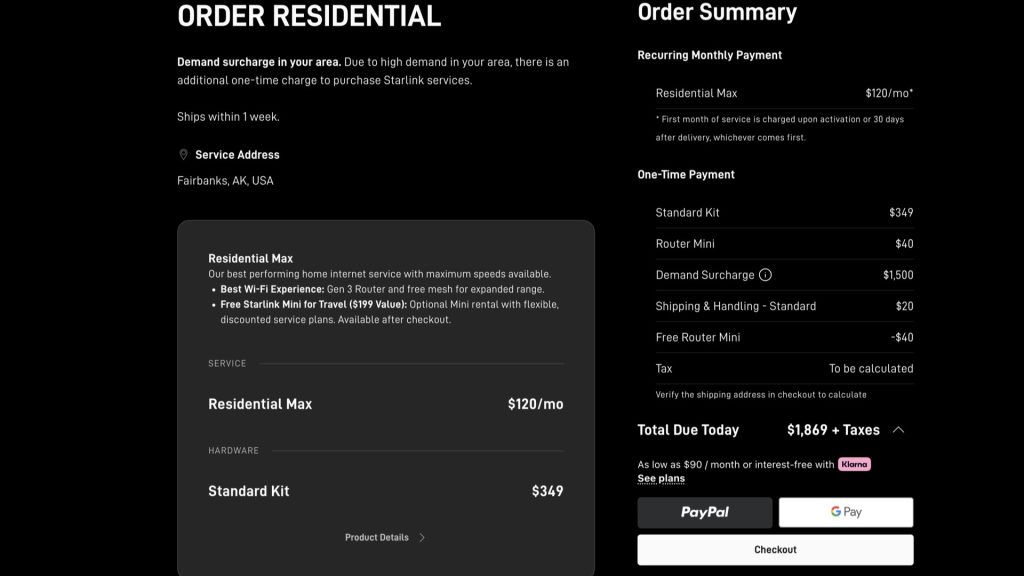
That user eventually got a refund after Starlink confirmed a GPS coordinate glitch had erroneously triggered the charge. But the burden of proof fell entirely on the customer, who reportedly spent days bouncing between support agents. Before touching anything in your account, check Starlink’s availability page in an incognito browser window — the surcharge often shows up there. If wrongly charged, open a support ticket immediately and document everything. Screenshots, billing history, proof of no address change. Some users have successfully disputed charges through their credit card issuer when Starlink refused to budge.
The Subsidy Contradiction Nobody Wants to Discuss
Routing federal broadband dollars toward a network already rationing capacity raises hard questions about who these programs actually serve.
Billions from the $42.5 billion BEAD broadband infrastructure program are reportedly being steered toward Starlink by Republican lawmakers and Trump-aligned officials — money originally earmarked to push fiber deeper into underserved communities. The contradiction is stark: Musk publicly scorns government subsidies while Starlink quietly collects federal contracts and support. Adding subsidized users to a network already charging $1,500 congestion premiums doesn’t solve the capacity math. It worsens it.
If surcharges keep climbing while capacity stays flat, Starlink risks pricing out the exact households federal money exists to serve. Advances in internet speed technology elsewhere only highlight how far behind congested satellite networks may fall. For anyone in a high-demand area: check before you click anything in your account. The $1,500 lesson is considerably cheaper to avoid than to dispute.