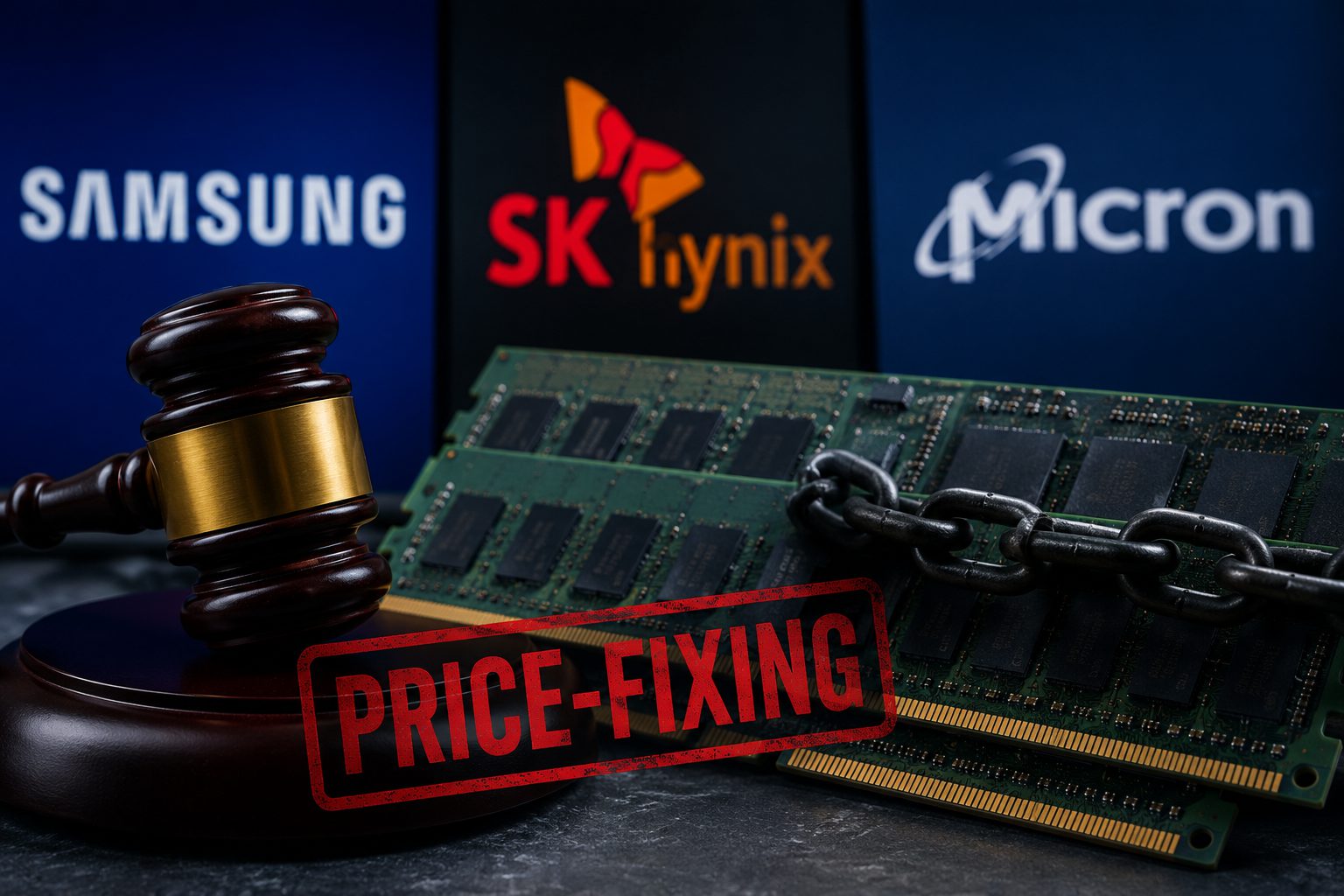
RAM prices have climbed roughly 700% since 2022, and a new federal lawsuit argues that surge was no accident. Filed June 25 in the U.S. District Court for the Northern District of California, Garciaguirre et al. v. Samsung Electronics Co., Ltd., et al. alleges Samsung, SK Hynix, and Micron Technology — three companies controlling roughly 90% of global DRAM revenue — fixed supply and prices for conventional RAM since around 2022. The case has been assigned to Judge Noel Wise, and defendants have not yet responded publicly.
The AI Pivot as Cover Story
The lawsuit claims the three chipmakers used the HBM boom to disguise a coordinated squeeze on DDR3 and DDR4 supply.
The complaint lays out a specific mechanism:
- All three firms allegedly coordinated a simultaneous pivot toward High Bandwidth Memory (HBM) — stacked DRAM feeding AI accelerators in data centers — while slashing DDR3 and DDR4 output.
- Plaintiffs argue HBM is actually less profitable per die than commodity DRAM, so cutting higher-margin production only makes economic sense if all three competitors do it simultaneously.
- The suit invokes Section 1 of the Sherman Act, California’s Cartwright Act, and Minnesota antitrust statutes, seeking treble damages and injunctive relief to restore competitive conditions.
“The DRAM oligopolists have simultaneously cut production, coordinated a pivot to HBM and exit from DDR3 and DDD4, and otherwise decreased and locked up conventional DRAM supply while prices charged up with mind-blowing scale and rapidity.” — from the complaint, as reported by VGChartz
Small repair shops versus three of the world’s most powerful chipmakers — that’s the lineup here. Seventeen plaintiffs, including Troy’s Computers LLC, My Florida PC, JB Tech Solutions LLC, and WNTD Fab LLC, are represented by New York-based Bathaee Dunne LLP. Critically, this is civil litigation, not a DOJ criminal probe, so the burden falls squarely on plaintiffs to prove collusion.
They’ve Done This Before
The same companies pleaded guilty to criminal DRAM price-fixing two decades ago — and paid hundreds of millions for it.
This isn’t the first time these names have appeared in antitrust filings — a pattern that echoes some of the worst tech scandals in modern history:
- Samsung previously pleaded guilty and paid $300 million in criminal fines for a late-1990s/early-2000s price-fixing scheme. Several Samsung executives served prison time.
- Hynix — now SK hynix — paid $185 million.
- European regulators separately fined nine semiconductor firms over €331 million for the same cartel.
- Micron cooperated with investigators and avoided a fine.
The new complaint explicitly references this history, arguing alleged collusion is “not unprecedented” in DRAM.
Still, the counterargument deserves a fair hearing. Memory pricing has always been boom-bust — dramatic swings without explicit collusion are well-documented in semiconductor cycles. DDR3 and DDR4 are aging standards, and shifting investment toward HBM and newer DDR5 nodes may simply reflect rational technology transitions rather than cartel behavior. A comparable 2018 civil case was dismissed, with the Ninth Circuit affirming in 2022 that parallel pricing alone isn’t sufficient to prove an illegal agreement. This case faces a real legal hill to climb.
If the suit survives early motions and reaches discovery, internal capacity-planning documents could surface — the point where regulatory interest tends to sharpen. Micron’s stock wavered on the news, according to Investors.com. Your RAM upgrade bill, though, isn’t getting cheaper on any courtroom timeline — and if you suspect you’re already paying too much for everyday tech, the pattern may be broader than just memory chips.