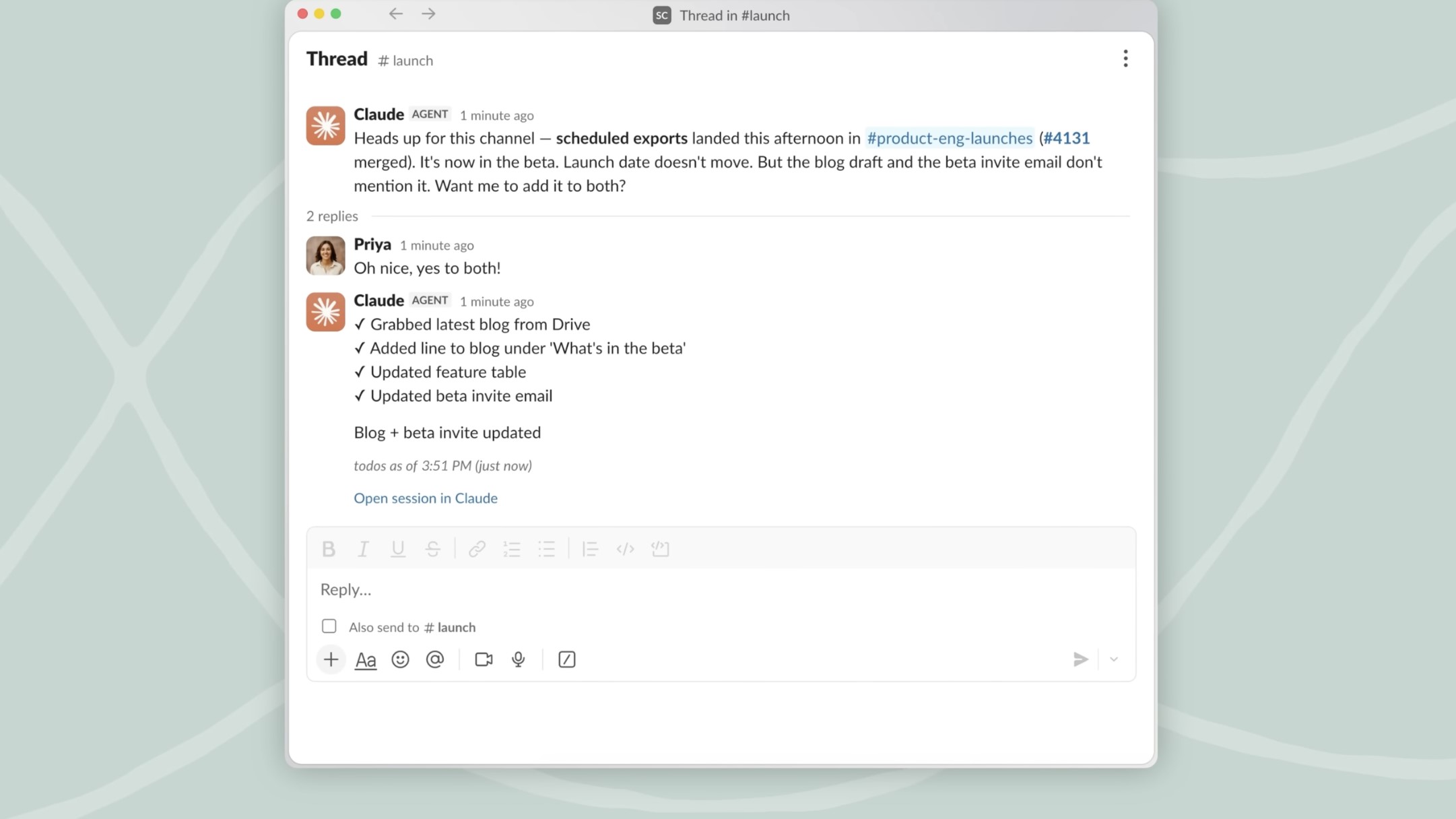
Most Slack bots have the memory of a goldfish. You tag them, they answer, they forget you exist. Claude Tag works differently. Anthropic’s research preview — currently available for Enterprise and Team customers — embeds a persistent Claude agent directly into your Slack channels. It doesn’t wait for commands. It follows along, accumulating context from every conversation, decision, and stalled thread. Think of it as the colleague who read every Slack message while you were on PTO and actually retained all of it — a pattern you’ll find across many AI-Powered Websites reshaping how teams work.
From Chatbot to Colleague
Claude Tag builds channel-level memory so your AI teammate never needs a re-briefing.
Picture the mid-sprint chaos. Someone tags @Claude to compile a status update pulling from three different channels. No briefing needed. Claude Tag already knows the decisions from last Tuesday, the thread that went quiet on Thursday, and the dependency another team flagged Friday morning. That persistent memory mechanic is the core difference: instead of cold-starting every session, the agent continuously learns your team’s work — more Google Docs replacing emailed attachments than another chatbot bolted onto a sidebar.
Here’s what Claude Tag actually does:
- Maintains persistent channel memory, learning team context over time without manual re-briefing
- Runs an ambient mode that proactively surfaces forgotten threads or stalled tasks — no @mention required
- Pulls facts from other channels when granted permission via MCP (Model Context Protocol, a standard connecting Claude to external tools and data sources)
- Supports scoped identities — admins create role-specific agents (legal, engineering, product) that can’t share context across domains
- Breaks multi-step requests into stages, posting progress and outputs back into the thread
Anthropic describes the model as an agent with “shared context, persistent awareness, and proactive execution” that “functions as a working member of the team,” according to the company’s AI teammate framework.
The Real Question Is Governance
How many of your Slack channels should an AI agent be allowed to read — and remember — indefinitely?
Microsoft Copilot, Glean, and Google Workspace AI are all chasing the same prize: becoming the persistent intelligence layer inside enterprise AI infrastructure. Claude Tag’s bet is Slack-native depth rather than a sidebar add-on. That’s a real differentiator. But an agent that reads and remembers messages across channels raises legitimate questions about data retention, employee privacy, and organizational control — questions that enterprise security and compliance teams will need to answer before wide deployment.
Slack admins do control access scopes and channel permissions. Still, clear policies on AI-visible channels, memory persistence, and deletion requests need to move as fast as the technology now sitting in your channels. Those governance decisions can’t wait for the next quarterly review.