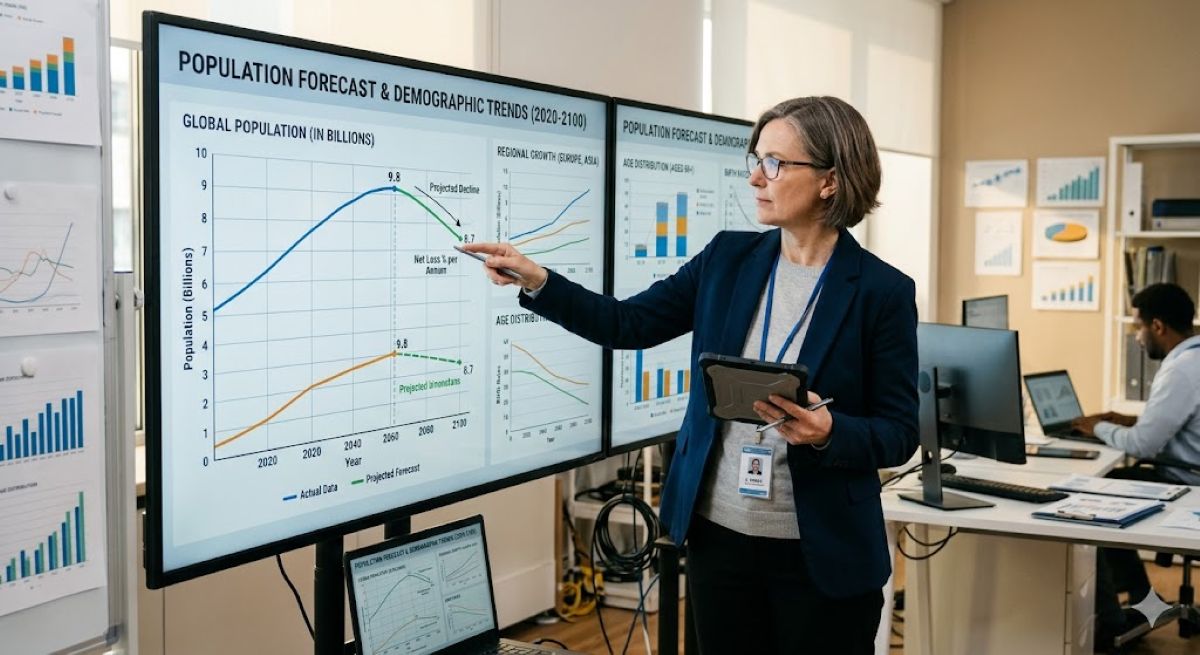
Pop quiz: what sounds scarier, a pandemic that kills millions or a mathematical equation? According to a new study, it might be the math. Researchers have created a model suggesting global population could plummet by 50% by 2064—but before you start hoarding canned beans, understand what you’re actually looking at.
The Doomsday Calculator
New mathematical model explores population collapse scenarios using extreme assumptions about Earth’s carrying capacity.
Published in Chaos, Solitons & Fractals, the study by Alessio Zaccone and the late Kostya Trachenko doesn’t predict population collapse—it stress-tests what could happen under catastrophic conditions. Their model assumes Earth’s sustainable carrying capacity suddenly crashes to around 2 billion people, perhaps through severe climate breakdown, pandemic, or resource depletion. Under those deliberately extreme assumptions, global population could halve within four decades.
Think of it like a climate scientist modeling what happens if Antarctica melts overnight. Useful for understanding system vulnerabilities? Absolutely. Likely scenario? Not remotely.
Reality Check From the UN
Mainstream demographic projections paint a completely different picture of humanity’s numerical future.
The UN’s latest projections couldn’t be more different. They expect global population to keep climbing for decades, peaking around 10.3 billion by 2084 before edging down modestly. Current fertility rates sit at 2.3 births per woman globally, declining toward replacement level by the late 2040s. No crashes, no catastrophic drops—just gradual demographic transition.
The gap between these scenarios illustrates the difference between modeling extreme shocks versus projecting current trends. One explores “what if everything goes wrong,” while the other asks “where are we heading based on what we know.”
Why the Math Still Matters
Theoretical exercises help scientists understand how population dynamics respond to severe disruptions.
The study’s real value isn’t fortune-telling—it’s system analysis. The same mathematical framework that produces the dramatic 2064 scenario also reproduces 12,000 years of historical population growth patterns, from ancient agricultural societies through industrial booms to modern demographic transitions.
You wouldn’t test a building’s earthquake resistance by hoping for sunny weather forever. Similarly, understanding how population systems respond to extreme stress helps policymakers prepare for genuine risks, even if those specific scenarios never materialize.
The lesson? When you see headlines about population collapse or explosive growth, check whether you’re reading a forecast or a stress test. The difference matters more than the numbers.