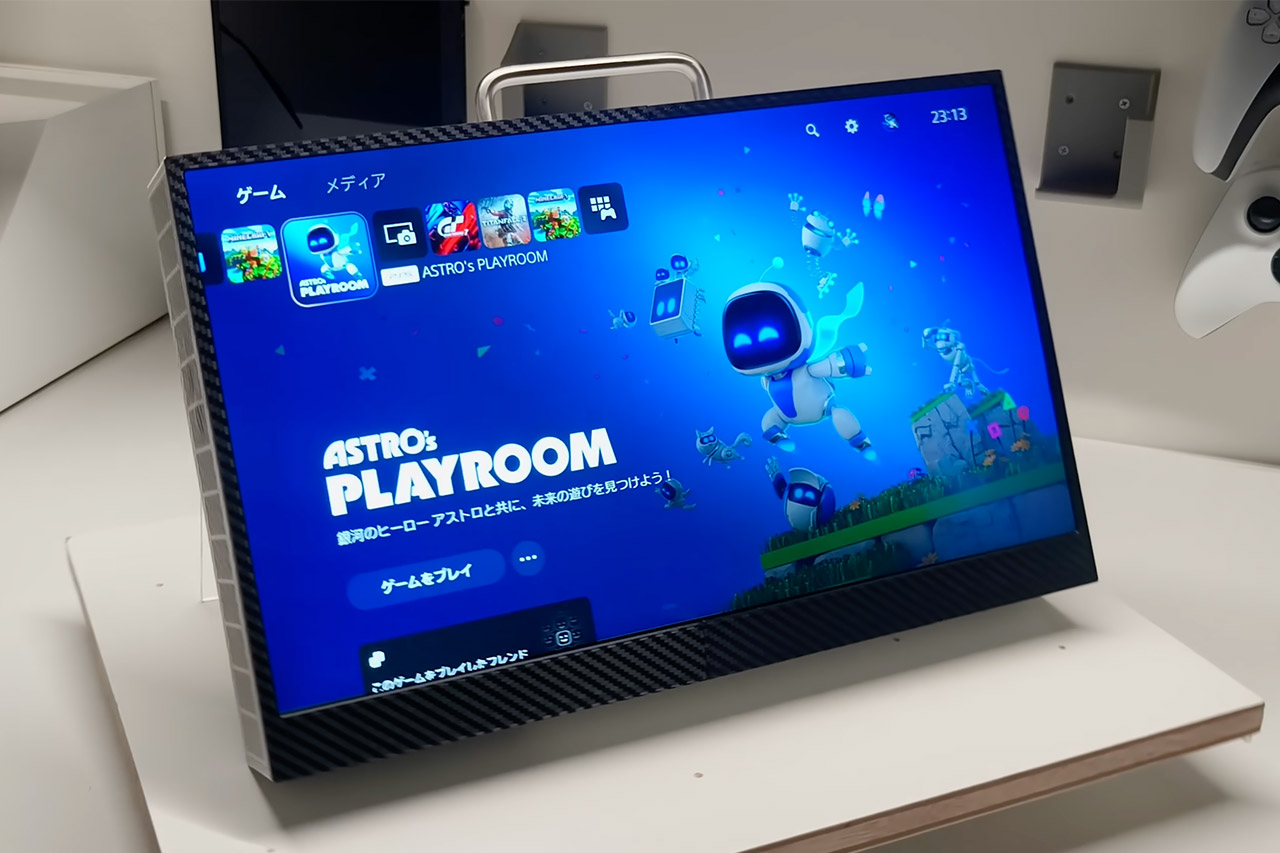
Making a 200-watt heat monster portable shouldn’t be possible, yet Japanese modder TERA cracked the thermal engineering problem Sony never intended to solve. TERA’s first portable PS5 was a cautionary tale—nearly 5 kilograms of briefcase bulk with battery life measured in embarrassing minutes. The new version weighs 2.8kg and slides into most laptop bags.
At 357 × 224 × 53 millimeters, it’s roughly the size of a chunky gaming laptop, complete with a 15.6-inch Sharp LCD display that makes the PS5 genuinely self-contained. The transformation required gutting a 22,000 yen PS5 and rebuilding it around the motherboard’s compact footprint.
TERA 3D-printed a custom chassis with:
- Side ventilation
- Integrated dual speakers
- USB-A ports
- Metal carrying handle that screams “serious engineering project”
Thermal Engineering That Actually Works
Custom cooling prevents the PS5’s 200-watt appetite from becoming a meltdown.
Sony’s APU can draw nearly 200 watts under load—enough to fry early cooling attempts within minutes. TERA’s solution reads like a masterclass in thermal management:
- Vapor-chamber heatsinks
- Strategically placed heat pipes
- Aluminum heat-spreading bars
- Liquid metal thermal compound with protective insulation for nearby components
Custom fan engineering deserves special mention here. TERA modified an off-the-shelf fan, trimmed the blades, printed new housing and replacement blades, then added temperature sensors tied to control circuits for dynamic speed adjustment.
A small display shows real-time temperature and fan speed, turning thermal management into visible data.
Power Without the Hassle
Integrated server PSU eliminates bulky external components and cable management.
Power delivery integration solves another portability nightmare. TERA modified a server PSU to fit inside the chassis, creating a truly self-contained system. Custom timing boards ensure the screen and fan only draw power when the system runs, preventing unnecessary battery drain that could disrupt the gaming experience.
Even copper grounding plates made the cut—TERA added them after early testing revealed video noise issues that could disrupt the gaming experience.
Reality Check on True Mobility
Battery limitations keep this tethered to wall outlets for serious gaming.
Battery life remains the Achilles heel. Testing with RC car battery packs yielded roughly 30 minutes of PS4 gameplay, while PS5 titles would drain faster due to higher power demands.
This isn’t replacing your Steam Deck for airplane gaming—it’s making PS5 gaming possible in spaces where the original console simply wouldn’t fit. TERA proved that Sony’s thermal and form factor constraints aren’t immutable laws of physics, just engineering choices that creative modders can reimagine.