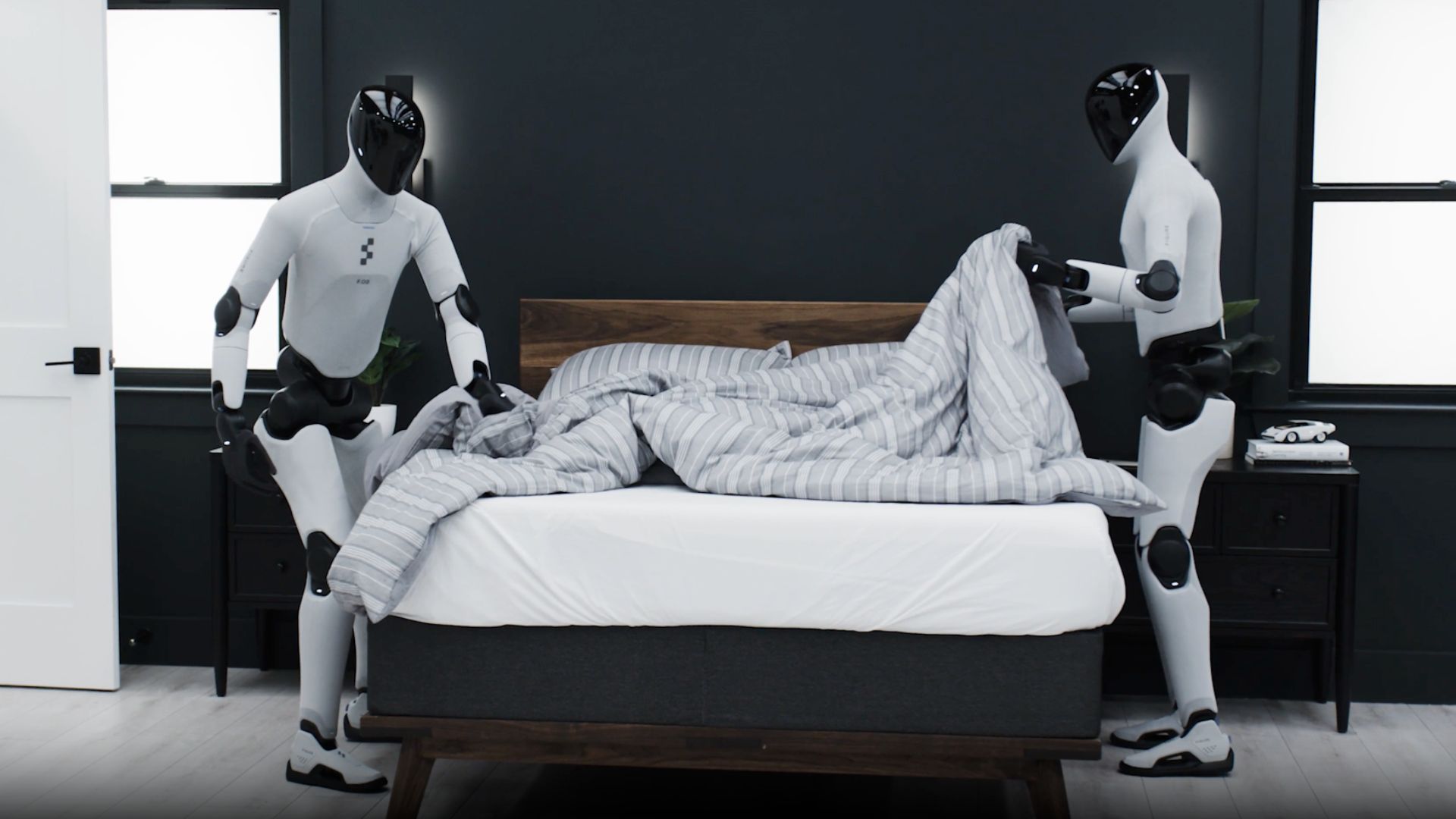
Your typical household chore coordination sounds like this: “Did you make the bed?” “I thought you were doing that.” “Well, I was hanging up clothes.” Now imagine two robots silently enter your bedroom and autonomously divide tasks—one hanging your coat while the other closes your laptop—completing a full room reset in under two minutes without a single beep of communication.
That’s exactly what Figure AI demonstrated with their latest Helix 02 system. Two Figure 03 humanoid robots coordinated 61 separate actions including opening doors, organizing objects, repositioning furniture, and jointly making a bed with seamless comforter manipulation. The kicker? Each 5’8″ robot operated independently, inferring the other’s intentions purely through visual observation.
The Silent Coordination Revolution
Multi-agent robotics achieves breakthrough in decentralized task management.
This represents a genuine technical leap in robotics. Previously, coordinated robot systems required central controllers or explicit communication protocols—imagine two warehouse robots constantly radioing their positions to avoid collisions. Figure’s approach eliminates that entirely.
Each robot uses its Vision-Language-Action neural network to interpret the environment and predict what its partner will do next, purely from watching movement patterns. The bed-making sequence showcases the most impressive capability: manipulating deformable objects under shared tension.
While one robot grips the comforter’s edge, the other must continuously adjust grip pressure as fabric shifts and stretches. This dynamic coordination—predicting how your partner will pull while adjusting your own force in real-time—mirrors the intuitive cooperation you’d see between two humans making a bed together.
Production Reality Check
Figure’s manufacturing claims face scrutiny as robots move from demo to deployment.
Figure claims their BotQ facility will scale from producing one robot daily to one per hour within four months, targeting 12,000 units annually. Those are bold numbers for a company whose robots still require human assistance for contingencies—like starting the dishwasher after loading it or retrieving dropped objects.
The gap between “impressive demo” and “reliable household assistant” remains significant. Your Roomba might occasionally get stuck under furniture, but you don’t expect it to hang your clothes afterward.
Figure’s robots perform complex sequences beautifully until something unexpected happens—then human intervention becomes necessary.
Your Robot Future Timeline
Household humanoids remain years away from mainstream adoption despite technical progress.
Don’t expect Figure robots in suburban homes anytime soon. Even if production scaling succeeds, early deployment will target controlled commercial environments—warehouses, hotels, corporate facilities—where tasks are predictable and failure consequences are manageable.
For your home, the timeline stretches longer. Cost, reliability, and the frankly weird experience of sharing your bedroom with two silent, coordinating machines create adoption barriers beyond pure technical capability.
But Figure’s breakthrough proves autonomous household robotics isn’t science fiction anymore—it’s engineering problems with manufacturing timelines.