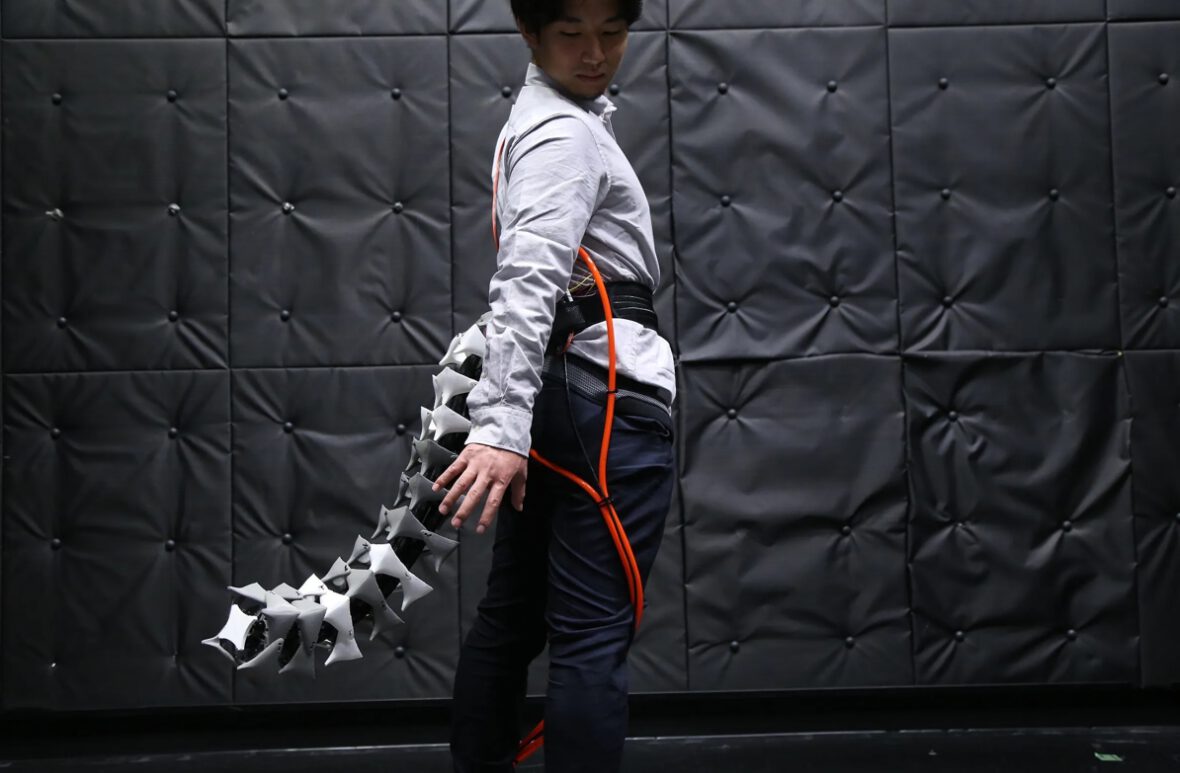
Balance issues plague millions of people daily, from elderly individuals navigating slippery surfaces to industrial workers handling heavy machinery. The solution might sound like something from a cyberpunk novel, but researchers at Japan’s Keio University have created Arque—a wearable robotic tail that mimics seahorse anatomy to keep humans upright when physics works against them.
This isn’t your typical sci-fi gadget collecting dust in a lab. The one-meter appendage weighs roughly five percent of your body weight and uses four artificial muscles responding to motion sensors. Lean left, and the tail automatically swings right to counterbalance your momentum. Lean forward while lifting something heavy, and it pulls backward to prevent you from toppling over.
The vertebrae-like plating gives it an oddly organic appearance that’s both functional and slightly unnerving—like wearing evolution’s backup plan. You feel minimal weight until the sensors detect movement, then the tail springs into action with mechanical precision that would make a seahorse proud.
The Keio team, led by researchers Yamen Saraiji, Junichi Nabeshima, and Kouta Minamizawa, originally experimented with cat and tiger tail designs before discovering that seahorses provide the optimal mass-to-effectiveness ratio for human counterbalancing. The applications stretch far beyond novelty:
- Medical teams are exploring partnerships for patients with balance disorders
- Industrial safety experts see potential for workers in high-risk environments
- VR developers are particularly excited about using the tail for haptic feedback
Imagine feeling wind resistance in a flight simulator through subtle shifts in your center of gravity. Think of it as the opposite of motion sickness: instead of your brain struggling to match conflicting signals, the tail creates physical sensations that align with virtual experiences.
The technology remains in research phase, with no commercial release timeline announced. Current limitations include:
- Response speed—the team plans to add more artificial muscles for quicker reactions
- Unknown long-term effects on users’ natural balance systems
Researchers are investigating whether prolonged use might affect the body’s natural equilibrium mechanisms.
Still, Arque represents something significant in Japan’s broader push toward wearable augmentation technology. This isn’t about replacing human capability; it’s about expanding it. Like smartphones became extensions of our memory, Arque suggests a future where mechanical appendages enhance our physical stability. The question isn’t whether this technology will find applications, but how quickly society adapts to humans sporting functional tails in everyday settings.