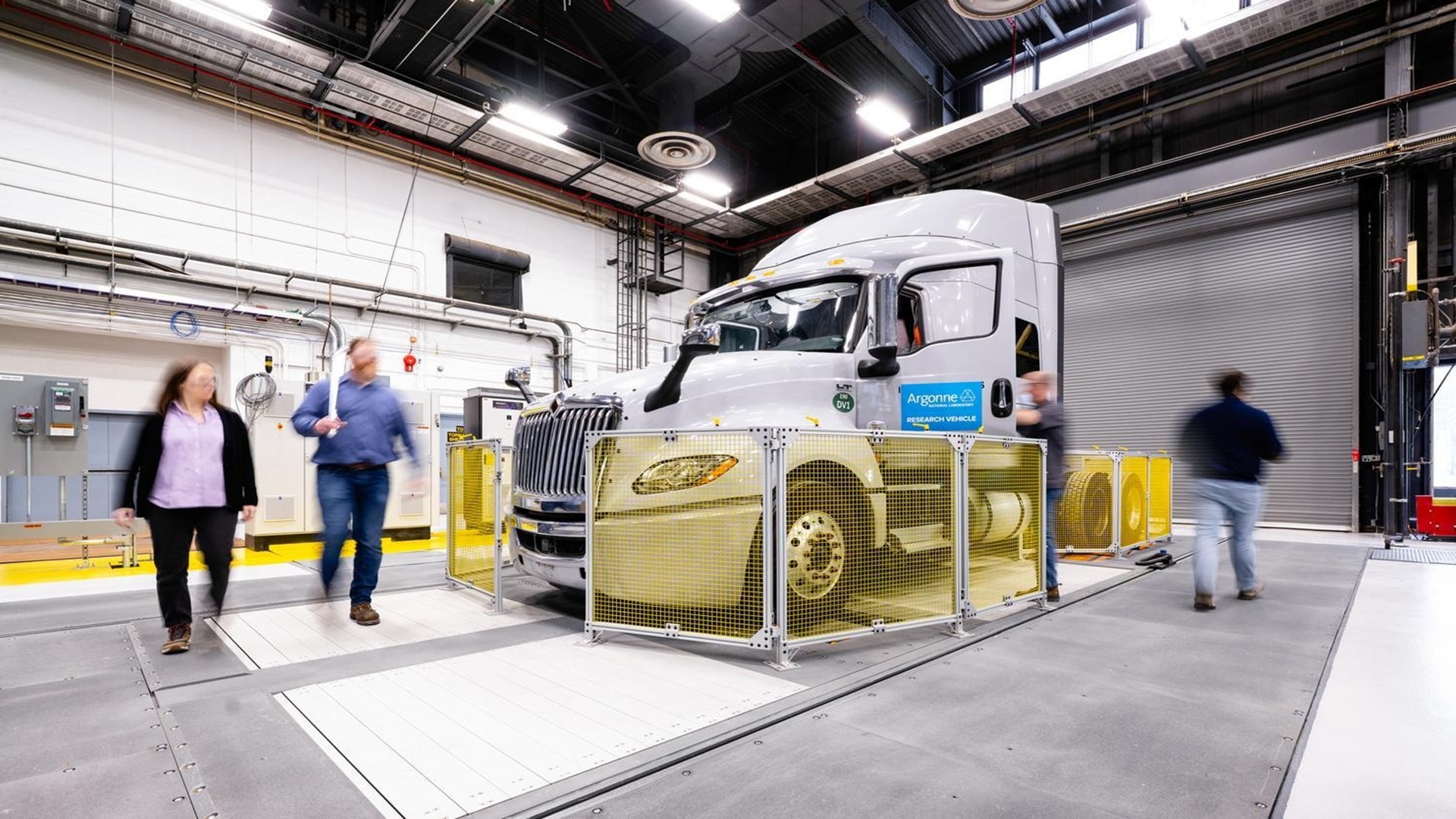
Argonne National Laboratory just unveiled America’s first “road in a lab”—a massive dynamometer that lets engineers test semi-trucks without ever hitting actual highways. The setup excavated 40 feet long, 24 feet wide, and 12 feet deep houses what’s essentially a giant treadmill for 80,000-pound vehicles.
Traditional truck testing means dealing with weather, traffic, and inconsistent road conditions. You can’t replicate the same hill climb twice or guarantee identical wind patterns. Argonne’s Heavy-Duty Dynamometer Test Facility eliminates those variables entirely, potentially delivering billions in industry savings through accelerated development timelines.
Massive Motors Meet Precision Engineering
Burke Porter’s Model 4701 dynamometer packs serious horsepower for realistic testing scenarios.
Four massive rollers powered by 600- and 800-horsepower electric motors simulate everything from stop-and-go city traffic to Interstate hill climbs. The system handles Class 3-8 trucks weighing between 10,001 and 82,000 pounds, accommodating rear-wheel, front-wheel, and all-wheel-drive configurations. Adjustable wheelbases from 100 to 280 inches mean virtually any commercial truck fits the platform.
The facility integrates physical testing with digital simulations, creating “Anything-in-the-Loop” workflows. Engineers can test fuel economy differences between compressed natural gas and diesel, evaluate transmission tuning effects, or measure how traffic-light coordination affects efficiency—all while the truck never leaves the building.
Economic Impact Through Efficiency Gains
Even modest improvements translate to massive industry-wide benefits over time.
Here’s where the math gets compelling: improving truck fuel efficiency by just 3% could save hundreds of millions over a decade. The facility accelerates development timelines while cutting testing costs, potentially shaving years off bringing new technologies to market. This controlled environment enables repeatable testing scenarios impossible on public roads.
Expert Validation and Spring 2026 Launch
Industry leaders emphasize rigorous testing capabilities for next-generation freight technologies.
“With this facility, Argonne delivers the rigorous, repeatable research and testing industry and government needs to bring new technologies to the market that reduce transportation costs,” explains Claus Daniel, Associate Laboratory Director for Advanced Energy Technologies.
Kevin Stutenberg, Advanced Mobility Technology Group Leader, highlights practical applications: “You could also look at the impact of—what if the transmission tuning is changed slightly… improving things by modifying some of the controls.”
The facility goes live spring 2026, positioning Argonne as the primary testing hub for next-generation freight technologies. This lab-based approach could revolutionize how transportation innovations reach American highways.