What if your ride never needed a human driver at all. Tesla just made that scenario tangible—the first production Cybercab rolled off the assembly line at Gigafactory Texas on February 17, 2026, marking the beginning of truly autonomous vehicle manufacturing in America.
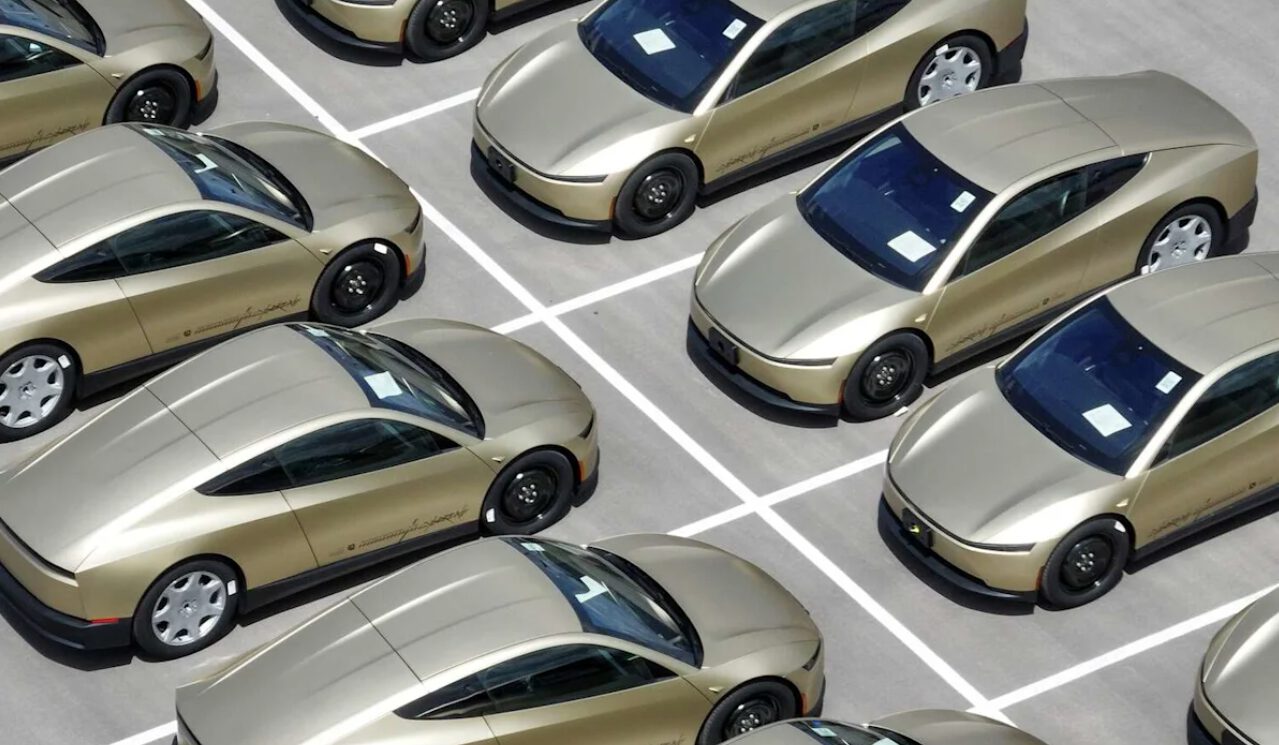
This isn’t another Tesla prototype tease. The company’s X video shows completed Cybercabs navigating factory roads independently, handling both sunny afternoon drives and rainy nighttime conditions without any human input. Volume production kicked off in April 2026, with approximately 60 units already spotted parked outside the Austin facility.
What’s Actually Different This Time
The Cybercab eliminates every trace of human control from its design.
Unlike Model Y vehicles Tesla currently uses for supervised robotaxi pilots, the Cybercab eliminates human controls entirely. No steering wheel. No pedals. No backup plan involving driver intervention. Early validation units spotted at Giga Texas included temporary steering wheels purely for testing purposes—the production versions won’t have them.
The two-passenger vehicle targets efficiency over luxury, delivering roughly 200 miles of range from a compact 35 kWh battery pack. That translates to 5.5 miles per kilowatt-hour, making it significantly more efficient than Tesla’s SUV lineup while maintaining the company’s under-$30,000 price target.
Reality Check on the Rollout
Production will start slowly due to entirely new manufacturing requirements.
Elon Musk warned during Tesla’s Q1 2026 earnings call that initial production would crawl due to entirely new supply chain requirements. Think iPhone launch quantities, not Model 3 production hell. The company expects exponential scaling by year-end, eventually targeting 2 million Cybercabs annually across multiple factories.
Tesla has been stress-testing prototypes in conditions that would challenge human drivers—snow in Buffalo, ice in Alaska, urban chaos in California. These tests suggest the company takes regulatory approval seriously, knowing one autonomous vehicle accident could derail the entire program.
Texas Builds the Future
Political leaders are betting big on autonomous manufacturing leadership.
The political response tells its own story. Senator Ted Cruz posted “Hell yes” on social media, while Governor Greg Abbott declared “the future is built in Texas.” Their enthusiasm reflects broader momentum—Texas has become ground zero for next-generation vehicle manufacturing, competing directly with traditional automotive centers.
Your transportation choices are about to expand dramatically. Whether you’re ready to trust a computer with your commute or not, the Cybercab represents the first commercially viable attempt at purpose-built autonomous vehicles. The question isn’t if this technology will reshape urban mobility—it’s how quickly you’ll adapt to cities where steering wheels become optional.