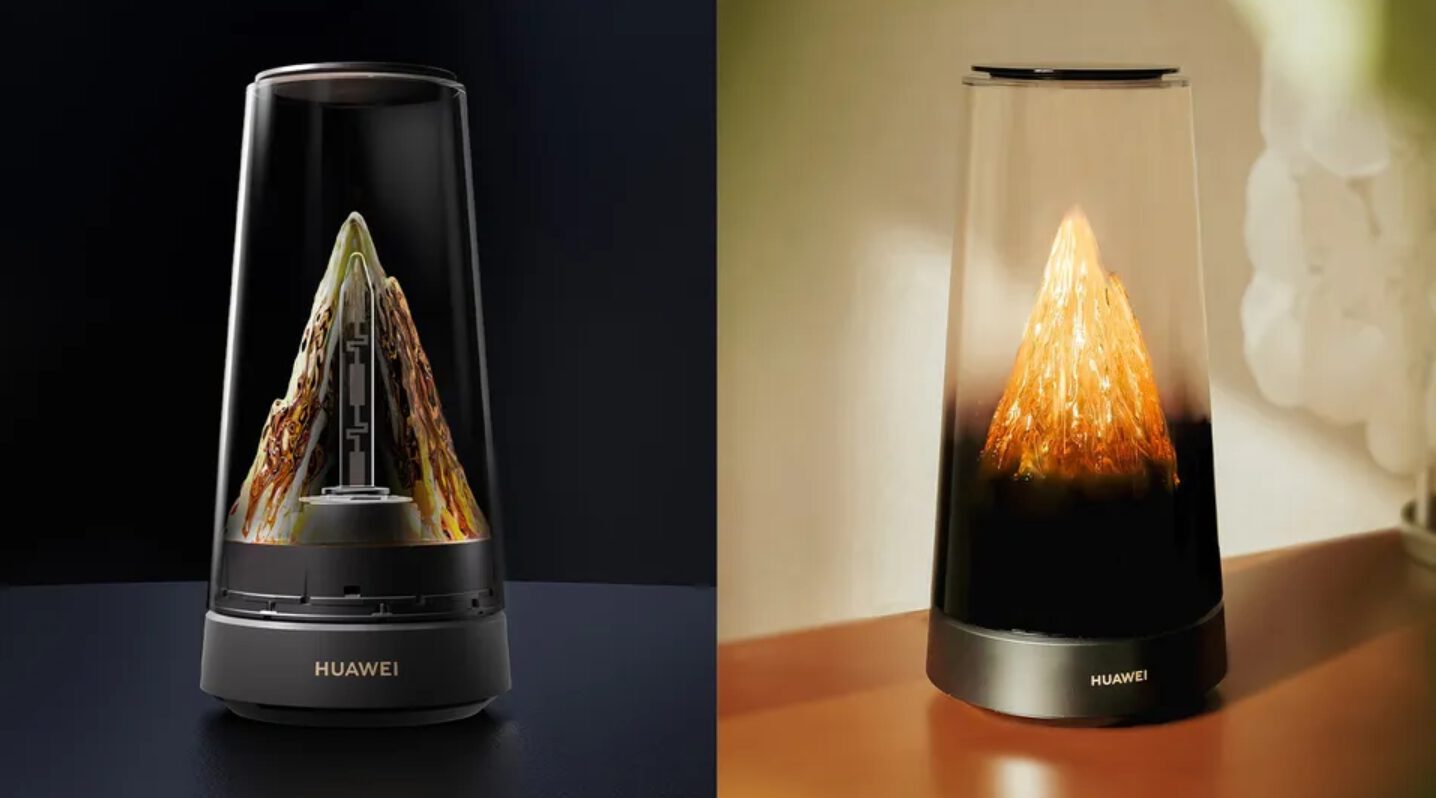
While most routers hide behind furniture like tech equipment you’d rather forget, Huawei’s WiFi Mesh X3 Pro demands center stage in your living room. This isn’t just another black box with blinking lights—it’s a glowing amber crystal that looks like something from a sci-fi film, complete with what Huawei calls the world’s first “mesh crystal antenna” design. The 250.9mm-tall tower resembles a snow-capped mountain with an illuminated core, transforming network hardware from necessary evil into conversation piece. Your Instagram-worthy smart home setup finally has a router that matches the aesthetic.
Wi-Fi 7 Performance Meets Thermal Innovation
Shark fin cooling prevents throttling during heavy gaming and streaming loads.
Beyond the eye candy, the X3 Pro delivers legitimate Wi-Fi 7 performance with theoretical speeds hitting 3570 Mbps across dual bands. The custom Gigahome SoC supports advanced features like MLO (multi-link operation) and 4K-QAM for 20% faster data transmission than previous standards. The standout engineering touch? A “Shark Fin Heat Exhaust System“ that prevents thermal throttling during marathon gaming sessions or massive file transfers. According to Tom’s Hardware, this cooling innovation addresses a real problem plaguing high-performance routers under sustained loads.
Crowdfunding Success Highlights Japan-Only Availability
8,600% funding suggests strong demand, but global launch remains uncertain.
Japanese consumers responded enthusiastically to Huawei’s February 27, 2026 crowdfunding campaign on GreenFunding, pushing funding to 8,600% of the target. At roughly $170 for the main unit, the pricing hits a sweet spot for Wi-Fi 7 hardware with design premium included. However, the Japan-exclusive availability limits global impact—you can’t actually buy this router anywhere else yet. Huawei has provided no timeline for international expansion, leaving worldwide tech enthusiasts watching from the sidelines.
Dual-Band Limitation Reveals Competitive Gaps
Missing 6 GHz band puts X3 Pro behind tri-band Wi-Fi 7 competitors.
The X3 Pro’s most significant limitation emerges in its dual-band configuration—2.4 GHz and 5 GHz only, without the 6 GHz band that defines complete Wi-Fi 7 implementations. Competitors like MSI’s Roamii BE Pro offer tri-band coverage at similar price points, potentially delivering better performance in congested wireless environments. Real-world benchmarks remain unavailable since the router hasn’t reached independent reviewers yet, making performance claims theoretical until proven.
Network Hardware Aesthetics Signal Broader Shift
Design-forward routers reflect changing smart home integration expectations.
Huawei’s crystal router represents more than flashy aesthetics—it signals recognition that networking hardware needs visual integration with modern living spaces. As smart homes become standard rather than novelty, every connected device faces pressure to justify its physical presence. Whether the X3 Pro’s $170 premium for Instagram-ready looks delivers genuine value depends on how much you prioritize form alongside function in your connected home ecosystem.