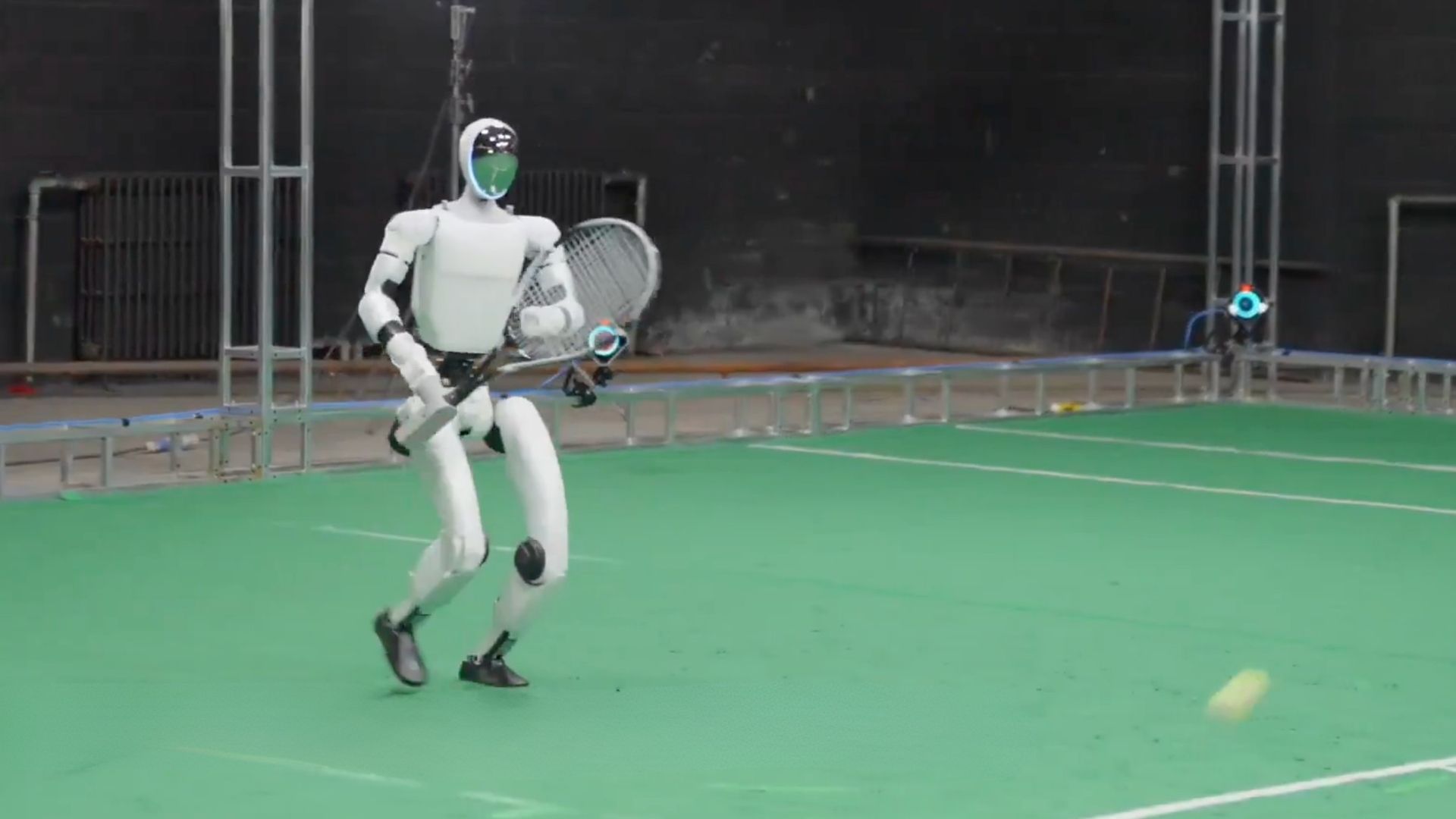
Lead researcher Zhikai Zhang watched his creation evolve from missing every ball to beating him in straight sets. The Unitree G1 humanoid robot, powered by Galbot Robotics’ LATENT system, now achieves remarkable tennis performance after learning from just five hours of imperfect human motion data. At $16,000, this four-foot athletic machine represents the moment consumer robotics stopped being clumsy party tricks and started threatening your weekend tennis game.
Learning From Messy Humans Makes Perfect Robots
Training breakthrough uses fragmented motion capture instead of pristine data.
Traditional robot training demanded perfect motion capture sessions—expensive, time-consuming, and frankly unrealistic. LATENT flipped that approach entirely. Researchers at Tsinghua University, Peking University, and Galbot fed the system short clips of forehands, backhands, and side steps from five amateur players. Think of it like learning tennis by binge-watching TikTok serves instead of studying Wimbledon footage frame by frame.
The system fragments these imperfect human movements, then teaches the robot to sequence them for real rallies. “Despite being imperfect, such quasi-realistic data still provide priors about human primitive skills,” according to the research team. Your weekend doubles partners just became valuable training data.
Performance Numbers That Actually Matter
Real courts deliver 90.9% forehand accuracy and sustained 25+ shot rallies.
Simulation training typically crumbles when robots hit actual courts. The G1 maintains its edge, converting 90.9% of forehands and 77-78% of backhands in real-world conditions—impressive numbers that translate beyond the lab. During testing, the robot sustained rallies exceeding 25 shots while handling balls traveling over 15 meters per second across full court positions.
Your Apple Watch already analyzes your tennis swing with decent accuracy. Now imagine that same motion intelligence controlling high-torque joints capable of millisecond reactions. The G1 uses external motion capture for ball tracking—no onboard vision yet—but the athletic precision rivals human club players.
Consumer Robotics Finally Gets Athletic
Sixteen-thousand-dollar humanoids could reshape sports training and home entertainment.
This isn’t another lab demonstration destined for academic papers. Unitree’s G1 platform already handles martial arts and shuttlecock games, with tennis representing the most dynamic challenge yet. At $16,000, these robots cost less than many cars while delivering consistent training partners that don’t cancel last-minute or complain about your backhand form.
The broader implications stretch beyond tennis courts into any scenario requiring dynamic, whole-body coordination under time pressure. Whether you’re envisioning robotic sports training, entertainment applications, or the foundation for more capable home automation, LATENT proves that consumer-grade humanoids can master complex athletic skills using readily available human motion data.